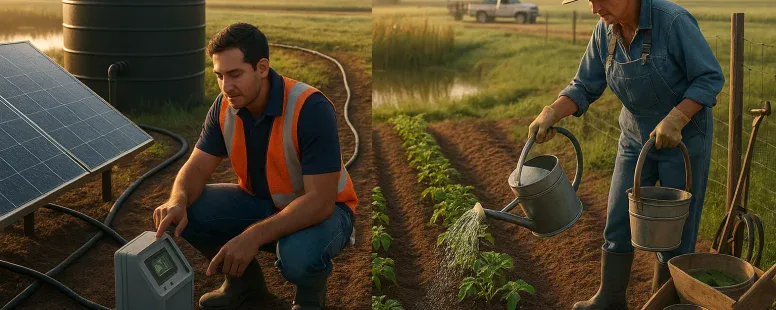
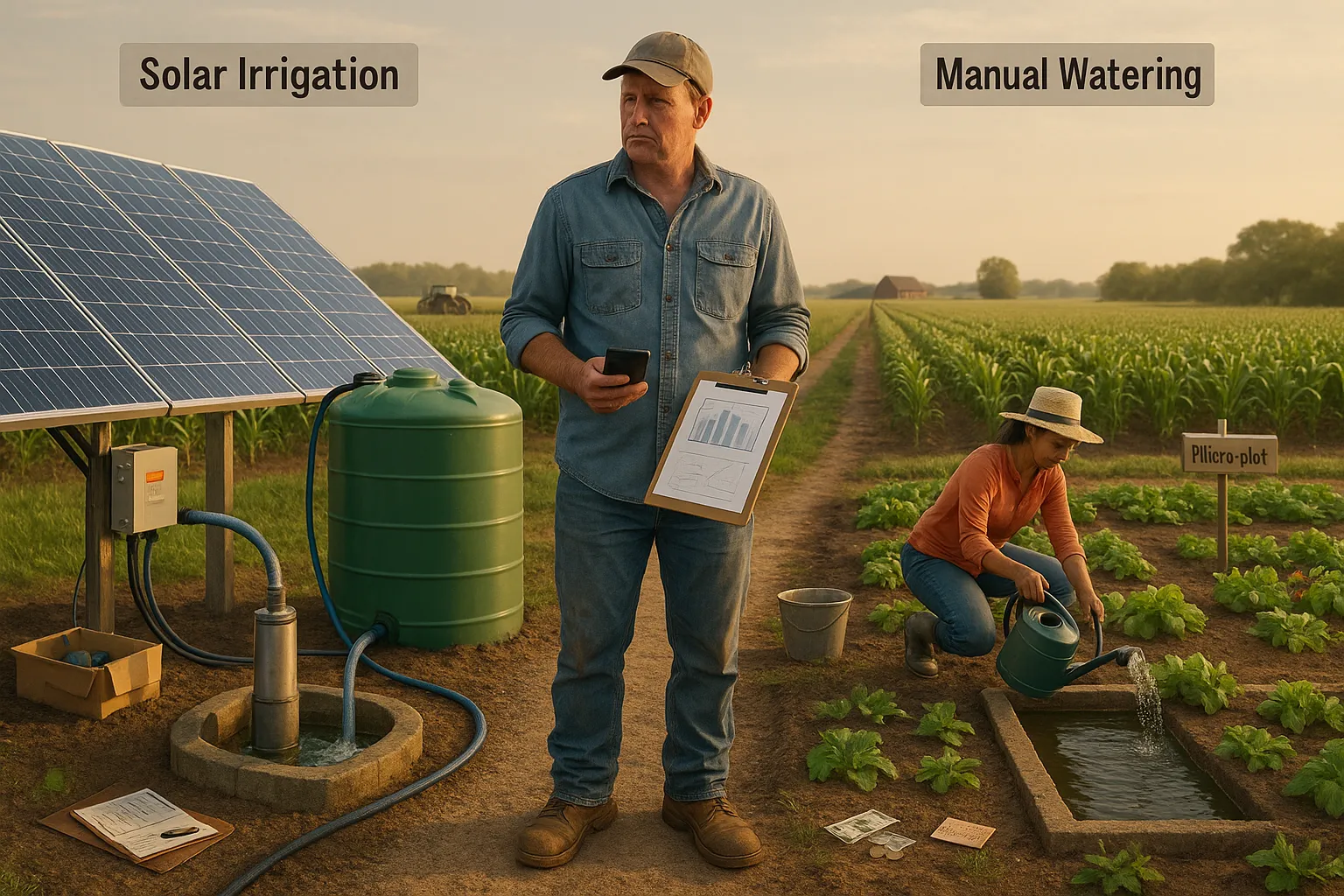
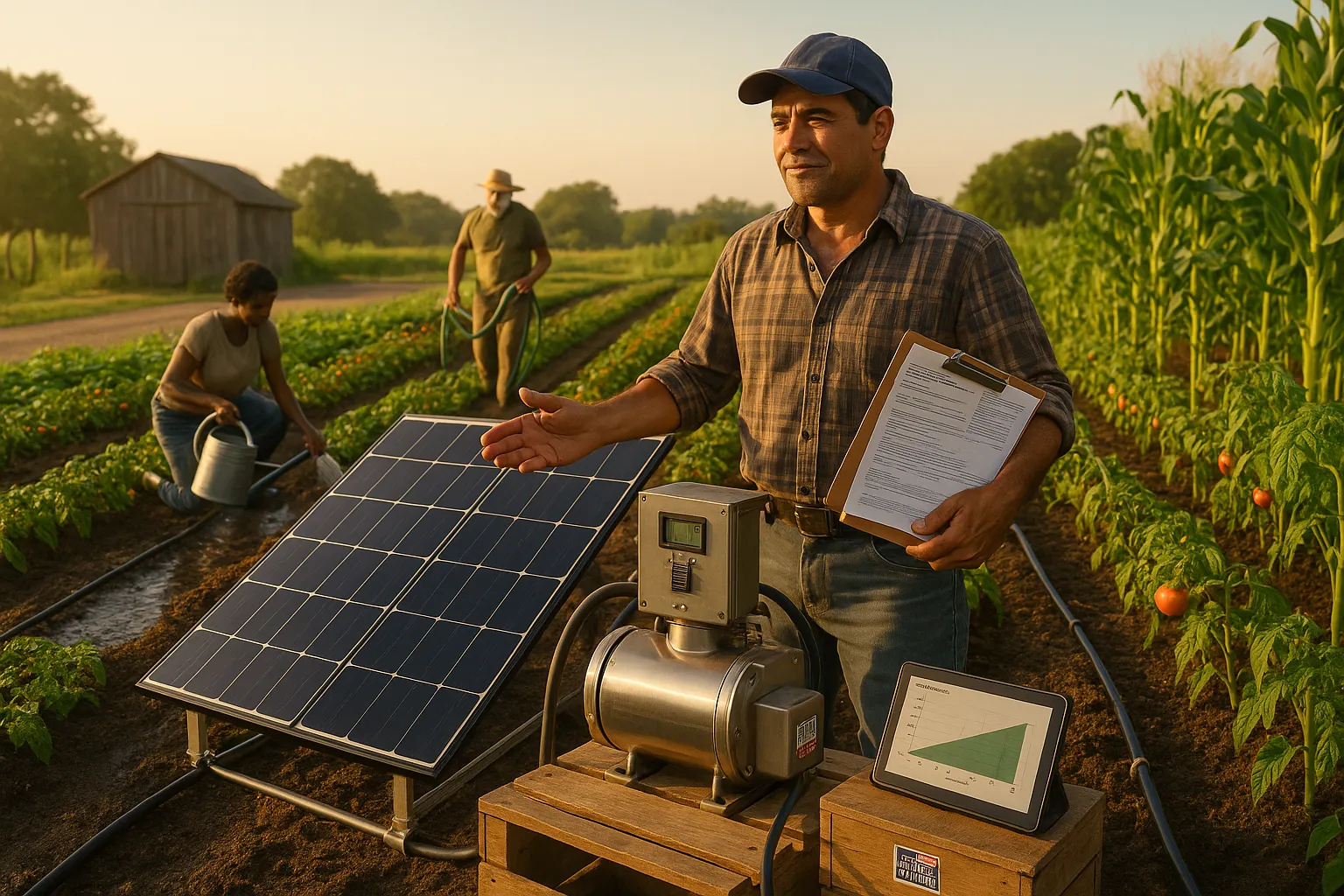
Solar irrigation cuts fuel bills and often lowers labor needs: manual watering keeps capital low and gives you tight control. Which approach fits your fields, wallet, and goals? Picture a dawn where panels hum and a pump feeds drip lines precisely, vs. a dawn where you and your team carry hoses, buckets, or run a treadle pump across beds. Each has clear wins and trade-offs. This article compares Solar Irrigation vs. Manual Watering with practical details, real examples, and a decision checklist so you can match technology to your farm’s reality, and avoid common mistakes that waste water, time, and cash.
How Solar Irrigation And Manual Watering Work
Fact: Both systems aim to deliver water to crops, but they differ in energy source, control, and scale.
How Solar Irrigation And Manual Watering Work
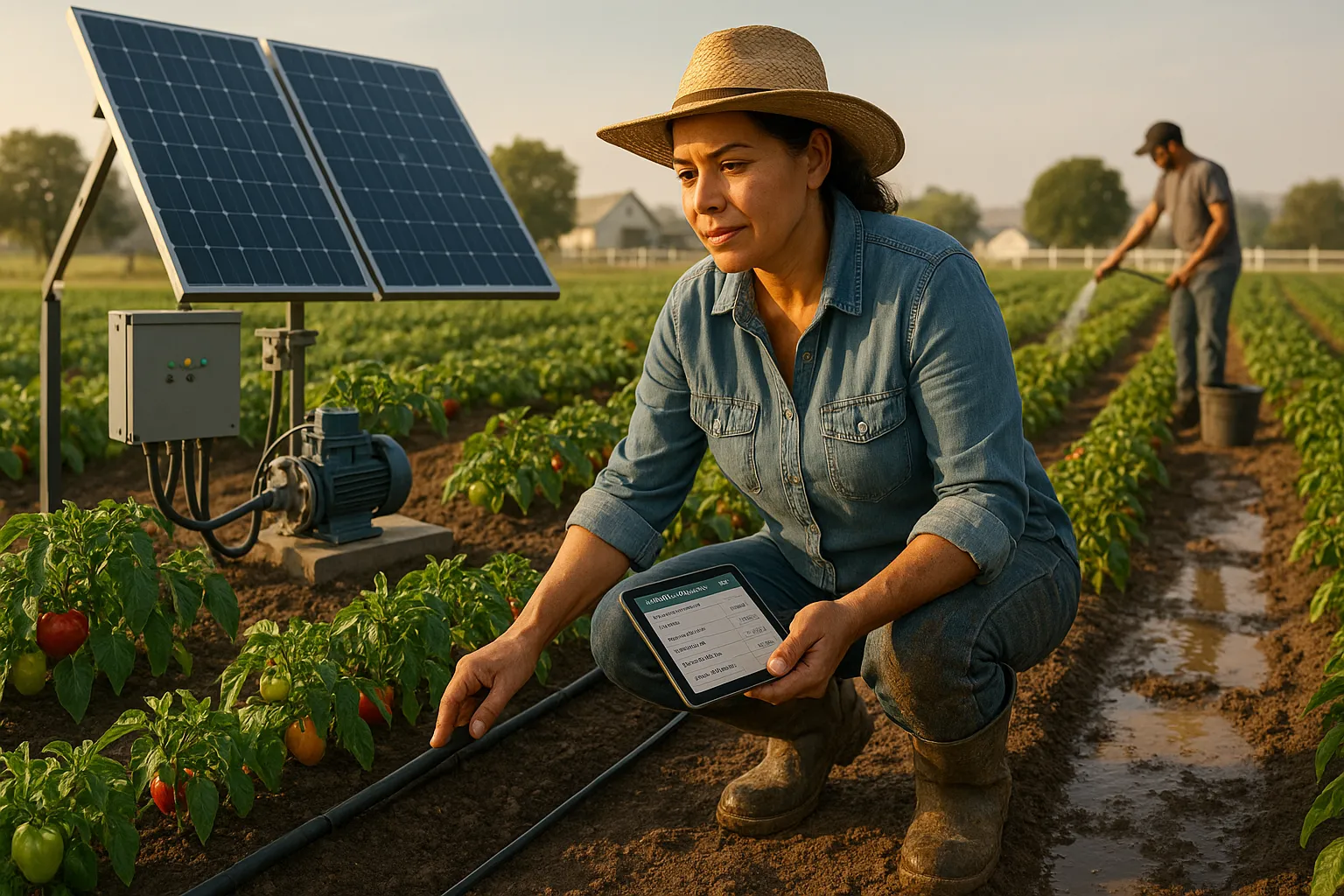
Solar irrigation uses sunlight to power an electric pump that moves water from a well, pond, or mains into distribution lines. You size panels and pumps to match flow and head. Systems range from simple DC surface pumps to larger AC pumps with inverters and controllers. In India and Kenya, brands like Lorentz and Grundfos are common: development projects by the World Bank and FAO often favor solar for remote areas.
Solar Pumping Systems: Components And Operation
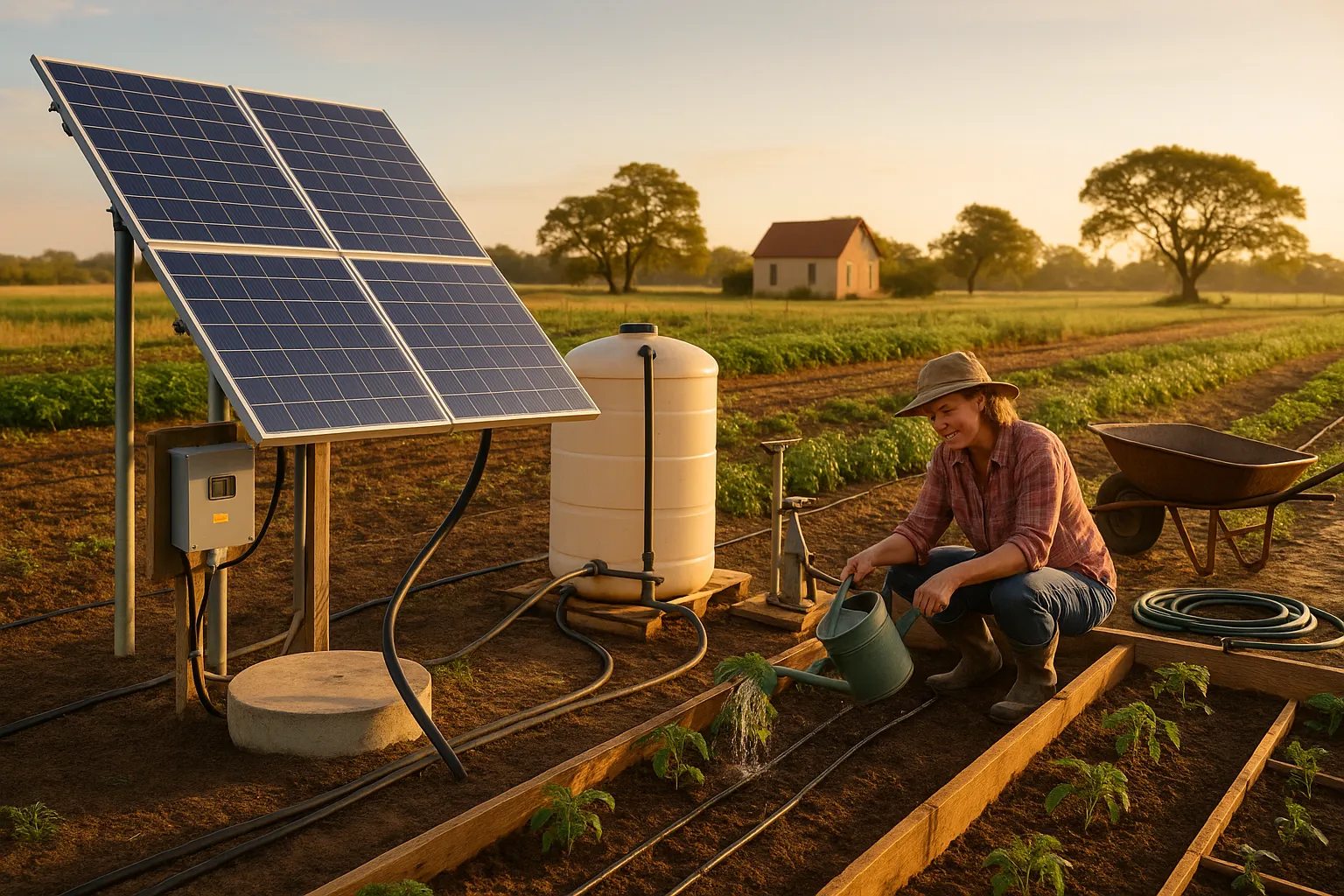
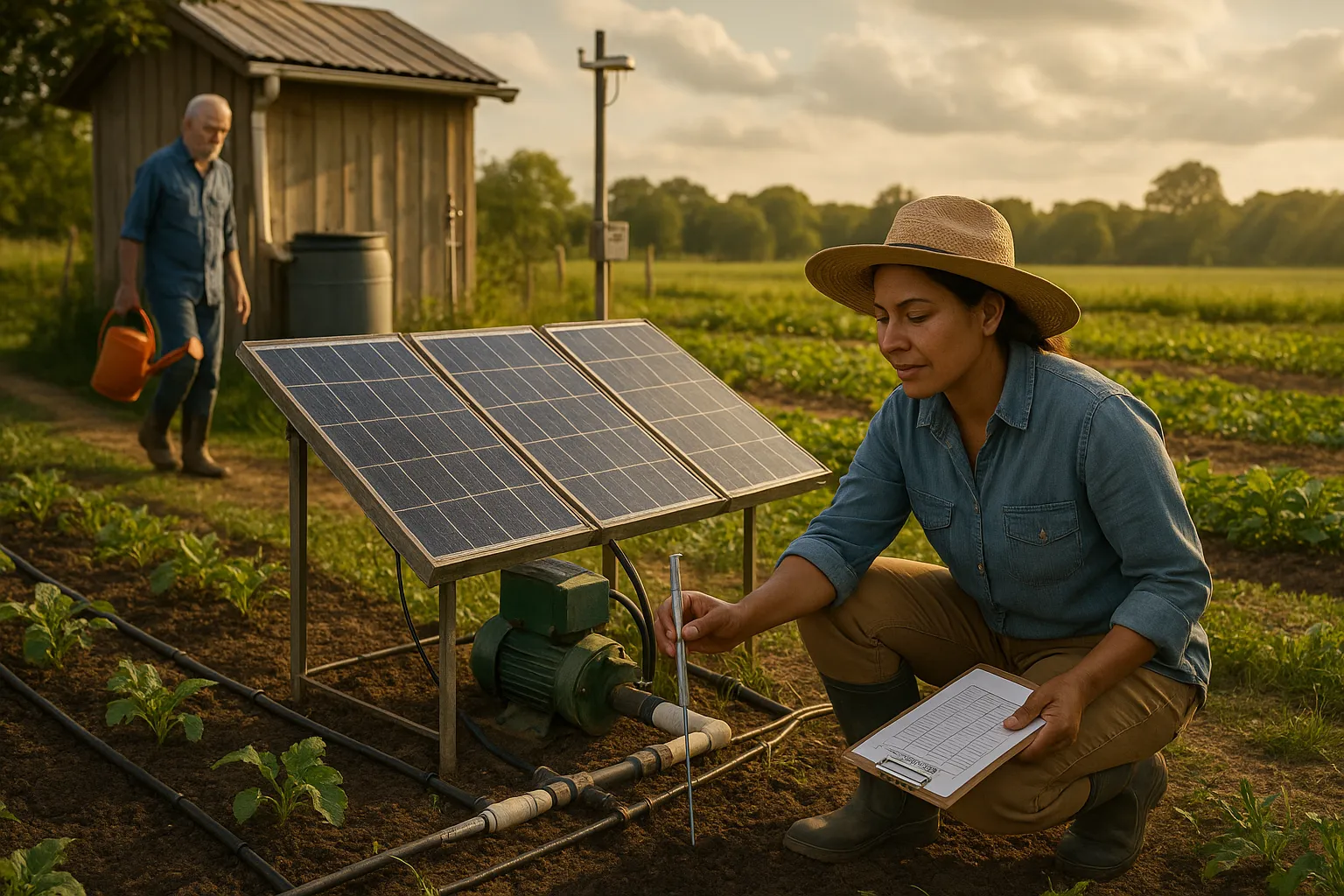
Solar systems include panels, a pump (submersible or surface), mounting structure, wiring, control electronics, and distribution (pipe, drip, sprinklers). The controller optimizes pump run-time to sun hours. Panels generate current: the pump converts it to flow. You can add batteries for storage, but many systems run directly on solar and use small reservoirs or tanks for buffering.
Manual Watering Methods: Tools, Labor, And Typical Practices
Manual watering methods include bucket irrigation, watering cans, hose hand-watering, treadle pumps, and wheelbarrow delivery. Labor supplies the energy. You decide timing by observation or simple timers. Manual methods give fine control at plant level but demand more time and steady labor. Smallholders in Vietnam and Mexico still rely on manual watering for high-value crops in kitchen gardens because the precision matters more than scale.
Key Factors To Compare
Fact: Your choice should hinge on scale, labor availability, water source, and finances.
Key Factors To Compare
Start with farm size and labor. Solar fits larger or multiple-hectare plots better: manual suits tiny plots. Consider water source: deep wells favor solar pumps: surface water with low head can use simple manual lifting. Think about your cash flow: solar has high upfront cost but low running cost: manual stays cheap to start but adds labor and time costs.
Scale And Farm Size
If your operation covers several hectares or you plan to expand, solar often wins on cost per hectare over time. For micro-plots under 0.5 hectare, manual watering usually remains cheapest and more flexible.
Labor Availability And Skill Requirements
Solar systems reduce daily labor but require someone who can monitor panels, clean them, and handle basic electrical checks. Manual watering requires reliable day-to-day labor and supervisors: labor shortages can force crop losses.
Water Source And Reliability
Solar pumps work well where a dependable groundwater or pond supply exists. Manual watering works where water access is immediate and low-lift. If water is seasonal, you may need storage tanks with either system, solar lets you fill tanks faster during sun hours.
Cost Comparison: Upfront, Operating, And Incentives
Fact: Solar costs are front-loaded: manual costs are labor-weighted over time.
Initial Capital Costs And Financing Options
Solar systems typically cost between $1,000 and $10,000 USD for small-to-medium setups, depending on pump size, panels, and storage. Grants and government subsidies exist: India’s PM-KUSUM scheme and many US state incentives reduce initial price. Manual kits, hoses, cans, treadle pumps, may cost $50–$500. You can finance solar with microloans, lease-to-own, or vendor financing.
Ongoing Operating Costs And Labor Savings
Solar operating costs are low: panel cleaning, occasional controller replacement, and pump servicing. Manual watering incurs steady labor wages. If you pay $5–$10 per day for a worker, annual labor may exceed solar amortized costs for medium farms. For example, a 5-hectare farm that needs two workers daily will spend more on labor in 3–5 years than the solar system cost.
Subsidies, Rebates, And Payback Timeline
Subsidies shorten payback. With subsidies and saved labor, many solar installations pay back in 3–8 years. Without incentives, payback may extend beyond a decade on small plots. Manual watering has no payback period, it’s immediate, but opportunity cost builds over time.
Water Use Efficiency And Crop Performance
Fact: Solar-powered precision irrigation generally improves water efficiency and yields compared with manual methods.
Irrigation Scheduling, Precision, And Yield Impacts
Solar-driven drip or sprinkler systems let you schedule water and deliver uniform doses. Studies from FAO and local extension programs show drip irrigation can raise yields by 20–50% on vegetables and reduce water use by up to 60% versus surface or manual watering. Manual watering often leads to uneven wetting and missed optimal timing, reducing yield potential.
Water Losses, Runoff, And Soil Health Effects
Manual flood or bucket methods increase runoff and create wet patches that compact soil. Solar systems paired with drip lines cut runoff and help maintain even soil moisture, improving root health and reducing disease pressure. But poor design or oversized solar pumps can cause overwatering if you don’t use proper controllers.
Environmental And Sustainability Considerations
Fact: Solar irrigation reduces fossil fuel use and carbon emissions compared to diesel pumping: manual watering’s footprint depends on labor travel and water source.
Carbon Footprint And Energy Source Comparison
Solar systems emit near-zero operational carbon: diesel pumps emit significant CO2 and require fuel logistics. The International Renewable Energy Agency (IRENA) highlights solar irrigation as a key way to cut agricultural emissions in off-grid areas. Manual watering has low direct emissions but may be inefficient if it prolongs labor travel or uses motorized water hauling.
Long-Term Resource Resilience And Climate Adaptation
Solar systems give resilience where the grid is unreliable. They let you manage water timing during heatwaves. But solar depends on sunlight, cloudy seasons reduce output: you may need storage. Manual watering adapts quickly to unexpected needs but strains labor during extreme weather. For climate adaptation, combining solar pumps with rainwater harvesting and soil moisture sensors builds resilience.
Installation, Maintenance, And Practical Requirements
Fact: Solar systems require upfront technical assessment: manual methods require ongoing labor management.
Site Assessment, Sizing, And Permitting For Solar Pumps
You must assess well depth, static water level, required flow, and total dynamic head. Vendors like Grundfos or Lorentz often provide sizing tools. Some regions require permits for pumping or well use: check local authorities. Incorrect sizing leads to poor performance and wasted money.
Maintenance Routines For Solar Systems Vs. Manual Tools
Solar maintenance includes panel cleaning (dust, bird droppings), electrical checks, and pump servicing every 1–3 years. Manual tools need hose repairs, replacement of cans, and steady labor scheduling. Both need a simple logbook: run hours, inspections, and repairs. If you skip maintenance on solar, panels lose output: if you skip manual care, tools fail and labor slows.
How To Decide: A Practical Checklist For Farmers
Fact: Use a short checklist that maps your farm’s facts to outcomes before choosing.
How To Decide: A Practical Checklist For Farmers
Farm size: under 0.5 ha → consider manual: over 1–2 ha → evaluate solar.
Water source: deep well or distant pond → solar likely: hand-access water → manual may suffice.
Labor: reliable low-cost labor → manual may fit: high wages or shortages → solar saves money.
Capital: available grants/loans → solar becomes viable: no capital and no financing → manual.
Climate risks: prolonged dry spells → prefer solar with storage.
Short-Term Constraints Vs. Long-Term Goals
If you need immediate low-cost action, manual watering gets crops in the ground today. If your goal is scale, reduced labor dependency, and long-term savings, invest in solar. Remember: you can phase, start manual, add a small solar pump later.
Sample Decision Scenarios (Small Plot, Medium Farm, Large Operation)
Small plot (0.2 ha): You grow herbs and tomatoes near a house. Manual watering gives control and low cost: install a simple hose and timers.
Medium farm (2–5 ha): You grow mixed vegetables and have intermittent labor. A solar pump with drip lines and a 5,000–10,000 L tank lowers labor and raises yield: seek subsidy and a 3–7 year payback.
Large operation (20+ ha): Solar arrays power multiple pumps and irrigation zones. Integrate telemetry, weather forecasts, and automated valves: combine with diesel backup if needed.
Call-to-action: run a quick cost model for your specific plot, list costs for equipment, labor, and expected yield gains, and you’ll see which side of Solar Irrigation vs. Manual Watering wins for your farm.
Published: March 2, 2026 at 9:05 am by Ellie B, Site owner & Publisher
To provide the best experiences, we use technologies like cookies to store and/or access device information. Consenting to these technologies will allow us to process data such as browsing behaviour or unique IDs on this site. Not consenting or withdrawing consent, may adversely affect certain features and functions.
Functional
Always active
The technical storage or access is strictly necessary for the legitimate purpose of enabling the use of a specific service explicitly requested by the subscriber or user, or for the sole purpose of carrying out the transmission of a communication over an electronic communications network.
Preferences
The technical storage or access is necessary for the legitimate purpose of storing preferences that are not requested by the subscriber or user.
Statistics
The technical storage or access that is used exclusively for statistical purposes.The technical storage or access that is used exclusively for anonymous statistical purposes. Without a subpoena, voluntary compliance on the part of your Internet Service Provider, or additional records from a third party, information stored or retrieved for this purpose alone cannot usually be used to identify you.
Marketing
The technical storage or access is required to create user profiles to send advertising, or to track the user on a website or across several websites for similar marketing purposes.