You can read a broken bowl two ways: as damage to hide, or as a map of past life. Kintsugi and gold-filled resin offer two very different answers. One treats a fracture as a narrative stitched with lacquer and gold: the other repairs with modern resins that embed metallic particles for a gleaming, resilient join. Both restore function and beauty, but they do so with different philosophies, materials, and practical trade-offs. This article breaks down what each method is, how they work, and how to choose the right path for your piece, whether it’s a chipped teacup, a family heirloom, or a mass-produced ceramic that needs everyday use.
What Kintsugi and Gold-Filled Resin Are
Fact: Kintsugi is a traditional Japanese repair technique that highlights breaks with lacquer and gold: gold-filled resin is a modern method using epoxy or polyester resin blended with gold-colored metals or powders to fill and bond cracks.
Kintsugi centers on Urushi lacquer and real gold (or powdered gold) to fuse shards and celebrate the break. It began as a repair technique for samurai-era ceramics and grew into a philosophy that values imperfection. Gold-filled resin, by contrast, uses synthetic adhesives, often two-part epoxy, mixed with metallic leaf, flakes, or powder to create a gold-like finish and strong adhesive bond. You find gold-filled resin in contemporary studios, repair shops, and DIY kits.
Why this matters: the choice shifts the object’s meaning. Kintsugi often increases perceived cultural and sentimental value. Gold-filled resin prioritizes speed, strength, and a consistent aesthetic that mimics gold but costs less.
Kintsugi: History, Philosophy, and Cultural Context
Fact: Kintsugi began in 15th-century Japan and ties to Wabi-Sabi aesthetics that value transience and imperfection.
Kintsugi emerged after Japanese craftsmen repaired a broken tea bowl with metal staples: artisans replaced staples with lacquer and gold. The technique grew alongside the tea ceremony and Zen thought, elevating repaired items into objects valued for their scars. Kintsugi signals resilience: it says damage can increase an object’s story and worth.
Kintsugi Materials and Traditional Techniques
Fact: Traditional Kintsugi uses Urushi (natural lacquer), powdered gold, and often rice flour to thicken lacquer.
Materials you will see named: Urushi lacquer (from the lacquer tree), 24K gold leaf or powdered gold, kinpaku (gold leaf), nori or rice paste (as filler), shikkui or powdered clay sometimes as a sous-layer. Craftspeople apply Urushi in multiple thin layers. They dust gold while the lacquer is tacky, then polish after curing. The process is tactile and slow. Urushi can cause allergic reactions for some people because it contains urushiol, the same irritant in poison ivy.
Kintsugi Step-by-Step Process (Traditional and Contemporary Variations)
Fact: The traditional method includes cleaning, joining with lacquer, filling, gilding, and polishing, often taking days to weeks per repair.
Traditional steps: clean shards and remove old adhesives: apply raw Urushi to bond pieces: use rice paste to fill gaps: apply successive lacquer layers: dust with gold leaf when tacky: let cure in humid conditions: polish and finish. Contemporary Kintsugi sometimes substitutes synthetic lacquer, gold powder, or even gold paint to reduce cost and cure time. Artists also adapt the aesthetic: some accent the crack boldly, others use thinner seams to mimic factory glazes.
Vulnerable note: I once tried a DIY Kintsugi kit and underestimated the drying time: I left a cup in direct sunlight and the lacquer bubbled. Traditional curing demands patience and care, shortcuts often show.
Gold-Filled Resin Restoration: Materials and Modern Technique
Fact: Gold-filled resin repairs use modern resins, typically epoxy, mixed with metallic powders or leaf to create a durable, gold-toned seam.
Gold-Filled Resin Materials and How They Differ From Traditional Gold
Fact: Epoxy resin mixed with metallic powder imitates gold visually but lacks the chemical and historical properties of 24K gold leaf.
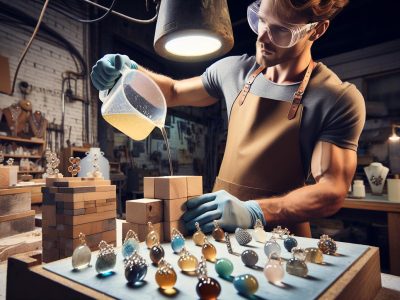
Common materials: two-part epoxy resin (clear or filled), gold powder (brass, bronze, or aluminum pigments), metallic leaf compatible with resin, fillers (microballoons, silica), and UV stabilizers. Brands like ArtResin or West System supply resins favored by craft restorers. These resins cure faster and bond strongly to ceramics, glazes, and underglazes. Metal powders used often include brass or bronze because they offer gold-like tones at lower cost: they will patina differently over time compared with real gold.
Typical Gold-Filled Resin Repair Process (Tools, Steps, Curing)
Fact: Resin repairs usually follow surface prep, mixing, filling, and curing in hours to days.
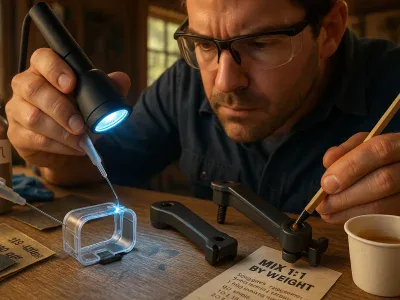
Typical steps: clean and degrease the ceramic: sand mating surfaces lightly: mix resin according to manufacturer ratios: add metallic pigment: apply resin into crack or gap using syringe or small spatula: remove excess before cure: post-cure sanding and polishing. Tools: syringes, disposable mixing cups, precision syringes, respirator mask (resins release VOCs), nitrile gloves, and fine sandpaper. Curing time varies but many epoxies reach functional strength in 24 hours and full cure in 72 hours. Resin is less temperature-sensitive during curing than Urushi, and you can often use heat lamps or controlled ovens for faster post-cure.
Aesthetic, Ethical, and Cultural Considerations
Fact: Aesthetic result differs: Kintsugi signals philosophy and history: gold-filled resin signals modern repair and utility.
Visual Outcomes: Appearance, Finish, and Design Intent
Fact: Kintsugi produces irregular, tactile seams with real gold luster: resin yields smoother, more uniform joins that mimic metallic surfaces.
Kintsugi seams vary in thickness, color depth, and surface texture. Light catches real gold uniquely: the seam may darken slightly over time depending on lacquer and environment. Gold-filled resin produces glossy, often high-sheen joins and you can match color closely to factory finishes. If you want a pronounced, visible scar that reads as art, Kintsugi usually delivers. If you want near-invisible or uniformly metallic fills that survive frequent handling, resin is often better.
Cultural Respect and Authenticity: When Kintsugi Is Appropriate
Fact: Kintsugi carries cultural significance tied to Japanese craft: using it on mass-market or culturally unrelated objects raises authenticity questions.
You should consider provenance. For antiques or items with Japanese lineage, Kintsugi can honor tradition. For modern, mass-produced plates, Kintsugi applied superficially may feel appropriative if presented as authentic craft. Many contemporary artists blend influences respectfully: they credit Kintsugi, describe techniques, and choose materials intentionally. Be transparent with buyers or recipients about whether you used real Urushi and gold or substituted materials.
Durability, Functionality, and Maintenance
Fact: Resin repairs usually outperform traditional Kintsugi in strength and heat resistance: Urushi repairs offer longevity but need careful maintenance.
Strength and Long-Term Performance (Heat, Dishwasher, Wear)
Fact: Most epoxies withstand higher thermal and mechanical stress than Urushi: but, high-quality Kintsugi can be very durable if done correctly.
Epoxy resin cures to a hard, impact-resistant finish that tolerates everyday use and light dishwasher exposure only if the manufacturer states so, many recommend hand wash only. Epoxy can yellow under UV exposure unless UV inhibitors are used. Urushi cures into a hard, resilient film that resists solvents and heat better than many household epoxies, but Urushi-cured seams require correct humidity and time to reach full hardness. Neither method automatically makes a plate microwave-safe: metal-containing seams should never go in microwave. Wear patterns differ: gold leaf stays bright, while metallic powders might abrade.
Repairability and Future Restoration Options
Fact: Both methods can be reworked: Kintsugi seams are often re-lacquered and regilded, resin seams can be sanded and re-filled.
If a resin repair chips, you can sand and reapply compatible resin to the area. If a Kintsugi seam cracks, a trained Urushi artisan can reapply lacquer and gold, but this takes skill and rarely is cheap. Consider future conservation: museum-grade restoration favors reversible and documented methods: both resin and Urushi have pros and cons for conservators. Keep records of materials used for future caretakers.
Practical Decision Guide: Which Method To Choose
Fact: Choose Kintsugi when you value cultural meaning and visible repair: choose gold-filled resin when you need speed, strength, or budget-friendly restoration.
When To Choose Kintsugi (Values, Aesthetics, Heirloom Pieces)
Fact: Kintsugi suits heirlooms, ceramics with provenance, or art pieces meant to celebrate repair.
Choose Kintsugi if the piece has sentimental or cultural value, if you want the repair to be a visible statement, or if you accept longer timelines and higher cost for authenticity. Kintsugi suits display objects and pieces used gently. You will likely pay more and wait longer, but the result often carries emotional weight and craft cachet.
When To Choose Gold-Filled Resin (Cost, Convenience, Functional Repairs)
Fact: Gold-filled resin suits functional items, budget repairs, and fast turnarounds.
Choose resin if the item gets daily use, needs strong bonds, or if you want a consistent metallic finish without the high cost of real gold. Resin repairs are common in cafes, boutiques, and repair shops where time and durability matter. They also allow easier DIY attempts, but take safety precautions: use a respirator and gloves.
Budget, Time, and Skill Considerations (Costs, DIY vs. Professional)
Fact: Kintsugi costs more in materials and skill: resin lowers cost and can be DIY-friendly.
Estimate: a professional Kintsugi repair can cost several times more than a resin repair and take weeks. Resin kits range from inexpensive DIY kits to professional two-part systems costing tens of dollars. Skill matters: Kintsugi demands craft training: resin demands precise mixing and safety. If you care about authenticity, hire a trained Urushi artisan or conservator. If you need fast, robust repair, a certified resin restorer or a careful DIY approach works. A warning: avoid microwaving metal-filled repairs, and keep good records about what you used, future conservators will thank you.
Call to action: Pick the method that matches your values and use-case. If you’re unsure, test both on non-valuable pieces to learn how each behaves: hands-on experience clarifies trade-offs better than theory.
To provide the best experiences, we use technologies like cookies to store and/or access device information. Consenting to these technologies will allow us to process data such as browsing behaviour or unique IDs on this site. Not consenting or withdrawing consent, may adversely affect certain features and functions.
Functional
Always active
The technical storage or access is strictly necessary for the legitimate purpose of enabling the use of a specific service explicitly requested by the subscriber or user, or for the sole purpose of carrying out the transmission of a communication over an electronic communications network.
Preferences
The technical storage or access is necessary for the legitimate purpose of storing preferences that are not requested by the subscriber or user.
Statistics
The technical storage or access that is used exclusively for statistical purposes.The technical storage or access that is used exclusively for anonymous statistical purposes. Without a subpoena, voluntary compliance on the part of your Internet Service Provider, or additional records from a third party, information stored or retrieved for this purpose alone cannot usually be used to identify you.
Marketing
The technical storage or access is required to create user profiles to send advertising, or to track the user on a website or across several websites for similar marketing purposes.