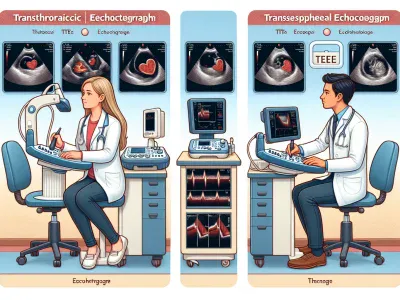
Picture navigating the intricate world of medical diagnostics, where every acronym holds a key to understanding your health. Among these, TTE (transthoracic echocardiogram) and TEE (transesophageal echocardiogram) might seem like just another pair of confusing terms. But these two procedures are far more than their names—they’re windows into the heart, each offering unique insights with distinct approaches.
Understanding TTE And TEE
Both TTE (transthoracic echocardiogram) and TEE (transesophageal echocardiogram) are diagnostic tools for assessing heart health. These procedures use ultrasound technology to create detailed images of your heart’s structure and function.
What Is TTE?
TTE involves placing a transducer on the chest wall to capture images of the heart through the ribcage. This non-invasive method provides real-time visuals of blood flow, valve movement, and overall cardiac performance.
Key Advantages: TTE is painless, quick, and doesn’t require sedation. It’s often used in outpatient settings to evaluate conditions like heart murmurs or left ventricular function.
Limitations: Image quality may decrease if there’s excess body fat or lung interference. For deeper structures, clarity might not be optimal.
For example, a patient with suspected mitral valve prolapse could undergo a TTE to confirm diagnosis without invasive measures.
What Is TEE?
TEE requires inserting a flexible probe into the esophagus to obtain closer proximity to the heart. The esophagus’s position behind the heart allows clearer imaging of posterior structures like atria or pulmonary veins.
Key Advantages: High-resolution imaging ensures detailed views of areas obscured during TTE. It’s crucial for detecting thrombi before atrial fibrillation procedures or identifying endocarditis.
Limitations: Requires sedation due to its semi-invasive nature. Risks include throat discomfort or rare complications like esophageal injury.
A cardiologist might recommend TEE before surgery for someone with prosthetic valves to rule out internal clots accurately.
Key Differences Between TTE And TEE
TTE (transthoracic echocardiogram) and TEE (transesophageal echocardiogram) are both essential diagnostic tools for assessing heart health. Their differences lie in how the procedures are performed, the quality of imaging they provide, associated risks, and their specific clinical applications.
Procedure
TTE uses a transducer placed on your chest wall to capture ultrasound images of your heart externally. It’s non-invasive, requires no sedation, and takes about 30-60 minutes. For example, this method is often used in routine check-ups or outpatient settings where patient comfort is prioritized.
TEE involves inserting a flexible probe into your esophagus to obtain closer views of the heart’s posterior structures. This semi-invasive approach demands sedation and preparation similar to endoscopic procedures. Its use typically occurs in hospitals when high-detail imaging is critical for accurate diagnosis.
Imaging Capabilities
TTE provides clear visuals of cardiac chambers, valves, and blood flow but can be limited by factors like obesity or lung interference. For instance, if a patient’s chest anatomy obstructs sound waves, image clarity may suffer.
TEE offers superior resolution by positioning the probe close to the heart without interference from external tissues or air-filled lungs. It excels in detecting abnormalities such as atrial thrombi or infections like endocarditis that might go unnoticed with TTE.
Risks And Comfort
TTE poses minimal risk since it doesn’t involve internal probing or anesthesia. Patients typically experience no discomfort during the procedure.
TEE carries potential risks due to its invasive nature, including throat irritation or rare complications like esophageal injury. Sedation adds another layer of risk but ensures patient comfort throughout the process.
Applications In Diagnosis
Doctors use TTE extensively for initial evaluations of general cardiac function—examples include assessing left ventricular ejection fraction after a myocardial infarction or diagnosing congenital defects in children.
TEE has specialized applications requiring high-detail imaging: identifying blood clots before cardioversion in patients with atrial fibrillation or evaluating prosthetic valve integrity post-surgery are key examples. Its precision makes it invaluable in pre-operative planning and complex cases where standard methods fall short.
Advantages Of TTE And TEE
TTE and TEE offer unique advantages in cardiac diagnostics, each tailored to specific clinical needs. Understanding their benefits helps you determine the most suitable option for accurate heart assessments.
Benefits Of TTE
Non-Invasive Nature
TTE is entirely non-invasive, making it comfortable for patients. The transducer rests on the chest wall without entering the body, eliminating risks of complications like infection or sedation-related issues.
Widespread Availability
Most healthcare facilities are equipped to perform TTE due to its ease of use and minimal resource requirements. Outpatient clinics frequently rely on this method for quick diagnostics.
Cost-Effectiveness
Compared to invasive techniques, TTE is more budget-friendly while still delivering valuable insights into cardiac structure and function.
Real-Time Imaging
Physicians can observe real-time blood flow and heart activity during a standard examination, aiding immediate decision-making in emergency cases.
Benefits Of TEE
Superior Image Quality
Since the probe is positioned closer to the heart via the esophagus, TEE captures detailed images of posterior cardiac structures such as atria or valves—important when diagnosing infections (e.g., endocarditis) or thrombi.
Reduced Interference
Unlike external methods that may have limited image clarity due to lung tissue or excess fat, TEE bypasses these barriers by directly accessing internal views through esophageal placement.
Critical Applications In Surgery
Surgeons often use intraoperative TEE during procedures like valve repairs or replacements because it provides precise guidance when monitoring structural changes in real time.
Detection Of Rare Conditions
Certain abnormalities like septal defects or prosthetic valve complications are better identified with this high-resolution imaging technique than with traditional transthoracic methods.
Choosing Between TTE And TEE
Deciding between transthoracic echocardiogram (TTE) and transesophageal echocardiogram (TEE) involves evaluating their suitability based on clinical needs, patient comfort, and diagnostic goals. Each method offers distinct advantages depending on the situation.
Factors To Consider
Understanding the key factors helps determine whether TTE or TEE is more appropriate.
Invasiveness: TTE is non-invasive, making it ideal for routine evaluations or initial cardiac assessments. Conversely, TEE requires sedation and probe insertion into the esophagus, which may cause discomfort but delivers clearer images of posterior heart structures.
Image Quality: While TTE provides adequate imaging for many cases, chest wall interference can limit clarity in obese patients or those with lung disease. In such scenarios, TEE bypassess these barriers by positioning the ultrasound closer to the heart.
Risk Profile: The risks are minimal with TTE due to its external approach. But, complications like throat irritation or anesthesia reactions make risk consideration crucial when opting for a TEE procedure.
Patient Condition: Some individuals cannot tolerate prolonged procedures or sedation required for TEE. For instance, elderly patients with multiple comorbidities might benefit more from a less invasive option like TTE.
Clinical Scenarios For Each
Specific clinical contexts dictate when to use each diagnostic tool effectively.
TTE Applications: Use this method during outpatient screenings to evaluate general cardiac function or monitor known conditions like valvular diseases over time. It’s also suitable in emergency situations where quick assessments are needed without additional preparation steps.
Example: A 45-year-old presenting with unexplained shortness of breath undergoes a prompt bedside evaluation using transthoracic echocardiography to rule out left ventricular dysfunction or pericardial effusion.
TEE Applications: This technique proves indispensable in detecting intricate abnormalities such as atrial thrombi pre-cardioversion or diagnosing infective endocarditis affecting prosthetic valves due to its superior resolution capabilities.
Example: A 62-year-old undergoing surgery for mitral valve repair benefits from intraoperative transesophageal echocardiographic guidance ensuring precise procedural outcomes while identifying potential complications promptly.
Conclusion
Understanding the differences between TTE and TEE helps you make informed decisions about cardiac diagnostic options. Each method serves a distinct purpose, with TTE offering convenience and comfort for routine assessments, while TEE provides unparalleled clarity for more complex cases.
Your healthcare provider will determine the most suitable approach based on your condition, ensuring accurate diagnosis and effective care. Both techniques play vital roles in advancing heart health through precise imaging and tailored treatment strategies.
Published: October 5, 2024 at 9:22 pm by Ellie B, Site owner & Publisher
To provide the best experiences, we use technologies like cookies to store and/or access device information. Consenting to these technologies will allow us to process data such as browsing behaviour or unique IDs on this site. Not consenting or withdrawing consent, may adversely affect certain features and functions.
Functional
Always active
The technical storage or access is strictly necessary for the legitimate purpose of enabling the use of a specific service explicitly requested by the subscriber or user, or for the sole purpose of carrying out the transmission of a communication over an electronic communications network.
Preferences
The technical storage or access is necessary for the legitimate purpose of storing preferences that are not requested by the subscriber or user.
Statistics
The technical storage or access that is used exclusively for statistical purposes.The technical storage or access that is used exclusively for anonymous statistical purposes. Without a subpoena, voluntary compliance on the part of your Internet Service Provider, or additional records from a third party, information stored or retrieved for this purpose alone cannot usually be used to identify you.
Marketing
The technical storage or access is required to create user profiles to send advertising, or to track the user on a website or across several websites for similar marketing purposes.