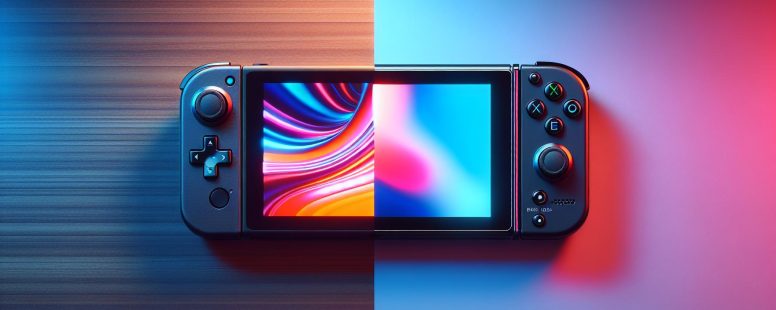
Caught in the dilemma of choosing between a Nintendo Switch and its upgraded version, the Switch OLED? You’re not alone. This is one tech decision that’s been puzzling gamers worldwide since the release of this new console variant.
What really sets these two apart from each other? Is it just about improved visuals or does the difference run deeper than what meets your eye?
Understanding Switch and Switch OLED
Diving deeper into the world of gaming consoles, let’s illuminate the differences between Nintendo Switch and its newer sibling, Nintendo Switch OLED.
What is a Nintendo Switch?
Nintendo introduced its hybrid console known as ‘Switch’ back in 2017. It offers a unique blend of handheld portability with home console power. Imagine this – You’re playing your favorite game on your TV at home when suddenly you have to leave for an appointment but don’t want to stop playing? The solution lies within this device! Detach it from the dock connected to your television, attach Joy-Con controllers directly onto either side of it and voila – you’ve got yourself a portable gaming system!
Featuring dynamic controls like motion sensing capabilities through built-in gyroscopic sensors, NFC reader/writer facilitating amiibo interaction along with HD Rumble feature that provides immersive tactile feedback during gameplay- all contribute towards enhancing user experience.
What is a Nintendo Switch OLED?
Advancing ahead from their standard model, 2021 saw introduction by Nintendo of another variant termed ‘Switch OLED’. This upgraded version shares many features found in original switch such as detachable Joy-Con Controllers plus ability for both stationary (via docking) & mobile use cases.
But main selling point here isn’t just about similarity; instead difference lies primarily within display technology used which explains term ‘OLED’ attached following name indicating usage type: Organic Light Emitting Diodes rather than Liquid Crystal Display(LCD).
While technical jargon may seem intimidating initially remember they’re merely terms referring how images are produced on screens- In essence offering brighter colors richer contrasts alongside improved audio quality due larger integrated speakers hence providing superior overall performance compared previous counterpart.
Key Differences between Switch and Switch OLED
This section highlights the crucial differences you’ll find when comparing Nintendo’s original Switch console to its enhanced counterpart, the Switch OLED. From display characteristics to price disparities and audio quality variations, this analysis provides insights into each console’s unique features.
Display Comparison
When it comes down to screen technology, both consoles hold their ground but in different ways. The traditional Nintendo switch offers a 6.2-inch LCD screen with a resolution of 720p on handheld mode. It presents crisp images for an enjoyable gaming experience.
On the other hand, as indicated by its name itself – “OLED,”- Nintendo’s latest version boasts a slightly larger 7-inch Organic Light-Emitting Diode (OLED) display that enhances color vibrancy while offering deeper blacks than an LCD panel can provide due to self-lighting pixels.
Screen Size
Type
Resolution
Switch
6.2″
LCD
1280×720
Switch OLED
\7″ |\OLED|\1280×720
You might wonder if these differences affect your gameplay significantly? While playing colorful games or those set in dark environments could offer more immersive experiences on an OLED panel because of richer colors and contrasts; but realistically speaking, most gamers won’t see much difference unless they compare side-by-side under optimal lighting conditions.
Price Range Difference
Next up is something everyone considers before purchasing – cost! In general terms,the standard model costs around $300 at retail stores whereas one has shell out approximately $350 for the newer iteration i.e.,the improved speakers,Oled Model . This marks about ~17% increase from previous edition hence making decision tad bit difficult considering minimal upgrades provided.But eventually ,it boils down personal preferences budgets
Cost comparison
Model Name Price(USD)
Nintendo Switch $300
Nintendo Switch OLED $350
Audio and Speaker Quality
Finally, let’s investigate into audio performance between the two consoles.The original switch came with decent stereo speakers that provide ample sound for gaming in handheld mode but it lacks depth at times.In contrast,the new model comes with larger integrated speakers , delivering enhanced audio quality which can prove to be a game changer during intense multiplayer battles or while playing games heavily reliant on sound effects.
Similarities between Switch and Switch OLED
Digging deeper into the comparison of Nintendo’s gaming marvels, it becomes evident that even though their differences, both consoles share some common ground. Let’s explore these similarities.
Gaming Experience
In terms of gameplay experience, there is a lot in common for both the original Nintendo Switch and its newer counterpart, the OLED model. For starters, they are powered by identical chipsets under the hood – Nvidia Custom Tegra processor to be exact. This ensures an equally seamless performance on either device during your immersive gaming sessions.
Another striking similarity lies within their multi-functionality as home console-cum-handheld devices. You can dock them with ease to enjoy big-screen entertainment or detach from docking station if you prefer portable playtime; flexibility remains consistent across models.
Finally yet importantly: game compatibility—both versions support all existing switch games without exception! So whether you’re battling foes in Breath Of The Wild or catching ’em all in Pokemon Sword & Shield—it doesn’t matter which version you’ve got!
Controllers and Joy-Cons
If controller dynamics form part of your decision-making process when buying a new console—you’d find yourself torn between these two versions again! Why? Because here comes another feature where they align perfectly: controllers and joy-cons remain unchanged across variants.
Both have removable joy-con controllers attached at sides making handheld mode feasible while providing traditional gaming comfort when detached—the choice is yours really!
The Impact on Gaming: Switch Vs. Switch OLED
Delving deeper into the gaming impact of these two devices, it’s time to analyze their performance and user comfort.
Performance Analysis
When comparing Nintendo’s regular switch with its newer OLED version, you’ll find striking similarities in terms of processing power. Both consoles sport an Nvidia Custom Tegra processor, ensuring that your favorite games run smoothly without any hiccups.
Plus to similar processors, both versions offer full compatibility with all existing switch games – from high-paced racing titles like “Mario Kart 8 Deluxe” to action-packed adventures such as “The Legend Of Zelda: Breath Of The Wild”. That means no matter which console you choose; your game library remains intact and ready for play.
Yet even though their shared specifications, differences start appearing when we look at audiovisual delivery aspects — the areas where the OLED model shines brightest.
Remember how earlier we mentioned those advanced display technology features? Well here they are again making a significant difference! On one hand is the standard Switch’s LCD screen while on other stands OLED’s vivid self-emissive panel giving richer colors and sharper contrasts – enhancing every bit of visual information fed by same powerful processors in each device.
Portability and User Comfort
As versatile hybrids designed for home or handheld use alike-both variants boast impressive portability factors but there lies subtle variations that may sway decision depending upon individual preferences.
Nintendo has retained physical dimensions across models so maintaining familiarity but added weight due new larger glass shielded display makes carrying around slight more tasking than before especially during longer sessions if used away from dock mode – think lengthy commutes or extended outdoor stays!
Interestingly controller dynamics remain unchanged–joy-con controllers still easily removable providing flexibility whether enjoying alone or sharing fun multiplayer bouts yet design tweaks have resulted better kickstand allowing multiple angles rest adding up overall improved stability portable usage scenario offering little something extra ergonomic department against older sibling.
Though minute, these differences can significantly impact user comfort. The OLED’s improved audio system gives immersive gaming experience when playing in handheld mode and its new wider kickstand provides stability for tabletop gaming — something that regular Switch users have been asking for quite some time!
It seems like with the Nintendo switch OLED, it’s less about big leaps forward more refining what already works – bringing together a series of small yet significant improvements to create an even better version of beloved hybrid console.
Choosing Between Switch and Switch OLED
In the quest for an optimal gaming experience, your choice between Nintendo’s two flagship consoles—Switch and its new sibling, Switch OLED—is crucial. This section delves into scenarios that might steer you towards one over the other.
When to Choose Switch
Nintendo’s original console makes a compelling case when cost is your primary concern. The standard model offers nearly identical functionality at a lower price point than its newer counterpart. Also, if audio-visual performance isn’t top of mind during handheld gameplay or if most of your playtime happens docked on TV mode—the strengths offered by the upgraded display technology in OLED are less likely to be noticeable.
Also, opt for this model if long-term comfort holds importance as it’s slightly lighter than its updated version—an aspect appreciated during prolonged handheld use sessions.
When to Choose Switch OLED
When seeking improvements in specific areas like visual fidelity or sound quality while playing undocked —the additional investment put forth for Nintendo’s latest offering can prove worthwhile. Enhanced with vivid colors and deep contrasts thanks to 7-inch vibrant OLED screen coupled with enhanced speakers—it adds significant value from both an auditory and visual standpoint providing more immersive gameplay experiences especially in portable mode.
Besides, frequent tabletop gamers will find benefit from wider adjustable kickstand which grants improved stability compared with standard switch making it apt selection where increased utility trumps minor weight addition.
Conclusion
You’ve delved into the intricacies of Nintendo Switch and its advanced sibling, the Switch OLED. The standard model’s appeal lies in affordability and lighter weight – it’s your go-to if budget or comfort are top priorities. Yet, there’s no denying that the OLED variant elevates gaming to a new level with superior visual and audio quality alongside added features for improved stability during play.
Choosing between these two boils down to what you value most in your gaming experience. If an immersive screen display, better sound output, and additional enhancements matter more than cost savings or long-term handling ease then surely consider opting for the Nintendo Switch OLED. In essence both versions have their merits but eventually it’s about aligning with your preferences as a gamer.
To provide the best experiences, we use technologies like cookies to store and/or access device information. Consenting to these technologies will allow us to process data such as browsing behaviour or unique IDs on this site. Not consenting or withdrawing consent, may adversely affect certain features and functions.
Functional
Always active
The technical storage or access is strictly necessary for the legitimate purpose of enabling the use of a specific service explicitly requested by the subscriber or user, or for the sole purpose of carrying out the transmission of a communication over an electronic communications network.
Preferences
The technical storage or access is necessary for the legitimate purpose of storing preferences that are not requested by the subscriber or user.
Statistics
The technical storage or access that is used exclusively for statistical purposes.The technical storage or access that is used exclusively for anonymous statistical purposes. Without a subpoena, voluntary compliance on the part of your Internet Service Provider, or additional records from a third party, information stored or retrieved for this purpose alone cannot usually be used to identify you.
Marketing
The technical storage or access is required to create user profiles to send advertising, or to track the user on a website or across several websites for similar marketing purposes.