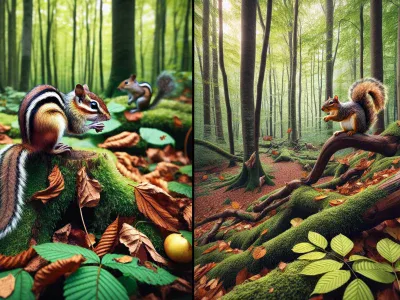
Picture this: you’re enjoying a peaceful walk in the park when a tiny creature darts across your path. Its bushy tail flicks as it scurries up a tree, while another smaller critter with stripes vanishes into the underbrush. Was it a squirrel? A chipmunk? At first glance, they seem almost interchangeable, but these woodland wonders are more distinct than you might think.
Overview Of Squirrels And Chipmunks
Squirrels and chipmunks belong to the Sciuridae family, but they differ significantly in appearance, behavior, and habitat. Understanding these distinctions helps you identify them more easily.
General Characteristics Of Squirrels
Squirrels are medium-sized rodents with bushy tails and sharp claws. They appear in diverse sizes, ranging from 5 inches to 36 inches. Most squirrels have gray, black, or brown fur, though some species exhibit red hues or albino coats. You often spot them climbing trees or running across open spaces.
Tree squirrels, for instance, live in wooded areas, building nests called dreys high in trees. Ground squirrels burrow under soil for shelter. Their diets consist of nuts, seeds, fruits, fungi, and occasionally insects. The eastern gray squirrel (Sciurus carolinensis) is common in North America, often visiting urban and suburban parks. Their agility and strong hind legs enable them to leap across tree branches efficiently.
General Characteristics Of Chipmunks
Chipmunks are small, striped rodents with compact bodies and short tails. They typically measure 4 to 11 inches, including tails. Their distinctive stripes stretch across their backs and heads, helping you differentiate them from other rodents.
Most chipmunks inhabit burrows underground, where they hoard food like acorns, grains, and berries. Unlike squirrels, which are active climbers, chipmunks stay closer to the ground and occasionally climb for food. A notable species, the eastern chipmunk (Tamias striatus), thrives in North America’s eastern regions. Their cheek pouches, which expand for carrying seeds, are an adaptation for efficient foraging.
Physical Differences
Squirrels and chipmunks, while both belonging to the Sciuridae family, display distinct physical traits that set them apart. Understanding these differences can aid in accurate identification.
Size And Body Structure
Chipmunks have compact bodies, measuring 4-7 inches in length, excluding their tails. Their tails add 3-5 inches, often making their overall body structure appear balanced. They weigh about 1-5 ounces, making them lightweight. Squirrels, but, are larger. Their bodies range from 12-20 inches, with tails adding 7-10 inches. Depending on species, their weight varies between 0.5-1.5 pounds.
Fur Patterns And Coloration
Chipmunks feature tan to brown fur with distinctive black and white longitudinal stripes running down their backs and sides. This striping helps differentiate them from squirrels. Squirrels exhibit a wider fur color range, including gray, brown, black, or red, depending on the species. Stripes are absent on squirrels, apart from the ground squirrel species, which may have faint back markings.
Tail Shape And Features
Chipmunks possess short, slender tails with less hair volume compared to squirrels, giving them a less bushy appearance. Their tails often stick straight out or rest in a downward position. In contrast, squirrels are known for their thick, bushy tails fully covered in fur. Squirrel tails serve multiple purposes, including balance, warmth, and communication, while chipmunk tails mainly add to their movement agility.
Habitat And Behavior
Squirrels and chipmunks exhibit distinct preferences for habitats and behaviors, shaped by their unique physical and ecological traits. Understanding these differences offers insights into the survival strategies of these rodents.
Preferred Habitats
Squirrels typically inhabit wooded areas, urban parks, and even suburban neighborhoods. They build nests, called dreys, in tree branches or tree cavities. These locations provide safety from predators and a vantage point to scout their surroundings. In contrast, chipmunks generally prefer forested regions, rocky terrains, and gardens. They construct underground burrows, which include food storage chambers and multiple entrances for escape. If you observe striped rodents scurrying near low shrubs, it’s probably chipmunks.
Activity Patterns
Both squirrels and chipmunks are diurnal, active during daylight hours. Squirrels spend much of their time climbing trees, leaping from branch to branch, and foraging for food like nuts and seeds. Their adaptability allows them to thrive in urban and rural environments. Chipmunks, on the other hand, actively forage near ground level. You’re likely to see them swiftly collecting acorns or berries, using their cheek pouches to transport food to their burrows. When winter arrives, squirrels rely on cached food even though occasional activity, while chipmunks enter a torpor state but wake periodically to eat from their stored provisions.
Communication And Sounds
Squirrels use their bushy tails and vocalizations like chattering, squeals, and warning calls to communicate. Their movements and sounds can alert fellow squirrels to threats like predators or territorial disputes. Chipmunks, while quieter, produce high-pitched chirps and squeaks, especially during mating season or when feeling threatened. Observing these behavioral cues, such as tail flicks in squirrels or rapid chipmunk chirps, reveals their social interactions and survival instincts.
Diet And Feeding Habits
Squirrels and chipmunks display distinct dietary patterns that align with their environments and physical adaptations. While their food choices overlap in some cases, their feeding habits highlight important differences.
Common Foods For Squirrels
Squirrels primarily consume plant-based foods, though they occasionally include animal matter in their diet. Nuts like acorns, walnuts, and pecans are staples, along with seeds from pine cones or sunflowers. Fruits such as apples, berries, and cherries also attract these animals. Leafy greens, fungi, and grains supplement their meals. When nuts are scarce, squirrels may eat small insects.
They exhibit caching behavior, burying food for future use. This trait becomes particularly noticeable in fall when they prepare for winter. If you’ve ever seen a squirrel darting across your yard and digging, it’s likely storing acorns or seeds. These animals also chew through tough nut shells with their sharp incisors to access the nutrient-rich contents inside.
Common Foods For Chipmunks
Chipmunks prefer a more varied diet compared to squirrels, even though their smaller size. They feast on seeds, grains, nuts, and fruits like blueberries or raspberries. Insects, small amphibians, and bird eggs make up a portion of their protein sources. You might also spot them eating mushrooms or even shoots from garden plants.
Their cheek pouches allow efficient foraging. Chipmunks collect food quickly and transport it to their burrows for storage, creating caches that enable survival during colder months. Unlike squirrels, they focus more on underground storage rather than scattering resources. Watching a chipmunk fill its cheeks with sunflower seeds is both fascinating and a reminder of how their adaptations suit their lifestyle.
Reproduction And Lifespan
Squirrels and chipmunks differ significantly in their reproductive behaviors and life expectancies. Their unique traits ensure survival and adaptation in diverse environments.
Mating And Breeding Cycles
Squirrels typically mate twice a year—late winter and midsummer—allowing them to align reproduction with seasonal changes. Females gestate for 38-46 days, birthing 2-5 young in tree nests. Infant squirrels are born hairless and blind but develop rapidly, starting to leave the nest around 8-10 weeks.
Chipmunks, mating only once or twice annually, prefer early spring and late summer. Females gestate for 30-33 days and produce 2-8 offspring per litter. Newborn chipmunks emerge from underground burrows after 4-6 weeks, showcasing their readiness to explore the environment.
Environmental conditions influence breeding cycles, particularly food availability and climate. Both species exhibit parental protection, with females primarily taking responsibility for young during vulnerable early stages.
Lifespan Variations
Squirrels in the wild generally live 6-12 years depending on species, predation, and habitat conditions, though urban squirrels can thrive longer due to human proximity. For instance, gray squirrels average 6 years, while some can survive up to 20 years in captivity.
Chipmunks exhibit shorter lifespans, averaging 2-5 years in the wild. They face higher predation risks, but in captivity, lifespans extend closer to 8 years. Eastern chipmunks, for example, typically live 2-3 years in natural settings.
Both species face threats from predators, disease, and environmental factors, which impact survival rates. Effective use of shelters like dreys or burrows helps some evade threats, demonstrating their evolutionary adaptations.
Conclusion
Understanding the differences between squirrels and chipmunks allows you to appreciate the unique traits of each species. From their physical characteristics to their habitats and behaviors, these small animals offer fascinating insights into the natural world around you. Next time you spot a bushy tail darting up a tree or a striped critter scurrying along the ground, you’ll know exactly who’s who and what makes them special.
Published: October 11, 2024 at 11:19 pm by Ellie B, Site owner & Publisher
To provide the best experiences, we use technologies like cookies to store and/or access device information. Consenting to these technologies will allow us to process data such as browsing behaviour or unique IDs on this site. Not consenting or withdrawing consent, may adversely affect certain features and functions.
Functional
Always active
The technical storage or access is strictly necessary for the legitimate purpose of enabling the use of a specific service explicitly requested by the subscriber or user, or for the sole purpose of carrying out the transmission of a communication over an electronic communications network.
Preferences
The technical storage or access is necessary for the legitimate purpose of storing preferences that are not requested by the subscriber or user.
Statistics
The technical storage or access that is used exclusively for statistical purposes.The technical storage or access that is used exclusively for anonymous statistical purposes. Without a subpoena, voluntary compliance on the part of your Internet Service Provider, or additional records from a third party, information stored or retrieved for this purpose alone cannot usually be used to identify you.
Marketing
The technical storage or access is required to create user profiles to send advertising, or to track the user on a website or across several websites for similar marketing purposes.