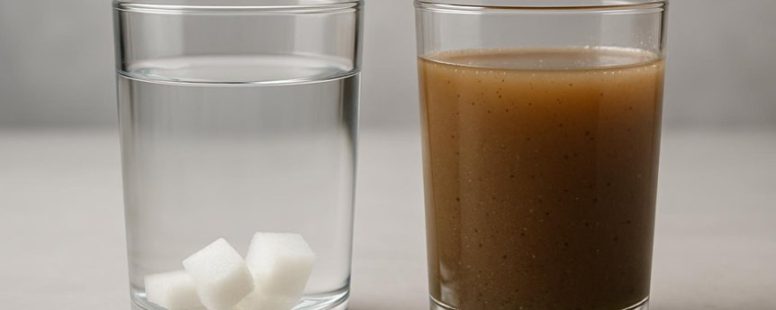
Imagine stirring sugar into a steaming cup of tea, watching it dissolve into a sweet, clear liquid. Now picture muddy water—how it clouds and settles into a murky layer. These everyday scenes reveal the fascinating world of solutions and suspensions.
While solutions like sugar in tea stay transparent and smooth, suspensions such as muddy water drift and eventually settle, revealing their true nature. Understanding these differences is like unlocking a secret code of how mixtures behave—knowledge that can turn your everyday observations into a window of discovery.
Surprisingly, knowing whether a mixture will clear or settle can help in areas from medicine to environmental science, making this small insight a powerful tool in everyday life.
Identify a Solution vs Suspension: Quick Definitions and Signals
A solution is a mixture where one substance dissolves completely in another, making it look clear and uniform. For example, sugar dissolving in tea creates a solution that you cannot see the sugar particles anymore. A suspension, on the other hand, has larger particles that do not dissolve fully. These particles can be seen and may settle at the bottom over time. Think of muddy water: it looks cloudy because of particles floating around, but if you let it sit, the dirt will sink to the bottom. When you shake a suspension, it often mixes again temporarily, but the particles will settle out again after a while.
To tell the difference quickly, look at the mixture’s clarity and how particles behave. If it looks clear and you can’t see any particles, it’s probably a solution. If it looks cloudy or opaque and you see bits floating or settling, it’s a suspension. Also, shake the container. If it mixes up but then settles again, it’s a suspension.
Some mixtures can be tricky. For example, paint is a suspension because the pigments are large particles that can settle out. But saltwater is a solution because the salt dissolves completely and stays mixed.
Why Substances Dissolve or Settle: Core Mechanisms at Work
The main reason substances dissolve or settle is because of how particles interact with each other. When particles are attracted to each other, they can either stay mixed or separate. If the forces pulling particles apart are strong enough, the substance will dissolve or stay mixed. If the forces are weaker, particles may settle out and form layers.
For example, sugar dissolves in water because the water molecules pull apart the sugar particles, spreading them evenly. But sand does not dissolve; instead, it settles at the bottom because the particles are too heavy and are not pulled apart by the water.
Whether a substance dissolves or settles depends on the balance of these forces. If the attraction between particles and the liquid is stronger than the force holding them together, the substance dissolves. If not, particles settle out. This is why some liquids mix easily while others do not.
There are two main points to remember: First, particles are more likely to dissolve if they are attracted to the liquid. Second, particles will settle if they are too heavy or not attracted enough to stay mixed. Both views have their limits because temperature, pressure, and particle size can change how well substances dissolve or settle. For example, heating water can help sugar dissolve faster, but it won’t make sand dissolve.
Particle Interactions Attract
Particles that attract each other pull closer when they interact. This pull affects how substances behave, like whether they dissolve or settle. Here is what you need to know:
Attraction helps dissolve substances when the particles of the solvent (the liquid doing the dissolving) and the solute (what is being dissolved) easily stick together. This creates new interactions that hold the particles together in a solution. For example, sugar dissolves in tea because the sugar particles and tea molecules attract each other.
When attraction is weak, particles tend to stay clumped together or settle out of the mixture. Think of how muddy water looks when dirt particles settle at the bottom because they do not stick well to the water.
Strong and specific attractions can speed up chemical reactions. For example, in some medicines, certain particles are designed to interact quickly with the body. However, if particles attract too strongly, they might stick together and not spread out, which can slow down the process.
Some scientists say that attraction is key to understanding how materials mix and react. Others warn that too much attraction can cause particles to stick and not dissolve properly. Knowing when particles attract enough or too much can help us make better medicines, foods, and cleaning products.
Solubility and Sedimentation
Solubility and sedimentation are about how particles behave in a liquid. Solubility is when particles dissolve and spread evenly in the liquid, creating a clear mixture. Sedimentation is when particles settle at the bottom over time because they are heavier or don’t fully dissolve.
When a substance dissolves, chemical reactions or physical traits help particles break apart and mix well. For example, sugar dissolves easily in hot tea because heat helps the sugar particles spread out faster. On the other hand, sedimentation happens when particles are too heavy or not mixed well. Gravity pulls these particles down, making a layer at the bottom. For example, muddy water shows sedimentation when the dirt settles after a while.
The speed of these processes depends on things like temperature, shaking, and particle size. Heating water makes substances dissolve faster. Stirring or shaking helps particles spread out more evenly. Smaller particles dissolve quicker because they have more surface area in contact with the liquid. But larger particles tend to settle faster because they are heavier.
Understanding solubility and sedimentation helps us know why some drinks stay clear while others turn cloudy. It also explains why some medicines dissolve easily in your stomach, while others settle and need shaking. Both processes are important in science and everyday life, like in making beverages, cleaning, or even in environmental studies. However, keep in mind that not all particles will dissolve or settle at the same rate. Some materials might never fully dissolve, no matter how long you wait or how much you stir.
Three Easy At-Home Tests for Solution vs Suspension
Here are three easy tests you can do at home to find out if a mixture is a solution or a suspension. These simple checks help you understand what’s happening with the particles in the mixture, based on how they behave.
1) Check if particles settle. If the particles sink to the bottom quickly, it is probably a suspension. For example, if you mix sand in water and the sand falls to the bottom after a few minutes, that’s a suspension. Solutions like saltwater don’t have particles that settle out easily. They stay mixed for a long time.
2) Stir and see if the mixture stays clear. When you stir a solution like sugar in tea, it stays clear and uniform. But if you stir a suspension like muddy water, the particles might spread out but then settle again. This means suspensions don’t stay evenly mixed without stirring.
3) Use a filter to test. Pour the mixture through a coffee filter or paper towel. If the liquid passes through without solids left behind, it is a solution. If tiny bits or solids stay on the filter, it is a suspension. For example, coffee filters work well to separate coffee from grounds, which are particles.
These tests help you tell the difference without fancy equipment. Remember, some mixtures can be tricky. For instance, some suspensions settle very slowly, making them look like solutions. Also, filtering might not catch super tiny particles, so these tests aren’t perfect.
Try these checks with different mixtures around your house. You might be surprised how many mixtures you can identify just by observing and simple testing!
Real-World Examples: Coffee, Sugar in Water, Muddy Water-What to Look For
When you look at coffee, sugar in water, and muddy water, the key thing to notice is what happens to the particles over time. A true solution, like sugar dissolved in water, stays clear because the tiny particles spread out evenly and do not settle. On the other hand, in a suspension like muddy water, larger particles float around but will eventually settle at the bottom if you wait long enough.
Understanding how particles behave helps you tell the difference between a solution and a suspension. For example, if you stir sugar into tea, it dissolves quickly and stays mixed, showing it’s a true solution. But if you stir dirt into water, the dirt floats around but will settle, showing it’s a suspension.
Sometimes, particles stay mixed for a while but then settle out, which means it’s a suspension. Other times, the particles stay evenly spread, which means it’s a true solution. Watching this process can help you see if a liquid is clear or cloudy and understand why.
Observing Particle Separation
Particles separate in different ways, and seeing this helps you understand the difference between a solution and a suspension. A solution has tiny particles that stay evenly spread out, so you don’t see any settling. A suspension has larger particles that float or sink over time, showing visible separation.
For example, if you put sugar in water, the sugar dissolves into tiny molecules that mix evenly. Even if you stir it, the sugar stays spread out, and no particles settle. But muddy water has big dirt particles that float or settle quickly. When left alone, you see the muddy water clear in some parts and muddy in others. This shows it is a suspension.
Agitation, or stirring, can change how these mixtures look. Stirring helps dissolve sugar better, but it won’t make muddy particles stay mixed. The size of the particles and how they bond chemically also affect how stable the mixture is. Larger particles tend to settle faster, and stronger bonds keep particles mixed longer.
Here are some tips to observe particle separation:
Watch how sugar in water stays clear and invisible even when stirred, showing it is a solution.
Try shaking or stirring both mixtures. You will see that solutions stay mixed longer, but suspensions settle quickly again.
Seeing these differences helps you understand how different mixtures behave. Some mixtures are stable, like sugar in water, while others, like muddy water, separate quickly. Knowing this can help you in cooking, cleaning, or even understanding how medicines work. Just remember, some mixtures might look similar but behave very different over time.
Clarity Through Settling
Clarity is a clear sign of what’s happening inside a mixture. When you see a liquid become see-through, it shows how particles are settling out. Settling is a physical process, not a chemical change. This means it depends on physical factors like particle size, density, and how thick or runny the liquid is.
For example, when you make coffee and let it sit, the grounds settle to the bottom. The faster the particles settle, the larger or more clumped they are. If sugar is added to water and it clears quickly, the sugar dissolves evenly. But if muddy water takes a long time to clear, the particles are bigger or stick together more.
Watching how quickly particles settle helps you understand what kind of mixture you have. If it clears slowly, it might have bigger particles or be less stable. If it clears fast, the mixture is finer or more evenly spread out.
Some people might think that clarity always means a chemical change. But often, it’s just physical settling. Knowing this helps you decide what to do next. For example, if you want clear water, you might need to shake or filter it first.
However, there are limits. Settling can be slow or incomplete if particles are tiny or stick together. In some cases, you might need special tools or chemicals to help clear the mixture faster. So, observing settling is helpful but not always enough to fully analyze a mixture.
In short, clarity through settling gives a simple way to see what’s happening inside a mixture. It helps tell if particles are big or small, and how stable the mixture is. But remember, it only shows physical changes, not chemical ones.
How Particle Size Affects Clarity and Visibility
Particle size is a key factor in how clear a liquid looks and how easy it is to see through. Smaller particles let more light pass with less scattering, making the solution look clearer and objects behind it easier to see. Larger particles scatter more light, turning the liquid cloudy or hazy, which makes it harder to see through. Think of it like looking through a window: if the glass is clean and smooth, you see clearly. If it’s foggy or dirty, your view is blocked.
Here are three main points about how particle size affects visibility:
Small particles make liquids clearer because they do not scatter much light. You can see objects well beneath the surface. For example, bottled water with tiny mineral particles looks transparent and clean.
Medium particles cause some haziness. They scatter more light than small particles, so details become harder to see. This is like looking through a glass of juice with pulp—some parts are visible, but it’s not perfectly clear.
Large particles create a suspension that looks cloudy or murky. They block your view quickly and may cause the liquid to separate over time. Think of muddy water or a thick smoothie with big fruit chunks; it’s obvious that the liquid isn’t clear.
Understanding particle size helps in many ways. It can tell you if a solution is clean enough, help you compare different samples, or decide if you need to stir or filter to improve visibility. For example, if you want clear lemonade, you may need to filter out larger pulp particles.
Keep in mind, smaller particles are better for clarity but may stay suspended longer, making the liquid cloudy over time. Larger particles are easier to remove but cause immediate cloudiness. Knowing this can save you time and effort when preparing solutions or cleaning liquids.
Stability Over Time: Staying Dissolved vs Gradually Settling Out
Stability over time means whether a mixture stays the same or changes as time passes. A solution that stays dissolved keeps the solid evenly spread in the liquid. This makes the mixture clear and uniform. On the other hand, if the solute tends to settle, the solid slowly separates and forms a layer at the bottom. This can happen even if you don’t stir the mixture.
Some substances can change even without stirring. For example, they might react chemically or change phase. Temperature or pressure changes can also make dissolved substances crystallize out. This means they turn back into solid and settle or form crystals. Sometimes, even if a substance stays dissolved, it can shift into another phase if the system reaches a new balance.
Understanding how solutions behave over time helps predict if a mixture will stay even or separate. For instance, in making drinks like iced tea, keeping the sugar dissolved makes a clear, sweet drink. But if the sugar settles, it’s not as nice to look at or taste.
There are two points of view. Some believe that solutions should stay stable for the best results, especially in science or manufacturing. Others say some settling or crystallization is okay if it doesn’t affect the product’s use.
A warning is that even solutions that seem stable can change later. So, it’s good to check how long a mixture stays uniform. Knowing this helps avoid surprises, especially when precision matters.
Stirring Behavior: How Solutions and Suspensions Respond to Agitation
When you stir a mixture, it helps you see if it is a solution or a suspension. A solution stays clear and even no matter how much you stir. A suspension, on the other hand, needs constant shaking or stirring to keep its particles from settling at the bottom. For example, if you mix sugar in water, the sugar dissolves and the water stays clear. But if you mix sand in water, the sand will settle to the bottom if you leave it alone. Shake a suspension and you can see the particles spread out again temporarily, but they will settle back down if you stop moving it.
Agitation affects how clear the mixture looks and how fast particles settle. Solutions are usually clear and stay that way even if you don’t stir them much. Suspensions may look cloudy or murky if they are still, but become clearer when shaken. This is a clue to tell them apart.
Some people might prefer solutions because they stay mixed longer without stirring, like saltwater used in cooking. Others may choose suspensions, such as paint, which needs to be stirred to keep the color even. But remember, suspensions can settle out quickly if left still, so they need constant motion to stay mixed.
In everyday life, stirring helps you see if you’re dealing with a solution or a suspension. Just think about what happens when you shake up a bottle of salad dressing. If it mixes back up easily, it’s a suspension. If it stays clear and uniform, it’s a solution. Both types of mixtures work differently and are useful in many ways.
Agitation Effects On Mixtures
Agitation is when you stir, shake, or mix a substance to make its particles move more. This movement helps particles spread out evenly and makes reactions happen faster. For example, stirring coffee helps dissolve the sugar quickly, and stirring muddy water keeps the dirt from settling to the bottom.
When you agitate a mixture, it speeds up diffusion, which is how particles spread from an area of high concentration to low concentration. This is helpful in many everyday tasks, like mixing paint or preparing medicine. Agitation can also change how chemical reactions happen by bringing reactants together more often.
In suspensions, stirring keeps particles from clumping together and settling out. But be careful—stirring too vigorously can cause problems. For example, it may emulsify oils in water, creating a new mixture, or even break a mixture into different layers. Gentle stirring keeps things stable, while aggressive stirring may change the outcome or damage the mixture.
There are two main points to remember about agitation. First, it helps mix things evenly and speeds up interactions between particles. Second, the speed of stirring affects what happens. Too slow, and particles might not spread well; too fast, and you might cause unwanted changes.
Some people might think vigorous stirring is always better. But in some cases, gentle stirring is best because it keeps mixtures stable. For example, when making salad dressings, gentle stirring prevents breaking the emulsion. On the other hand, if you want a quick solution, stirring faster can help.
Shake To Distinguish Phases
Shake to tell the difference between a solution and a suspension. A solution is a mix where particles are evenly spread out and stay that way. When you shake it, nothing much changes because the particles are already mixed and bonded chemically. For example, sugar in water is a solution.
A suspension is different. It has larger particles that are not evenly spread. When you shake a suspension, you break apart clumps and make the mixture look uniform for a moment. But soon, the larger particles settle back down. For example, muddy water is a suspension that separates over time.
To test if a mixture is a solution or a suspension, just shake it and watch. If nothing changes and it stays clear or evenly mixed, it’s a solution. If it looks cloudy or the particles float up or settle down, it’s a suspension.
Some people might think that shaking always mixes things well. But in suspensions, the particles are heavy and tend to settle again. That’s why shaking only gives a temporary look of uniformity.
Suspension Settling Versus Solution Clarity
When you stir or shake a mixture, you can see a clear difference between suspensions and solutions. A suspension is a mixture where particles are floating around but will settle over time. For example, muddy water looks cloudy at first but clears up after sitting. Sometimes the particles settle and make the liquid darker or cloudy again. This shows that suspensions are not evenly mixed and are physical mixtures that change with time.
A solution is different. When you stir salt into water, the salt dissolves and spreads evenly. The liquid stays clear and uniform no matter how much you shake it. Solutions stay the same because the particles are mixed at a tiny level, called the molecular level. They don’t settle or separate easily. This makes solutions stable and clear for longer.
The difference in how fast they settle or stay clear helps us tell them apart. Suspensions settle quickly, sometimes in minutes or hours. Solutions stay mixed and clear for long periods unless something special happens. This is useful in cleaning, cooking, or even in science experiments. For example, when making juice, fruit pulp is a suspension that settles out, but sugar dissolved in tea is a solution that stays clear.
Some people might think that all mixtures behave the same when shaken. But understanding if a mixture is a suspension or solution helps you predict what will happen next. If you see particles floating and settling, it’s probably a suspension. If it stays clear and uniform, it’s a solution. Knowing this can save you time and effort in everyday tasks.
However, it’s good to remember that some suspensions take longer to settle or may stay cloudy for a while. And in some cases, solutions can become cloudy if they are mixed with other substances. So, while these rules work most of the time, there are exceptions. Knowing the basic difference helps, but always watch what actually happens in your mixture.
Temperature and Mixing: When Heat Helps or Hinders Dissolution
Temperature and mixing are key to dissolving substances smoothly. Heat can help dissolve things faster because it makes molecules move more quickly. For example, warm water helps sugar dissolve faster than cold water. But too much heat or stirring too vigorously can cause problems. High heat might make some substances break down or clump together instead of dissolving evenly. Similarly, rough stirring can trap air or create cloudy mixtures, which means the substance isn’t dissolving properly.
Here’s how to get the best results. First, start with warm, not boiling, water for most solids. This helps the solute dissolve faster without damaging it. Second, stir gently but steadily. This stops clumps from forming and keeps the mixture smooth. If you’re dissolving something like salt or sugar, adding heat and stirring slowly works best. For liquids, heating can change how easily they mix, but sometimes it makes them too thin or too thick to stir well.
Some people think more heat always means better dissolving, but that’s not true for every substance. For example, some medicines or food ingredients can break down if heated too much. So, it’s good to know what you are working with.
In the real world, try starting with warm water and gentle stirring. If it takes too long, carefully increase the temperature and keep stirring gently. This way, you get a clear, uniform solution without settling residue or clumps. Remember, patience and the right heat make dissolving easier and safer.
Quick Diagnostic Checklist You Can Memorize
Quick Diagnostic Checklist for Solubility Problems
When you want to find out why a substance isn’t dissolving properly, use this simple checklist. It helps you see what’s happening and figure out the problem quickly.
First, look at the solution. Is it clear and uniform, or are there clumps or particles floating around? If it looks cloudy or there are particles, the substance might not be fully dissolved. For example, if you mix sugar into tea and see grains at the bottom, it’s not dissolved.
Next, check the temperature and stirring. Higher temperatures often help solids dissolve better. If you’re stirring slowly or not at all, the solution might take longer to dissolve. For example, stirring sugar into hot coffee helps it dissolve faster than in cold tea.
Then, watch for settling or clumping. If particles settle at the bottom or stick together, it could mean the solution isn’t stable or the substance isn’t compatible with the liquid. Sometimes adding a little acid or adjusting pH can help, especially with chemical reactions.
Finally, confirm if the liquid stays clear after some time. If it turns cloudy or particles reappear, the solution may have reacted or the solute may be reacting with the liquid. For example, adding salt to water usually keeps it clear, but certain chemicals can cause cloudiness or precipitates.
Key Takeaways: Spotting the Difference in Daily Life
Knowing how to spot the difference in daily life is helpful. First, a mixture is a combination of substances that can be separated easily, like salad or salt water. A chemical reaction is when substances change into new ones, often producing bubbles or heat.
For example, if you stir a drink and it looks clear and uniform, it might be a true solution. But sometimes, tiny particles stay mixed and can only be seen with a microscope. This shows it is a suspension, like muddy water. In contrast, a clear beverage usually means the particles are so small they are not visible, so it’s a true solution.
Look for clues like bubbles, heat, or color changes. These are signs of chemical reactions happening. For example, when baking soda reacts with vinegar, it makes bubbles and releases gas. That’s a chemical change. Meanwhile, if a liquid looks the same from top to bottom and doesn’t settle, it’s probably a mixture like juice or soda.
To get better at spotting these differences, follow these steps: First, check if the substance looks uniform or if parts settle out. Second, see if bubbles or heat are produced—these hint at a chemical change. Third, use a microscope if you can to see tiny particles.
Be careful though. Some mixtures can look clear but still contain tiny particles that only a microscope shows. Also, not all bubbling or heat means a chemical change—sometimes physical processes cause these signs.
Practicing these tricks can help you understand what you see in everyday life, whether it’s checking if a drink is really clear or noticing a chemical reaction in your kitchen. Recognizing the difference makes you smarter about the stuff around you.
To provide the best experiences, we use technologies like cookies to store and/or access device information. Consenting to these technologies will allow us to process data such as browsing behaviour or unique IDs on this site. Not consenting or withdrawing consent, may adversely affect certain features and functions.
Functional
Always active
The technical storage or access is strictly necessary for the legitimate purpose of enabling the use of a specific service explicitly requested by the subscriber or user, or for the sole purpose of carrying out the transmission of a communication over an electronic communications network.
Preferences
The technical storage or access is necessary for the legitimate purpose of storing preferences that are not requested by the subscriber or user.
Statistics
The technical storage or access that is used exclusively for statistical purposes.The technical storage or access that is used exclusively for anonymous statistical purposes. Without a subpoena, voluntary compliance on the part of your Internet Service Provider, or additional records from a third party, information stored or retrieved for this purpose alone cannot usually be used to identify you.
Marketing
The technical storage or access is required to create user profiles to send advertising, or to track the user on a website or across several websites for similar marketing purposes.