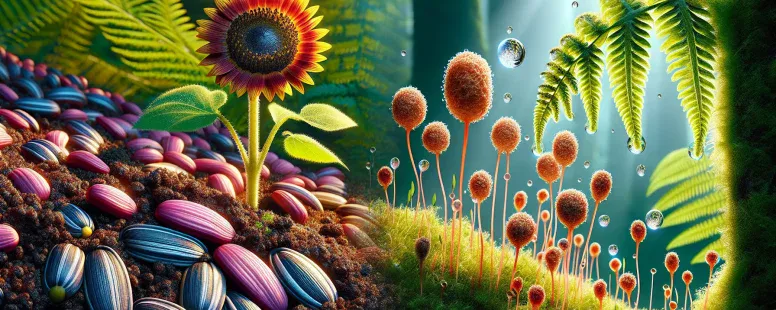
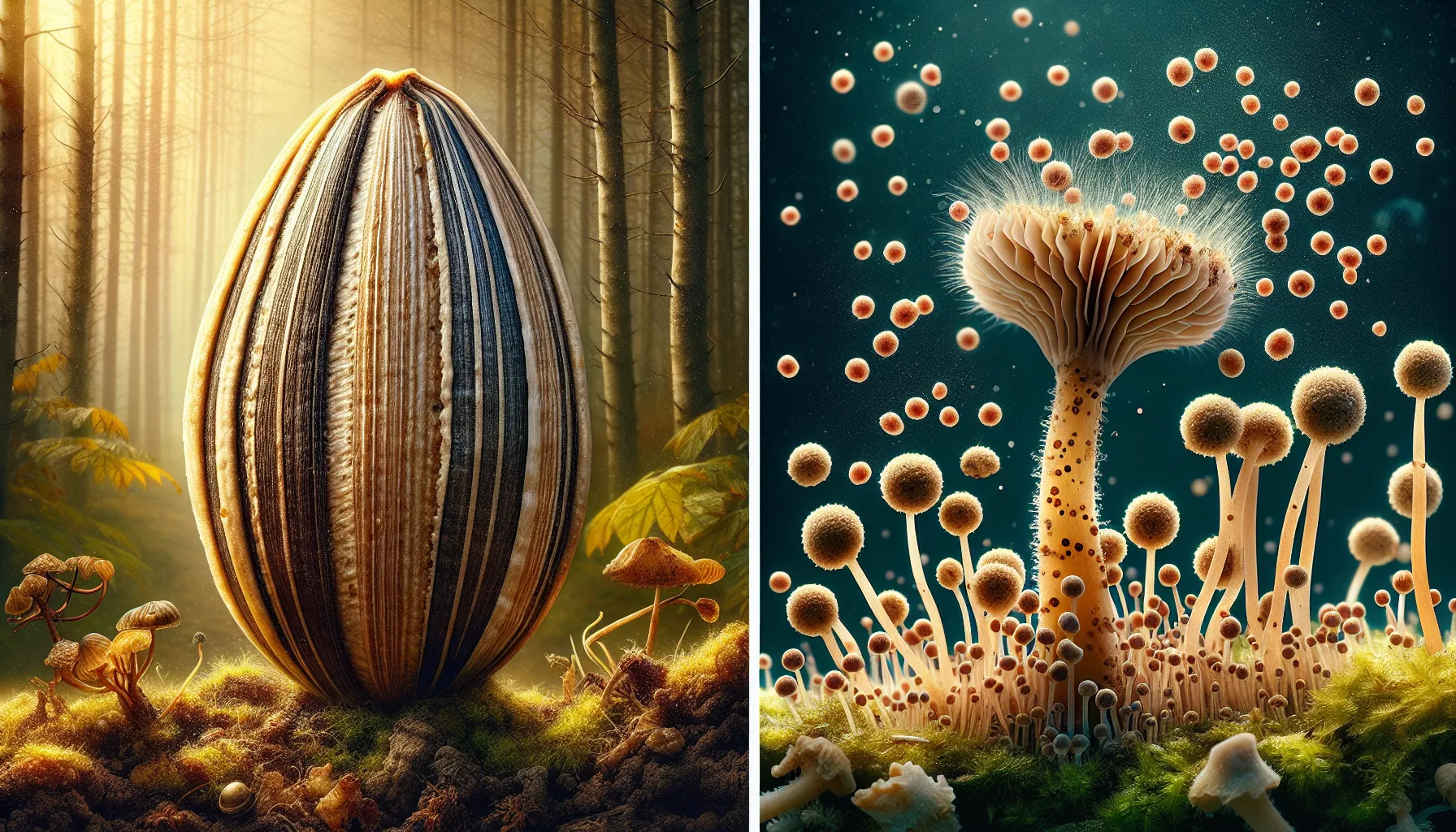
Have you ever found yourself admiring the fascinating variety of plants and fungi that populate our world? Each organism, from towering trees to microscopic molds, employs unique strategies to ensure its survival and reproduction. Among these strategies, seeds and spores represent two distinct mechanisms of propagating life. But have you ever paused to wonder: what truly distinguishes a seed from a spore?
Understanding Seeds and Spores
Definition and Biological Role of a Seed
A seed is a complex structure produced by flowering and cone-bearing plants, containing an embryonic plant, a protective outer coat, and stored nutrients to support germination and initial growth. This intricate composition allows seeds to remain dormant under unfavorable conditions, awaiting the opportune moment to sprout and thrive.
Definition and Biological Role of a Spore
A spore serves as a reproductive unit for a wide array of organisms, such as fungi, mosses, and ferns. Unlike seeds, spores are microscopic and typically consist of just one or a few cells. While they lack stored nutrients, their small size and simplicity enable mass production and broad dispersion, increasing the likelihood of finding suitable growth conditions.
Key Differences Between Seeds and Spores
Size and Structure
Seeds are macroscopic and often visible to the naked eye, typically comprising an embryo, nutrient reserves, and a protective casing. Spores, in contrast, are microscopic, consisting of a singular cell or a small cluster of cells, without additional nourishment or an extensive protective layer.
Mechanism of Reproduction
Seeds emerge from sexual reproduction in gymnosperms and angiosperms, while spores are products of both sexual and asexual reproductive strategies in fungi, algae, and non-vascular plants.
Adaptations for Dispersal
Seeds often rely on mechanisms like animals, wind, and water for dispersal, equipped with adaptations such as wings, fruit encasements, or sticky coatings. Spores, because of their lightweight and diminutive size, are primarily wind-dispersed and designed for widespread distribution.
Advantages and Limitations of Seeds and Spores
Adaptation to Specific Environments
Seeds offer a significant advantage for surviving harsh conditions due to their durable outer coats and nutritious content. Spores, on the other hand, excel in colonizing new or rapidly changing environments due to their sheer numbers and dispersal capacity.
Implications for Survival and Propagation
While seeds ensure the development of a robust individual through their nutrient reserves, spores rely on quantity and adaptability, with only a fraction finding optimal growth conditions yet successfully perpetuate the species.
Examples of Seed and Spore-Producing Organisms
Seed-producing organisms include flowering plants, such as sunflowers, and conifers like pine trees, which use seeds to propagate their species. In contrast, spore-producing organisms include fungi like mushrooms, ferns spread through spores developed in sori, and algae where spores help survival in aquatic habitats.
To provide the best experiences, we use technologies like cookies to store and/or access device information. Consenting to these technologies will allow us to process data such as browsing behaviour or unique IDs on this site. Not consenting or withdrawing consent, may adversely affect certain features and functions.
Functional
Always active
The technical storage or access is strictly necessary for the legitimate purpose of enabling the use of a specific service explicitly requested by the subscriber or user, or for the sole purpose of carrying out the transmission of a communication over an electronic communications network.
Preferences
The technical storage or access is necessary for the legitimate purpose of storing preferences that are not requested by the subscriber or user.
Statistics
The technical storage or access that is used exclusively for statistical purposes.The technical storage or access that is used exclusively for anonymous statistical purposes. Without a subpoena, voluntary compliance on the part of your Internet Service Provider, or additional records from a third party, information stored or retrieved for this purpose alone cannot usually be used to identify you.
Marketing
The technical storage or access is required to create user profiles to send advertising, or to track the user on a website or across several websites for similar marketing purposes.