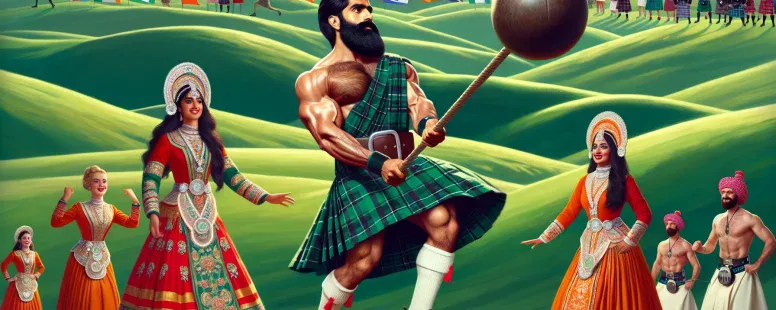
Picture yourself wandering through rolling green hills shrouded in morning mist. The air hums with ancient stories—some whispered in a lilting brogue, others sung in a sharp, melodic burr. You pause, curious. Are those voices Scottish or Irish? The answer isn’t always obvious, even to a keen ear.
Diving into the world of Scots and Irish, you’ll discover more than just accents or tartans. These cultures pulse with unique traditions, languages, and histories that have shaped their people in ways you might not expect. Unraveling the differences between them can unlock a deeper appreciation for their music, folklore, and even the way they see the world. Ready to explore the subtle threads that set them apart?
Historical Origins of Scots and Irish
Grasping the historical origins of Scots and Irish draws you into centuries of migrations, alliances, and layered linguistic roots. Scots, shaped by the Germanic tongue of the Anglo-Saxons, anchors itself in the Lowlands where agriculture bustled and commerce thrived. Meanwhile, Irish forms the oldest branch of Insular Celtic, echoing across windswept hills and remote stone circles—Gaelic prayers once rising with the mist.
Picture yourself hearing echoes of Old Norse from Viking traders in Shetland, mixing with Scots words in markets, or envision priests in medieval monasteries transcribing Irish on fragile vellum. Ask yourself: what does language truly preserve, memory or identity? Your answer might shift as you trace the moment when Scottish King James VI ordered the union of the crowns in 1603, entwining destinies yet deepening distinctiveness. Oxford English Dictionary notes “brae” (Scots for hillside) and “craic” (Irish for good conversation) mark unique living expressions, never merely synonyms (OED, 2024).
If you wander into Derry, you’ll sense how Ulster Scots arose from 17th-century Planters, planting corn and accents beside Gaelic-speaking clans. Contrasting, Irish Gaelic persisted fiercely in Connemara, passed at firesides even through English suppression—some say language, like seed, outlasts storms.
Every phoneme in both languages stands as a fossil of survival and adaptation, signaling waves of invasion, trade, and policy. Consider, do you notice how “bairn” whispers Norse ancestry or how “uisce beatha” (water of life) became “whiskey,” straddling Scots and Irish tables alike?
If voices call out in Glasgow pubs, mingling “wee lass” with “sláinte,” you’re hearing living history—not just dialects, but epic poems in every exchange, where the semantic roots reveal much more than difference, weaving together your understanding of heritage and homeland.
Language and Linguistics
Scots and Irish reflect centuries of linguistic evolution, intertwining influences from Germanic and Celtic origins. Your experience of these languages shifts dramatically as you travel from Edinburgh’s cobbled streets to Galway’s windswept coast.
Key Differences in Vocabulary and Grammar
Scots and Irish diverge prominently in their lexicons and syntactic structures. Scots, derived from Northumbrian Old English, features Germanic elements—words like “bairn” (child), “ken” (know), and “greet” (cry) surface in daily speech across Glasgow and Aberdeen. Irish, rooted in Goidelic Celtic, offers expressive terms like “uisce” (water), “ceol” (music), and “craic” (fun or news); these infuse casual chats in counties such as Kerry or Mayo.
You’ll notice the grammar takes different paths. Scots verb agreement often lacks the standard -s ending familiar in English (“he walk” instead of “he walks”), reflecting historic Middle English inflectional loss (Smith, 2000). In contrast, Irish sentence order frequently places the verb at the beginning—“Itheann Séán arán” translates to “Eats John bread”, maintaining a VSO (Verb-Subject-Object) structure uncommon among most European languages (Ó Siadhail, 1989). This syntactic dissonance can bewilder even seasoned linguists and yous too.
Dialect Variations and Accents
Dialect geography paints each language in distinct hues. In Scots, Doric reigns in the northeast, Lallans colors the Lowlands, and Ulster Scots bridges the linguistic gap between Ayrshire and County Antrim. Some speakers recall swapping jokes on ferries, their accents softening or sharpening, depending on the tide and the company.
Irish splits into Munster, Connacht, and Ulster dialects, each marked by unique pronunciation of “r”, differences in verb forms, and words like “craobh” (branch) variously rendered as /kriːv/ or /krɯː/ (Hickey, 2014). Dialect boundaries often blur—you might overhear two Donegal farmers debating turf prices, their guttural “ch” sounds echoing off the hills, while Dubliners turns heads with a smoother cadance that almost echo English rhythm.
Which accent feels warmer? Listeners split—some find the musical lilt of Connemara Irish irresistible, while others marvel at the clipped vigor of Glaswegian Scots. The experience becomes a personal journey, like picking between landscapes—each varied but unmistakably their own.
Language
Example Vocabulary
Grammatical Trait
Noted Dialects
Scots
bairn, ken, greet
No -s in 3rd person singular
Doric, Lallans, Ulster Scots
Irish
uisce, ceol, craic
Verb first (VSO) order
Munster, Connacht, Ulster
Listen closely as language shapes memory and belonging. Accents and phrases reveal a tapestry woven through migration, conquest, and resilience. Each utterance in Scots or Irish opens a window onto centuries of survival and adaptation—do you catch the echoes?
Cultural Traditions and Identity
You’ll find Scotland and Ireland pulse with living traditions. These customs bind families and fire the sense of identity, but diverge in melody, story, and pageantry.
Music, Dance, and Festivals
You hear the skirl of bagpipes drifting across a Scottish loch, while fiddles and bodhráns thrum at an Irish ceilidh. Scots traditions anchor themselves in ballads, pipe bands, and Highland games. In July, you’ll witness the Braemar Gathering, a spectacle of caber tossing and tartan, attracting monarchs, clans, and curious onlookers alike (VisitScotland, 2023).
Across the Irish Sea, Irish music flows into reels, jigs, and sean-nós songs. St. Patrick’s Day turns the streets of Dublin and Boston emerald, with parades echoing old migration tales. Irish stepdance, with arms taut to the sides, demands discipline and rhythmic precision, contrasting Scotland’s Highland fling with its athletic leaps and playful spontaneity.
Communities gather in pub sessions, trading melodies and Guinness—how many verses do you know by heart? Shared musical lineages spar with localized pride, as some Scots see their pipes as sounding defiance, while Irish musicians channel longing and wit into every tune.
Folklore and Storytelling
You immerse yourself in lands thick with tales: banshees wail under Irish moons, while selkies sing in Scottish mist. Rival stories compete for space in each nation’s collective memory. Scottish folklore champions chieftains and shape-shifters, with the Loch Ness Monster lurking in deep waters, a global icon since the first “sighting” in 1933 (BBC, 2021).
Ireland whispers of the Otherworld, where Tir na nÓg lies beyond the western horizon. Seanchaís (traditional storytellers) weave intricate tales of Cú Chulainn’s exploits, so people will still argue over his heroics in roadside pubs. You spot shared motifs—fairy hills, enchanted animals, fatal bargains—but distinct narrative styles emerge. Scots favor terse wit and dark humor, while Irish tales spiral in wordplay and poetic longing.
Which legend stirs your imagination: the selkie bride leaving her skin on a rocky shore, or the bean sídhe’s cry foretelling fate? Folklore breathes semantic entities into the present, shaping everything from national mascots to branded tourism, so you find yourself living the story while you walk cobbled lanes. If you listen close, you hear heritage not as a static museum but as a grammar of belonging—spun new with each retelling.
Geographic Differences
Geographic context shapes Scottish and Irish identities, intertwining their stories with land and border. Place names, climate, and regional politics all contribute unique layers, influencing both language and worldview.
Regional Distribution
Scottish people predominantly live in Scotland’s boundaries, spanning the rolling Lowlands, mountainous Highlands, and windswept islands like Skye and Orkney. Ireland splits into the Republic of Ireland and Northern Ireland, each fostering its own Irish-speaking communities—Donegal, Galway, and Kerry being vibrant Irish Gaelic hubs. If you’ve ever heard a local say “Slàinte” on Islay, or “Dia duit” in Connemara, you’re overhearing old patterns echo in new stories—dialects mapping the landscape as much as road signs.
Regional borders never stay fixed, shifting through centuries of conflict and kinship. For example, Dumfries, close to the Anglo-Scottish border, shaped a Scots accent colored by Northern English influence (cf. McClure, J.D., Scots Language Today). Meanwhile, Ulster, positioned at the northeast of Ireland, became a linguistic crossroads, where Scottish and Irish Gaelic sometimes blend, especially among Ulster Scots.
Impact of Migration and Diaspora
Migration ripples across generations, scattering traditions from Edinburgh to Boston and Cork to Chicago. If your great-grandparents spoke Scots in the shadow of Ben Nevis, their voices might linger in Appalachian twangs or New Zealand slang today. Mass emigration in the 19th century, driven by famine and industrial revolution, sent both Scots and Irish people across the globe (Mokyr, J., “Why Ireland Starved”).
You might read poetry by Robert Burns in a Nova Scotia classroom or hear Irish rebel songs at a New York pub. Diaspora communities often preserve words and customs that fade in the home country, creating snapshots of ancestral homes—sometimes frozen in time, sometimes transformed by contact with new cultures. So, is the real Scottish voice found only in Glasgow, or does it thrive in expat communities worldwide?
Relocation changed both languages. In Belfast, you’ll notice Scottish surnames alongside Gaelic street names, evidence of centuries-old migrations. Irish places like Boston or Sydney pulse with festival dances and Gaelic football, keeping voices and values alive far from their original green hills. Would traditions have survived, if migration had not carried them across the sea?
The geography of Scotland and Ireland isn’t merely scenic—it’s a living map of heritage, change, and the boundless interplay between homeland and diaspora.
Social and Political Distinctions
Social and political distinctions between Scots and Irish shape identity through heritage, governance, and symbolic traditions. Centuries of sovereignty, struggle, and adaptation color civic life, always visible in language, law, and even in the texture of daily routines.
National Symbols and Heritage
National symbols anchor Scottish and Irish identity in collective memory. You’ll see Scotland’s blue-and-white Saltire fluttering above castles, while the Irish tricolor—green, white, and orange—ripples over city halls, bridging centuries of history (National Records of Scotland, 2023; Government of Ireland, 2024). Tartan kilts and thistle motifs carry you into the mythic highlands, where Robert the Bruce outwitted the English, his legacy echoing through every ceilidh. In Ireland, the harp resounds as the country’s official emblem, immortalized in ancient manuscripts and euro coins, with the symbolism of Saint Patrick’s shamrock woven into St. Patrick’s Day celebrations everywhere from Dublin to New York.
Heritage sites punctuate both landscapes: the Standing Stones of Callanish on Lewis and the passage tombs of Newgrange in Meath. These sites, older than the pyramids, ground identity in ancestral soil. Clan gatherings still animate Scottish glens, with tartans and bagpipes summoning kinship, while the GAA (Gaelic Athletic Association) unites communities across Ireland through hurling and Gaelic football. If you’ve ever tasted Scotch whisky or Irish stout, you’ve sampled liquid heritage—each sip offers a toast to memory, and to home.
Modern Political Context
Modern political realities distinguish Scots and Irish not just by parliaments, but by aspirations and affiliations. Scotland, a part of the United Kingdom, votes in both British and devolved Scottish Parliament elections. People talk about independence with fierce passion, especially since the 2014 referendum, when 45% voted ‘Yes’ to leaving the UK (Electoral Commission, 2014). In pubs or on the Royal Mile, folk debate a future outside Westminster, citing North Sea oil and EU alignment as reasons for and against.
Ireland’s political landscape, meanwhile, reflects full sovereignty since 1922, when the Irish Free State entered history. The legacy of partition is present on both sides of the border: Northern Ireland remains in the UK, with its own Assembly, while the Republic governs itself from Dublin. If you cross from Derry into Donegal, road signs switch from miles to kilometers, English blends into Irish, and the memory of the Troubles lingers in murals and monuments. Peace agreements haven’t erased sectarian tension, but young people lead a renewal of culture and civic participation—a surge mirrored in Belfast’s murals and Galway’s festivals.
Questions hover: Would Scotland choose full independence if asked again? Will the story of Irish reconciliation inspire or caution? As history unfolds, you’ll find the answers written not just in law, but in the everyday speech and symbols that chart the course for future generations.
Conclusion
Exploring the differences between Scots and Irish opens your eyes to the depth and diversity of these neighboring cultures. When you listen closely to their languages and traditions you’ll notice the echoes of history and the strength of identity that still shape daily life.
Whether you’re drawn to a lively ceilidh or a quiet pub conversation you’ll find that every word and custom carries a story. Embracing these distinctions lets you connect more deeply with the heritage and spirit that make Scotland and Ireland truly unforgettable.
To provide the best experiences, we use technologies like cookies to store and/or access device information. Consenting to these technologies will allow us to process data such as browsing behaviour or unique IDs on this site. Not consenting or withdrawing consent, may adversely affect certain features and functions.
Functional
Always active
The technical storage or access is strictly necessary for the legitimate purpose of enabling the use of a specific service explicitly requested by the subscriber or user, or for the sole purpose of carrying out the transmission of a communication over an electronic communications network.
Preferences
The technical storage or access is necessary for the legitimate purpose of storing preferences that are not requested by the subscriber or user.
Statistics
The technical storage or access that is used exclusively for statistical purposes.The technical storage or access that is used exclusively for anonymous statistical purposes. Without a subpoena, voluntary compliance on the part of your Internet Service Provider, or additional records from a third party, information stored or retrieved for this purpose alone cannot usually be used to identify you.
Marketing
The technical storage or access is required to create user profiles to send advertising, or to track the user on a website or across several websites for similar marketing purposes.