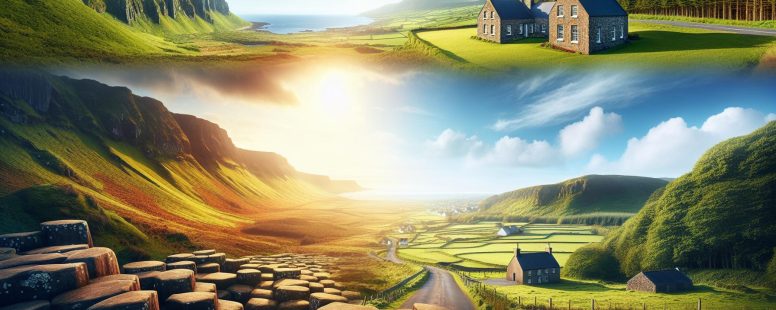
Imagine standing on a lush, emerald-green hill, the wind carrying whispers of history and culture. On one side, you hear the lilting melodies of Irish folk music; on the other, the distinct echoes of British influence. Ireland and Northern Ireland may share a name and a stunning world, but they’re worlds apart in identity, governance, and culture.
You might wonder how a single island can hold such contrasts. The answer lies in centuries of history, from ancient kingdoms to modern political divides. Whether it’s the accents, traditions, or even currencies, the differences are fascinating and often surprising. Understanding these distinctions isn’t just about geography—it’s about unraveling the rich world of two unique yet interconnected regions.
Geographic Differences
Ireland and Northern Ireland occupy the same island, but their geographic characteristics set them apart, shaping distinct identities within a shared space.
Location And Borders
Ireland comprises the Republic of Ireland and Northern Ireland. The Republic covers about 84% of the island and operates independently, while Northern Ireland, making up the remaining 16%, is part of the United Kingdom. The border between them is approximately 310 miles long, demarcating two separate political and legal systems. This seamless physical border, but, remains symbolically significant, reflecting historical divisions and contemporary cooperation.
Major cities highlight these contrasts. Dublin, the Republic’s capital, lies in the eastern region, serving as Ireland’s cultural and economic hub. Belfast, Northern Ireland’s capital, thrives in the northeast, with a legacy tied to maritime heritage and industrialization.
World And Climate
Both regions share lush green landscapes but differ in specific geographical features. Ireland boasts expansive lowlands, mountain ranges like the Wicklow Mountains, and scenic coastal inlets such as the Wild Atlantic Way. Northern Ireland, while smaller, features notable landmarks like the Giant’s Causeway, an UNESCO World Heritage Site, and Lough Neagh, the largest freshwater lake in the British Isles.
Climate variations are slight but impactful. Ireland experiences a temperate maritime climate with mild winters and cool summers, influenced by the North Atlantic Drift. Northern Ireland follows a similar pattern but exhibits slightly cooler average temperatures due to its higher latitude.
Political Structure
Ireland and Northern Ireland have distinct political systems, reflecting their historical and constitutional differences. These systems influence governance, identity, and international relationships.
Republic Of Ireland
The Republic of Ireland is a sovereign state. Its political framework operates as a parliamentary democracy under a unitary structure. The President, serving as head of state, holds a largely ceremonial role, while executive power resides with the Taoiseach (Prime Minister). The two-house legislature, the Oireachtas, consists of Dáil Éireann (lower house) and Seanad Éireann (upper house).
The Republic is part of the European Union (EU). This membership facilitates trade, travel, and economic policies that align with other EU nations. For example, the euro is the official currency, contrasting Northern Ireland, where the pound sterling is used. The 1937 Constitution established Ireland as an independent nation, further solidifying its distinct identity.
Northern Ireland Within The UK
Northern Ireland functions as a devolved region within the United Kingdom (UK). Its governance structure includes the Northern Ireland Assembly and Executive, enabling self-administration in certain domestic matters, like health and education. The UK Parliament in London retains authority over reserved issues, such as defense and foreign affairs.
Northern Ireland’s connection to the UK creates unique dynamics. Its currency is the British pound, and its political systems integrate with broader UK frameworks. The Good Friday Agreement of 1998 remains a critical milestone, promoting shared power between unionist and nationalist communities. Belfast, as the capital, acts as the administrative hub.
These structural contrasts between Ireland and Northern Ireland reflect deeper historical and ideological divisions, yet mechanisms like the Good Friday Agreement highlight their ongoing efforts at cooperation.
Cultural Variations
Cultural distinctions between Ireland and Northern Ireland reflect their unique histories and evolving identities. These differences manifest in language, traditions, and celebrations, showcasing their vibrant diversity.
Language And Dialects
Language use diverges significantly between Ireland and Northern Ireland. In the Republic of Ireland, Irish (Gaeilge) serves as the first official language, alongside English. You’ll notice Irish signs, radio stations, and even government communications emphasizing its status. Although fewer speak it fluently daily, efforts to revitalize Irish culture have intensified. For example, Gaeltacht regions, where Irish is a community’s spoken language, provide immersive cultural experiences.
In Northern Ireland, English dominates, with distinct influences from Ulster Scots. The Ulster Scots dialect, spoken in some communities, reflects a blend of Scots and English linguistic elements. Conversely, the Irish language, though present, faces limited institutional recognition compared to the Republic. So, bilingual street signs are less common. Some Northern Ireland schools and civic groups, but, promote Irish learning, reflecting gradual shifts in attitudes toward cultural heritage.
Traditions And Celebrations
Traditional practices differ, drawing from varied sociopolitical and religious legacies. In Ireland, St. Patrick’s Day is celebrated worldwide as a colorful representation of Irish heritage, marked by parades and festivals. Local customs, like music sessions in pubs and céilithe dances, also spotlight an enduring connection to Gaelic roots. Festivals like Lughnasa celebrate seasonal changes, blending folklore and rural life expressions.
In contrast, Northern Ireland interweaves British influences with local customs. The Twelfth of July, or Orangemen’s Day, stands as a key Unionist occasion, commemorating the 1690 Battle of the Boyne. Marches, bonfires, and social events illustrate this region’s identity trends. Meanwhile, nationalist communities honor traditional folk events or promote Irish-themed celebrations.
Religious dates, such as Easter and Christmas, unite the regions but symbolize varying focal points. You’ll see Northern Ireland often highlighting British ceremonial traditions during holidays, while Ireland emphasizes their integration within broader Gaelic and Catholic legacies.
Economic Distinctions
Economic landscapes in Ireland and Northern Ireland reflect their differing political alignments and historical developments. These distinctions influence everything from currency to trade networks, creating unique opportunities and challenges for each region.
Currency
The Republic of Ireland uses the euro (EUR) as its official currency, integrated with the economic structure of the European Union. This positions it within a larger economic zone, facilitating seamless trade with other EU member states. For example, businesses in Dublin benefit from eurozone-free trade agreements when dealing with countries like Germany or France.
Northern Ireland, on the other hand, retains the British pound (GBP) since it’s part of the United Kingdom. This often leads to dual-currency acceptance along the border areas. For instance, in towns near the border like Newry, both euros and pounds are commonly used, reflecting the region’s cross-border commerce. But, differences in currency systems may complicate financial transactions for companies operating across the island.
Trade And Industry
Ireland’s economy focuses on technology, pharmaceuticals, and export-driven industries. Home to multinational corporations like Google and Pfizer, its low corporate tax rate attracts global investment. Agricultural products, including beef and dairy, also form a significant part of its trade profile; approximately 90% of Ireland’s beef production is exported globally according to Bord Bia.
Northern Ireland’s economy emphasizes manufacturing, agri-food production, and a growing service sector. Aerospace companies like Bombardier operate in Belfast, showcasing its industrial prowess. Meanwhile, local growers export Northern Ireland’s staples like potatoes and whiskey to markets worldwide. The Northern Ireland Protocol, designed post-Brexit, attempts to maintain smooth trade between Northern Ireland, the UK, and the EU, though political debates over its impact on local businesses persist.
Even though these differences, cross-border collaborations thrive in sectors like tourism and renewable energy. Initiatives such as the All-Island Electricity Market highlight shared economic interests, helping both regions capitalize on their geographical proximity and cultural connections.
Historical Context
The division between Ireland and Northern Ireland stems from centuries of conflict, colonization, and political change. Understanding their historical context reveals the roots of their cultural and political differences.
Partition of Ireland
The 1921 Anglo-Irish Treaty established the partition, dividing the island into two distinct political entities. Ireland became the Irish Free State, later the Republic of Ireland, while six northern counties remained part of the United Kingdom as Northern Ireland. This division reflected deep-seated religious and political divides: the predominantly Catholic nationalist majority in the south sought independence, while the mainly Protestant unionist population in the north favored staying with the UK.
The border created lasting challenges, from economic disparities to identity conflicts. It became a symbol of division, separating communities with shared cultural ties. During the Troubles (1960s-1998), this boundary intensified sectarian violence, highlighting the complexities of coexistence.
Key Historical Events
Several historical milestones shaped the relationship between Ireland and Northern Ireland. The Easter Rising of 1916 marked a turning point in the struggle for Irish independence. Its leaders, including Patrick Pearse and James Connolly, became symbols of freedom, even as the rebellion was suppressed harshly by British forces.
The Good Friday Agreement of 1998 represents a watershed moment for peace. This accord brought nationalist and unionist communities together, establishing a power-sharing government in Northern Ireland. It exemplifies ongoing efforts to bridge historical divides through cooperation and mutual respect.
The shared history is complex, rooted in overlapping colonial, religious, and political dynamics. Events like the Plantation of Ulster in the 1600s, where English and Scottish settlers were granted land in Ireland, further deepened tensions that persist in cultural identities today.
Travel And Tourism
Both Ireland and Northern Ireland attract tourists with their breathtaking landscapes, historical sites, and cultural richness. While sharing the same island, their tourism offerings highlight distinct narratives and experiences.
Attractions In Ireland
Ireland features iconic landmarks and vibrant cities that draw millions annually. Dublin, the capital, offers a blend of historical and contemporary attractions, including Trinity College’s Long Room Library with the Book of Kells and the renowned Guinness Storehouse. The charming streets of Galway, known for traditional Irish music and festivals, provide a glimpse into the country’s lively heritage.
Rural Ireland showcases the Cliffs of Moher in County Clare, a UNESCO Global Geopark offering panoramic views of the Atlantic Ocean. The Ring of Kerry, a 111-mile scenic drive, highlights coastal and mountainous landscapes alongside small villages like Killorglin and Kenmare. Ancient history enthusiasts explore Newgrange, a 5,200-year-old passage tomb older than both Stonehenge and the Great Pyramid of Giza.
Ireland’s tourism infrastructure is integrated seamlessly, from extensive rail networks to guided tours emphasizing Gaelic culture. You’ll find local crafts, such as woolen goods from Donegal and Waterford crystal, popular among visitors. Its rich culinary scene combines traditional dishes like Irish stew with modern farm-to-table concepts.
Attractions In Northern Ireland
Northern Ireland enchants travelers with its blend of natural and cultural splendor. Belfast, the capital, is home to the Titanic Belfast Museum, an award-winning interactive exhibit within the city’s thriving Titanic Quarter. The Giant’s Causeway, a UNESCO World Heritage Site, features over 40,000 interlocking basalt columns formed over 60 million years ago.
Derry/Londonderry attracts visitors with its well-preserved 17th-century city walls and historic Bogside murals that narrate the region’s political past. Game of Thrones fans explore filming locations like Dark Hedges in Ballymoney and Ballintoy Harbor. In County Fermanagh, the Marble Arch Caves offer guided tours through an intricate underground cave system.
Northern Ireland tourism emphasizes heritage and innovation. You can experience traditional crafts, such as linen weaving, alongside local delicacies like an Ulster fry or Bushmills whiskey. Accessible transportation and cross-border flexibility enhance convenience for international travelers.
Conclusion
Understanding the differences between Ireland and Northern Ireland offers you a deeper appreciation of their unique identities, shaped by history, politics, and culture. Even though their contrasts, these regions share a rich heritage and interconnectedness that make them both fascinating to explore. Whether you’re drawn to the vibrant cities, breathtaking landscapes, or historical landmarks, each region provides its own distinct charm and story to discover.
To provide the best experiences, we use technologies like cookies to store and/or access device information. Consenting to these technologies will allow us to process data such as browsing behaviour or unique IDs on this site. Not consenting or withdrawing consent, may adversely affect certain features and functions.
Functional
Always active
The technical storage or access is strictly necessary for the legitimate purpose of enabling the use of a specific service explicitly requested by the subscriber or user, or for the sole purpose of carrying out the transmission of a communication over an electronic communications network.
Preferences
The technical storage or access is necessary for the legitimate purpose of storing preferences that are not requested by the subscriber or user.
Statistics
The technical storage or access that is used exclusively for statistical purposes.The technical storage or access that is used exclusively for anonymous statistical purposes. Without a subpoena, voluntary compliance on the part of your Internet Service Provider, or additional records from a third party, information stored or retrieved for this purpose alone cannot usually be used to identify you.
Marketing
The technical storage or access is required to create user profiles to send advertising, or to track the user on a website or across several websites for similar marketing purposes.