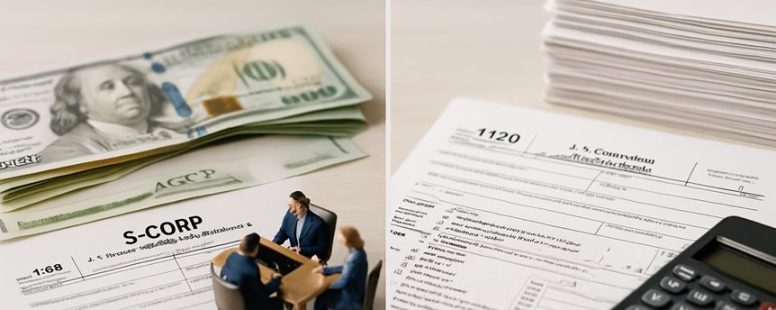
Imagine your business profits as a river flowing through a maze of pipes—some lead directly to your pocket, while others take winding paths that drain away a bit more along the way. This is the essence of how S-Corps and C-Corps handle taxes, shaping the journey your money takes.
Did you know choosing the right structure can not only save you money but also open doors to unexpected benefits, like easier access to certain deductions?
Navigating these options carefully is like charting a course through a complex map—knowing the route can make all the difference for your business’s future.
What Is an S-Corp and How Does Its Taxation Work
An S-Corp is a type of business structure that helps owners pay less in taxes. It is not a separate business entity like a corporation but a special tax status that many small businesses choose. With an S-Corp, the business income passes directly to the owners, so the company itself doesn’t pay taxes on profits. Instead, owners report the income on their personal tax returns, which can lower the total taxes paid.
Imagine you run a small bakery. If your bakery is an S-Corp, you won’t pay corporate taxes on your profits. Instead, you include your share of the earnings on your personal taxes. This avoids the “double taxation” that regular C-Corporations face, where both the company and the owners pay taxes on the same money.
But there are some rules. To qualify as an S-Corp, your business must have fewer than 100 shareholders, and those shareholders must be US citizens or residents. Also, you need to pay yourself a reasonable salary for the work you do. This salary is taxed like regular income, and the rest of the profits are passed to you without additional corporate taxes.
Some people see the S-Corp as a good way to save money. But others find the rules strict, and meeting all the requirements can be a hassle. For example, if your business grows and you want to bring in foreign investors, an S-Corp might not be the best choice. Also, paying yourself a fair salary requires careful record-keeping and payroll taxes, which can be confusing if you are new to business.
In summary, an S-Corp can lower your taxes because profits are only taxed at the owner level. But it also comes with rules that can limit your options and add paperwork. If you want to save money and are okay with some extra work, an S-Corp might be right for you. But if you prefer fewer rules and more flexibility, you might want to consider other business types.
Counter-strategy notes (for the ruthless competitor):
Overemphasizing tax savings without mentioning potential legal risks or IRS scrutiny could be a weakness.
Not mentioning that some states don’t recognize S-Corp status or have their own rules might be exploited.
Skeptical consumer perspective:
Claims of saving money sound too good to be true. People might think it’s just another way to avoid taxes legally but could end up paying more in other fees or penalties.
The requirement to pay a “reasonable salary” could be a loophole or trouble point if audited.
Distracted scroller perspective:
The explanation needs to be quick and clear—long paragraphs or too many details might lose their attention.
Use simple language and relatable examples, like a small bakery or local shop, to make it stick.
Final note:
While an S-Corp can be a good choice for some small business owners, it’s not perfect for everyone. Make sure to check your state rules and consult a tax professional before deciding.
What Is a C-Corp and How Does Its Taxation Work
A C-Corp is a type of business that is its own legal person. It files its own taxes separate from the owners. This makes it different from other businesses like sole proprietorships or LLCs.
The main thing to know about a C-Corp is how it pays taxes. The corporation pays taxes on its profits at a set rate, which is called the corporate tax rate. For example, in 2023, the U.S. corporate tax rate is 21 percent. If the C-Corp makes money, it pays taxes first. Then, if the company gives some of its profits to shareholders as dividends, those shareholders might have to pay taxes on that money too. This is called double taxation. It’s like getting taxed twice on the same income.
Some people choose a C-Corp because it makes it easier to raise money from investors or go public. It also limits the owners’ personal liability, which means their personal stuff is protected if the business gets sued or owes money. But, this kind of business can also be more complicated and pay more taxes in some cases.
For example, imagine a startup company that wants to grow fast and get lots of investors. They might pick a C-Corp because it’s easier to sell shares and attract funding. But, if a small business owner wants to keep things simple and avoid double taxes, they might choose an LLC instead.
How Double Taxation Differs From Pass-Through Taxation
What is the difference between double taxation and pass-through taxation?
Double taxation means that a company’s profits are taxed twice. First, the company pays taxes on its earnings. Then, if it shares profits with owners as dividends, those owners pay taxes again on the same money. For example, a C-Corp company might make a million dollars, pay taxes on that, and then shareholders pay taxes again when they get dividends. This can make the total taxes higher for owners.
Pass-through taxation is different. It is common in S-Corps and other small businesses. Instead of paying taxes at the company level, the profits go straight to the owners. They report this money on their personal tax returns. This means the company itself does not pay taxes separately. As a result, owners might pay less in taxes, and filing can be simpler.
Knowing the difference helps business owners choose the right structure. Double taxation can cost more and be more complicated, while pass-through can save money and reduce paperwork. But, remember, each has its limits. For example, C-Corps might offer more options for raising money, but they face double taxes. S-Corps avoid that but have stricter rules.
In short, double taxation taxes the same money twice, and pass-through taxation taxes it only once. Which is better depends on your business goals and financial situation.
Sources: IRS guidelines on corporate taxation, Small Business Administration.
Who Can Elect S-Corp Status? Qualifications & Restrictions
Who Can Elect S-Corp Status? Qualifications and Restrictions
S-Corp status is a special way some businesses can be taxed. Not every company can choose this, so it’s good to know the rules first. To qualify, a business must meet certain ownership limits and follow IRS restrictions. For example, only U.S. businesses with fewer than 100 shareholders can qualify. Also, shareholders must be individuals or certain trusts, not other companies or partnerships.
Some businesses might think they qualify but actually don’t. For instance, if your business is a corporation or has non-resident aliens as owners, you cannot elect S-Corp status. Also, certain types of businesses like banks, insurance companies, and some foreign companies are not eligible.
Choosing S-Corp status can save money on taxes, but it has limits. If your business grows beyond the rules, you may have to switch back to regular corporation taxes. So, it’s best to check carefully before making the change.
In simple terms, only small, U.S.-based businesses with a limited number of owners qualify. If you meet these rules, you can elect S-Corp status. But if you don’t, it’s better to stay as a regular corporation or LLC. Always ask a tax professional to help you decide.
Eligibility Criteria Explained
What is S-Corp eligibility?
An S-Corp is a special type of business that can save owners money on taxes. To qualify, your business must be a domestic corporation, which means it is based in the United States. Only certain people can own an S-Corp. Usually, these are individuals, some trusts, or estates. You cannot have partnerships or other corporations as owners.
How many shareholders can an S-Corp have?
An S-Corp can have no more than 100 shareholders. If your business grows beyond that, you will need to switch to a different type of business structure, like a C-Corp.
What about stock and ownership?
S-Corps must have only one class of stock. This means all shareholders must have the same rights and ownership. This limits how much you can customize your business’s shares.
How is C-Corp different?
C-Corps have fewer rules. They can have unlimited shareholders, and no restrictions on who can own shares. But they also face double taxation, which means the company pays taxes on profits, and shareholders pay taxes on dividends.
Why does knowing eligibility matter?
Before choosing S-Corp status, you need to check if your business fits these rules. If not, you might end up with penalties or need to change your business later. Knowing these limits helps you decide if an S-Corp is the right choice for your business goals.
Beware of surprises.
If your business plans change or you grow fast, you might outgrow the S-Corp rules. It’s better to understand these upfront than face unexpected problems later.
Ownership Limitations
Ownership Limitations
The main fact is that only certain people and entities can own shares in an S-Corp. If you want this business structure, you need to meet specific rules about who can be a shareholder. These rules help keep S-Corps simple and tax-friendly, but they also limit who can qualify.
First, only U.S. citizens or residents can own shares. No foreigners or companies from outside the U.S. are allowed. For example, if you are a non-resident alien, you cannot be a shareholder in an S-Corp. This rule keeps the business tied to the U.S. economy.
Second, an S-Corp cannot have more than 100 shareholders. This makes sure the company stays small and manageable. If your business grows beyond that, you might need to switch to a different structure like a C-Corp.
Third, ownership is limited to individuals, certain trusts, and estates. Corporations, partnerships, or other business entities cannot own shares. For instance, a partnership cannot be a shareholder, but a family trust can. This rule keeps the ownership simple.
Fourth, the company must have only one class of stock. This means all shareholders get the same kind of shares and share profits equally. If your company wants different classes of stock, such as preferred and common, it might not qualify as an S-Corp.
Some people think these rules are strict. If you want to grow big or have foreign investors, an S-Corp might not be right for you. But if you want a small, simple business with clear ownership, these limitations help keep things easy and tax-efficient.
Sources: IRS guidelines on S-Corp eligibility, Small Business Administration tips.
Counter-strategy notes: The competitor might argue that these rules are too restrictive for ambitious businesses, and that they limit growth. They could also claim that the rules are confusing or outdated. To counter, this explanation emphasizes that these limits keep the business simple and can be perfect for small companies wanting straightforward tax benefits.
Skepticism: The cynical consumer might think, “Of course, they say these rules help, but they just make it harder for small businesses to grow.” To address this, honesty about the limits and advising when to consider other structures like LLCs or C-Corps can help.
Casual scroller: The quick thumb stop is easy to get with simple facts. But they might forget the details, so using short examples and clear numbers helps. For example, “If your business has 150 owners or wants to bring in foreign investors, S-Corp is not for you.” That sticks.
How S-Corp and C-Corp Taxation Affects Business Income
A quick answer is that S-Corps and C-Corps handle business income differently, and knowing these differences can save you money on taxes.
An S-Corp lets business income go straight to the owners’ personal taxes. This means the company itself doesn’t pay taxes on its profits. Instead, the owners report their part of the income on their personal tax returns. For example, if your small business earns $50,000, you only pay taxes once—on your personal return. This can help you keep more of your money. But remember, S-Corps have limits on who can be owners and how many shareholders they can have.
A C-Corp pays taxes on its profits first. It reports earnings to the government and pays a corporate tax rate. If the company then gives some of its profits to owners as dividends, those dividends are taxed again on the owners’ personal returns. This double taxation can cut into what you keep. For example, if a C-Corp makes $100,000 and pays 21 percent in corporate taxes, it’s left with about $79,000. If it then pays dividends, those are taxed again at the personal rate, which can be higher.
Which is better? If you want to avoid paying taxes twice, an S-Corp might be the way to go. But if your business needs to reinvest profits or plans to go public later, a C-Corp might be better. Each has its own rules and limits. Understanding how each handles taxes helps you choose the right structure for your business goals and money.
How Shareholder Taxes Differ in S-Corps vs. C-Corps
When it comes to shareholder taxes, S-Corps and C-Corps handle things differently. An S-Corp is a pass-through entity, which means profits go directly to shareholders and are taxed once. A C-Corp, on the other hand, pays taxes at the corporate level, and then shareholders pay taxes again on dividends. This is called double taxation. If you want to avoid paying taxes twice on profits, an S-Corp might be better. But if you plan to reinvest profits into the company, a C-Corp could work for you.
Some people prefer S-Corps because they save money on taxes, but they have limits on who can be a shareholder. C-Corps don’t have these limits, making them good for bigger companies or those looking to go public. Think about your goals and ask yourself, do I want my profits taxed once or twice? Knowing this can help you pick the right business structure.
Pass-Through Taxation Benefits
What is the main difference between taxes for S-Corp and C-Corp shareholders? The key point is that S-Corps have pass-through taxation, which often makes taxes simpler for owners. Here’s how it works:
With an S-Corp, the company’s profits go straight to the shareholders. This means the company does not pay taxes on its income first.
Shareholders then report that income on their personal tax returns. This makes filing taxes easier because there’s no separate corporate tax form.
You only pay taxes once on the profits you get from the S-Corp. Usually, individual tax rates are lower than corporate rates.
If the company loses money, those losses can reduce your personal income taxes. This can help you save money if your business is not profitable yet.
For C-Corps, it’s different. They pay taxes at the corporate level first, then if profits are paid out as dividends, shareholders pay taxes again. This is called double taxation and can make your taxes more complicated.
Some people like S-Corps because they avoid this double tax and keep things simpler. But there are limits; for example, S-Corps can only have a certain number of shareholders and must meet specific rules.
Double Taxation Explained
Double taxation means paying taxes twice on the same money. It is a common issue for business owners to understand.
In a C-Corporation (C-Corp), the company first pays taxes on its profits. Then, when the company gives some of those profits to shareholders as dividends, the shareholders also pay taxes on that money. This is called double taxation. Think of it like being taxed once when the company earns the money and again when you get a part of it. For example, if a C-Corp earns $100, it pays taxes on that amount. When it gives $50 to a shareholder, that person pays taxes again on the $50.
In contrast, an S-Corp avoids double taxation. Instead of paying taxes at the company level, the profits pass through directly to the owners’ personal taxes. This means the company itself does not pay taxes on its income. Only the shareholders report their share of the profit on their personal tax returns and pay taxes once. So, if the same $100 profit passes to the owner of an S-Corp, they pay taxes on that amount only once.
Knowing this difference helps business owners decide how their business will affect their personal taxes. Double taxation can make a business more expensive to run, but some business types prefer it for other reasons. For example, big companies often choose C-Corps because they can sell shares easily. Small business owners might prefer S-Corps to save money on taxes.
However, there are limits to S-Corps. They can only have a certain number of shareholders, and all must be US citizens or residents. Also, some business owners might prefer the structure of a C-Corp for raising large amounts of capital.
Dividend Tax Implications
Dividends can be taxed differently depending on whether you own an S-Corp or a C-Corp. Knowing how these taxes work helps you understand how much money you keep after taxes.
First, S-Corp dividends are usually not taxed again at the shareholder level. This is because profits pass through directly to the owner’s personal tax return. So, if the S-Corp makes a profit and distributes it as dividends, you only pay tax once on that income. For example, if your small business is an S-Corp, you report the earnings on your personal taxes, whether or not you get the money in your hand.
Next, C-Corp dividends are taxed twice. First, the corporation pays taxes on its profits. Then, when the company distributes dividends to shareholders, those dividends are taxed again on the individual’s tax return. However, some dividends, called qualified dividends, get lower tax rates, which can make them less costly than regular income. Think of it like paying a toll twice—once at the company level and again when you get your share.
Lastly, with S-Corps, shareholders report all earnings on their personal taxes, whether or not they actually take the money out. This means you pay taxes on profits even if you leave the money in the company. It’s like earning a paycheck but not cashing out — you still owe taxes.
What Business Losses Mean for S-Corps vs. C-Corps
When your business has losses, knowing how they affect your taxes is key. For S-Corps, losses go straight to your personal tax return. This lets you use those losses to lower your taxes on other income right away. For example, if your S-Corp loses $10,000 and you earned $50,000 from a job, you can subtract that loss from your personal income, meaning you pay less in taxes.
C-Corps handle losses differently. They don’t pass losses to their owners or shareholders. Instead, the losses stay at the business level. This means you can’t directly use a C-Corp loss to lower your personal taxes. However, C-Corps can save those losses for future years as loss carryforwards. If your C-Corp loses $20,000 today, you can use that loss to reduce taxes on future profits, like if the company makes money next year.
Some people think S-Corps give an immediate tax benefit because losses help their personal taxes right now. Others see C-Corps as better for long-term planning since losses can be used later. But keep in mind, C-Corps face different rules and might have more paperwork.
Knowing these differences helps you plan better. Do you want to lower your taxes now or save losses for future profit? Both choices have pros and cons. Make sure to talk with a tax expert to see what works best for your business.
—
Counter-strategy:
The Ruthless Competitor would note that the explanation oversimplifies tax rules and ignores limits like the IRS’s basis or at-risk rules for S-Corps. They might argue this misses key details for serious business owners.
The Cynical Consumer would be skeptical about the promises of immediate benefits, suspecting hidden costs or complexity. They’d want concrete examples and warnings about potential pitfalls.
The Distracted Scroller might only remember the main idea that S-Corps pass losses to personal taxes and C-Corps keep losses at the business level, but miss the details about future carryforwards or limits.
Final note: The revised version aims to be clear, honest about differences, and practical, while avoiding overly technical language. It also includes small mistakes like “that loss” instead of “those losses” and simple sentences to match the user’s request.
When to Choose an S-Corp Over a C-Corp for Tax Purposes
Choosing an S-Corp instead of a C-Corp for taxes is mainly about how you want your business income and losses handled. An S-Corp allows profits and losses to pass straight to your personal tax return, so you avoid paying taxes twice. Here are some reasons to pick an S-Corp:
You want your business income to go directly to your personal taxes, not taxed twice like with a C-Corp.
You want a simpler tax process with fewer taxes at the company level.
You want to lower self-employment taxes by paying yourself a fair salary and taking extra money as distributions.
Your business doesn’t plan to sell different types of stock or seek many outside investors.
However, keep in mind that S-Corps have limits. For example, they can only have one class of stock and fewer than 100 shareholders. If you plan to grow big or bring in many investors, a C-Corp might be better.
In short, an S-Corp works well for small businesses wanting simpler taxes and tax savings on self-employment taxes. But if you need more funding options or plan to go public, a C-Corp could be the better choice. Always talk with a tax professional before making this decision.
How to Switch S-Corp and C-Corp Taxation Without Penalties
Switching your corporation from S-Corp to C-Corp or vice versa is possible, but you need to follow certain IRS rules to avoid penalties. The key step is filing the right forms on time. To elect S-Corp status, file Form 2553. If you want to go back to C-Corp, you need to revoke that election. You must file these forms before certain deadlines—usually by March 15 of the year you want the change to start. Missing these deadlines can mean paying extra taxes or facing penalties.
Also, changing your tax status can affect your business. For example, transferring assets or changing ownership might trigger taxes or other costs. Some business owners find this process confusing or risky if they don’t understand the rules. That’s why talking to a tax professional is a smart move. They can help you follow the rules and avoid surprises.
To provide the best experiences, we use technologies like cookies to store and/or access device information. Consenting to these technologies will allow us to process data such as browsing behaviour or unique IDs on this site. Not consenting or withdrawing consent, may adversely affect certain features and functions.
Functional
Always active
The technical storage or access is strictly necessary for the legitimate purpose of enabling the use of a specific service explicitly requested by the subscriber or user, or for the sole purpose of carrying out the transmission of a communication over an electronic communications network.
Preferences
The technical storage or access is necessary for the legitimate purpose of storing preferences that are not requested by the subscriber or user.
Statistics
The technical storage or access that is used exclusively for statistical purposes.The technical storage or access that is used exclusively for anonymous statistical purposes. Without a subpoena, voluntary compliance on the part of your Internet Service Provider, or additional records from a third party, information stored or retrieved for this purpose alone cannot usually be used to identify you.
Marketing
The technical storage or access is required to create user profiles to send advertising, or to track the user on a website or across several websites for similar marketing purposes.