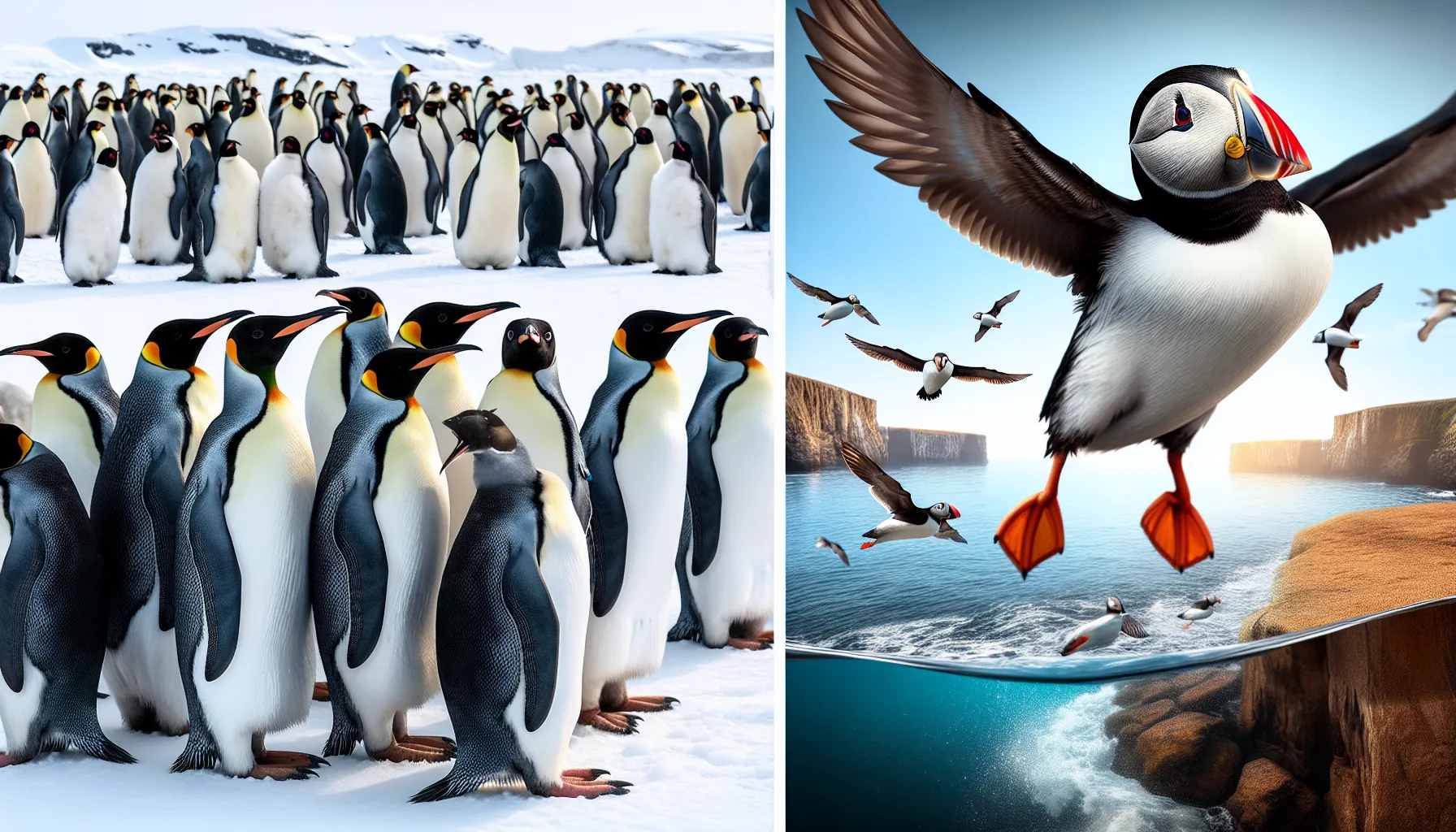
When observing seabirds, penguins and puffins often catch our attention for their intriguing appearances and captivating behaviors. With their tuxedo-like plumage and adept swimming skills, these birds have carved out unique niches in their respective ecosystems. But, even though occasional misconceptions, penguins and puffins are fundamentally different. In this exploration, let’s investigate into the contrasts that distinguish these two fascinating avian species, broadening our understanding of the natural world.
Introduction to Penguins and Puffins
Penguins and puffins are two iconic birds that enchant animal enthusiasts and researchers alike. While sharing certain characteristics, such as their impressive swimming ability and distinct black-and-white plumage, these birds belong to separate avian families and exhibit significant ecological and biological differences. Understanding these distinctions provides insights into adaptation and evolution across diverse environments.
Physical Characteristics
Size and Weight
Penguins typically range in size significantly larger than puffins, with some species, like the Emperor Penguin, reaching up to 4 feet in height. Puffins, on the other hand, typically measure around 10 inches tall, making them considerably smaller and lighter.
Coloration and Patterns
While penguins and puffins share a similar black-and-white coloration, their patterns vary upon closer inspection. Penguins generally have a smooth, monochromatic transition, while puffins boast vibrant additions such as colorful beaks during breeding seasons.
Habitat and Distribution
Penguin Habitats
Penguins are predominantly found in the Southern Hemisphere, with some species exclusively inhabiting icy environments like Antarctica, and others adapting to temperate zones.
Puffin Habitats
In contrast, puffins make their home in the Northern Hemisphere, favoring the chilly coastal cliffs of the Atlantic and Arctic Oceans. This geographical separation underscores their ecological differences.
Behavioral Adaptations
Penguin Behavior Insights
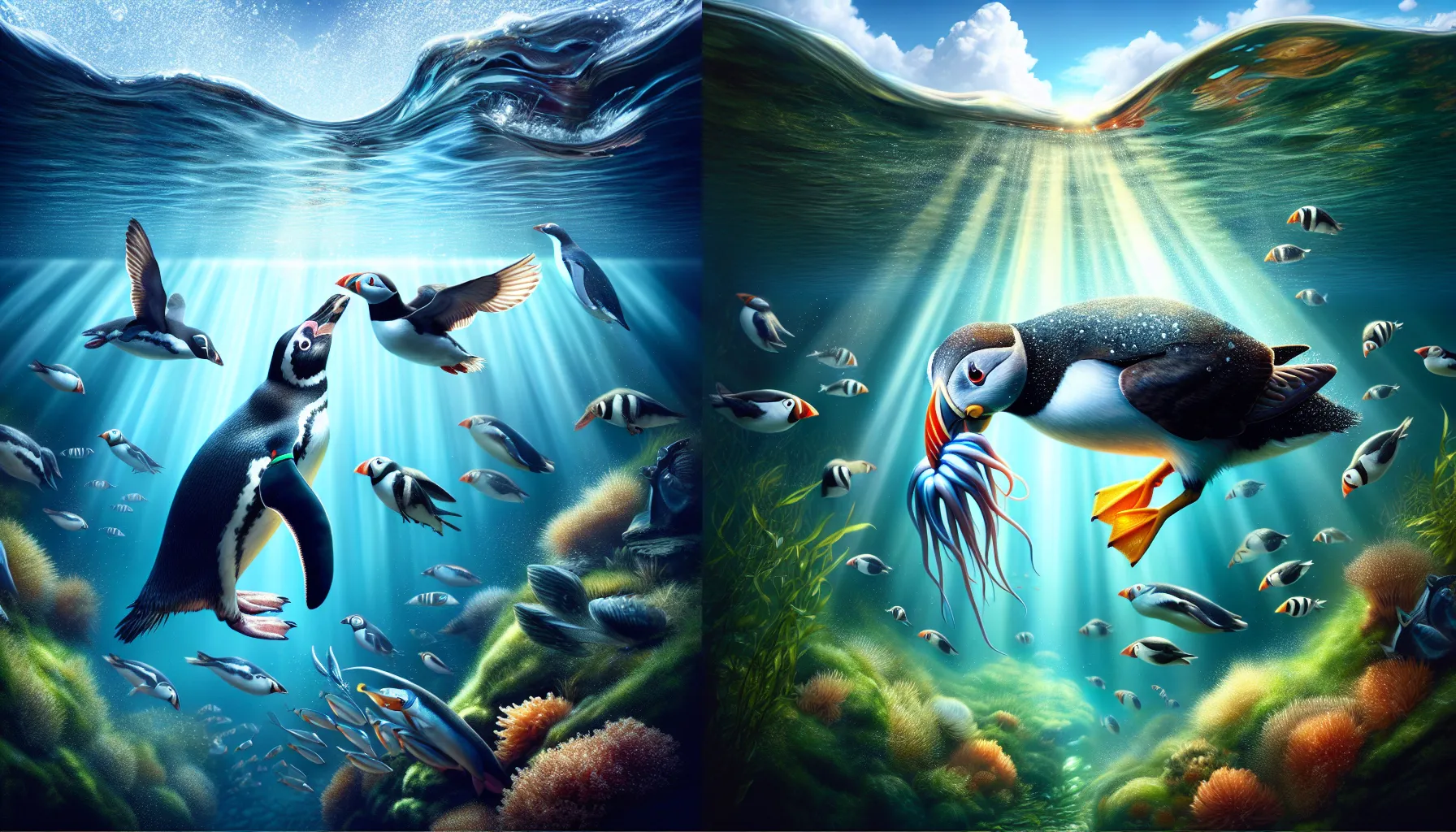
Penguins are flightless, relying on their robust swimming abilities to hunt underwater. They live in large colonies called rookeries, showcasing collaborative behaviors.
Puffin Behavior Insights
Puffins retain the ability to fly, using their wings both in the air and underwater. Known as “sea-parrots,” they often exhibit solitary or paired behaviors outside breeding periods.
Diet and Feeding Habits
Penguins primarily consume fish, krill, and squid, catching their prey during extended deep dives. Puffins have a similar diet but typically catch smaller fish closer to the surface, often holding multiple fish in their colorful beaks at once.
Breeding and Lifecycle
Penguins lay their eggs in nests or on bare ground, with males often taking on incubation responsibilities. Puffins nest in burrows or cliff crevices, and their chicks, known as “pufflings,” are nurtured until mature enough to fledge independently.
Distinguishing Features and Fun Facts
Penguins are well-adapted for aquatic life, sporting streamlined bodies. Puffins, but, are notable for their brightly colored beaks, which they shed after breeding season. Interestingly, puffins can beat their wings up to 400 times per minute when in flight.
Published: December 5, 2025 at 3:37 pm by Ellie B, Site owner & Publisher
To provide the best experiences, we use technologies like cookies to store and/or access device information. Consenting to these technologies will allow us to process data such as browsing behaviour or unique IDs on this site. Not consenting or withdrawing consent, may adversely affect certain features and functions.
Functional
Always active
The technical storage or access is strictly necessary for the legitimate purpose of enabling the use of a specific service explicitly requested by the subscriber or user, or for the sole purpose of carrying out the transmission of a communication over an electronic communications network.
Preferences
The technical storage or access is necessary for the legitimate purpose of storing preferences that are not requested by the subscriber or user.
Statistics
The technical storage or access that is used exclusively for statistical purposes.The technical storage or access that is used exclusively for anonymous statistical purposes. Without a subpoena, voluntary compliance on the part of your Internet Service Provider, or additional records from a third party, information stored or retrieved for this purpose alone cannot usually be used to identify you.
Marketing
The technical storage or access is required to create user profiles to send advertising, or to track the user on a website or across several websites for similar marketing purposes.