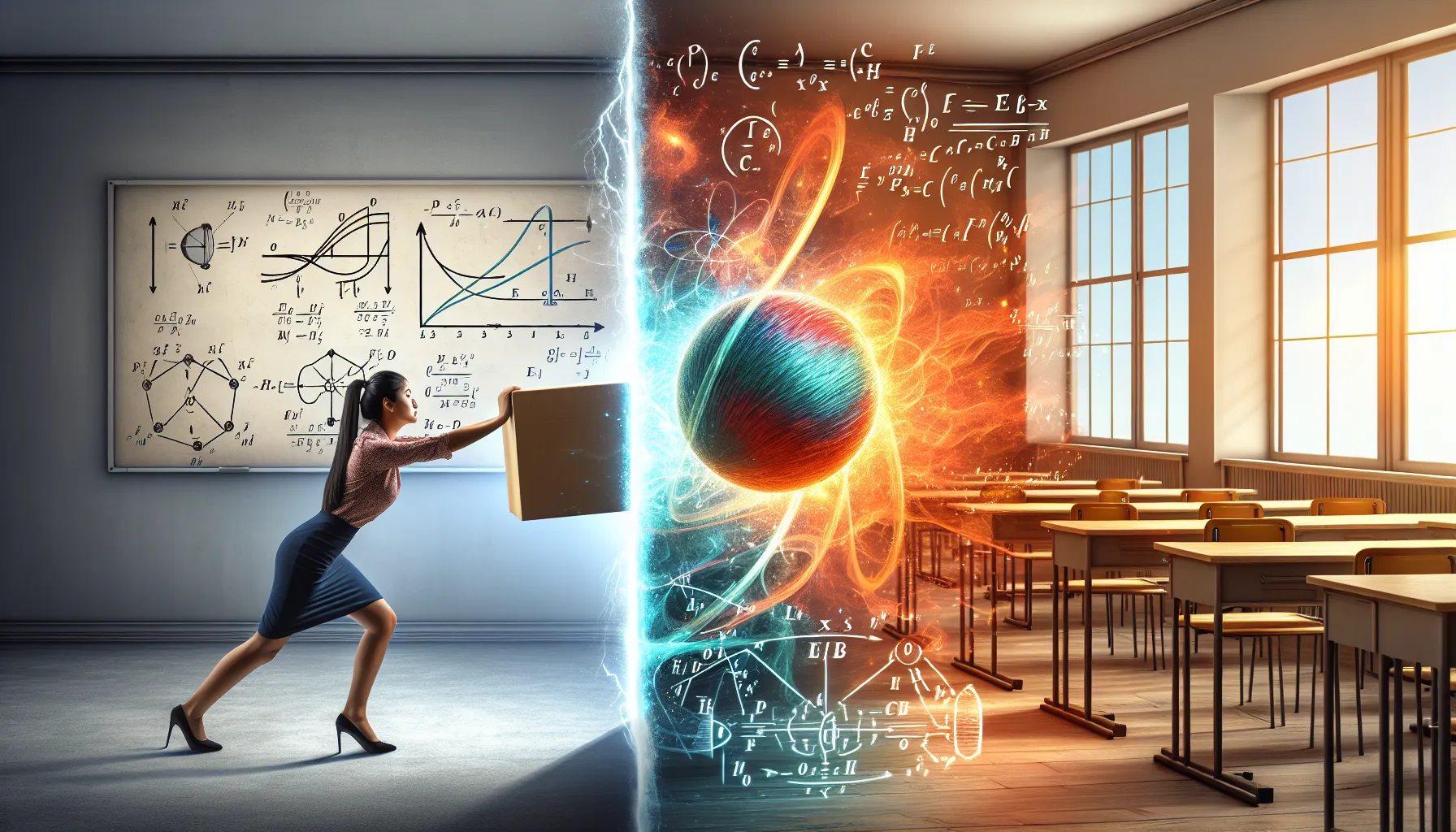
Picture standing beside a calm lake, tossing a stone into the still water, and observing the ripples expanding outward. The act of throwing the stone involves force, a direct push or pull, while the energy driving those ripples can be attributed to power, a measure of how quickly work is done. With this article, let’s unravel the distinct concepts of force and power, demystifying their meanings, mathematical representations, and applications in our everyday experiences and scientific scenarios.
Understanding the Concept of Force
Definition and Units of Force
Force is defined as an interaction that, when unopposed, changes the motion of an object. In the International System of Units (SI), force is measured in newtons (N), where one newton is equivalent to the force required to accelerate a one-kilogram mass by one meter per second squared.
Types of Forces in Physics
Forces come in various forms, categorized as contact or non-contact forces. Contact forces include friction, tension, and normal force, whereas non-contact forces encompass gravity, magnetic force, and electric force.
Mathematical Representation of Force
Newton’s Second Law of Motion encapsulates forces mathematically as ( F = ma ), where ( F ) denotes the force applied, ( m ) is the mass of the object, and ( a ) is the acceleration produced.
Exploring the Concept of Power
Definition and Units of Power
Power is the rate at which work is done or energy is transferred. It is measured in watts (W) in the SI system, where one watt equals one joule of work done per second.
Power in Mechanical Systems
In mechanical contexts, power indicates the efficiency of machines in performing tasks over time. For instance, an engine’s capability to produce motion is characterized by its power rating.
Mathematical Representation of Power
Mathematically, power is expressed as ( P = \frac{W}{t} ), where ( P ) is power, ( W ) represents work or energy, and ( t ) is the time during which the work is done.
Key Differences Between Force and Power
Comparison by Definition
While force is a direct interaction causing motion modifications, power pertains to the execution rate of work or energy transfer.
Relevance to Work and Energy
Force is crucial for performing any work on an object, whereas power measures how efficiently that work is performed over time.
Role in Various Physical Applications
In scenarios such as automobile mechanics, bridges construction, and even athletic sports, understanding the distinction aids in optimizing designs, functionalities, and performances.
Practical Examples Highlighting Their Differences
Force in Daily Life Scenarios
When you push a shopping cart, the applied force moves the cart in a specified direction depending on your push’s strength and duration.
Power in Real-World Contexts
Compare two athletes climbing the same height but at different speeds. The one who finishes quicker exhibits greater power since they perform the same amount of work in less time.
To provide the best experiences, we use technologies like cookies to store and/or access device information. Consenting to these technologies will allow us to process data such as browsing behaviour or unique IDs on this site. Not consenting or withdrawing consent, may adversely affect certain features and functions.
Functional
Always active
The technical storage or access is strictly necessary for the legitimate purpose of enabling the use of a specific service explicitly requested by the subscriber or user, or for the sole purpose of carrying out the transmission of a communication over an electronic communications network.
Preferences
The technical storage or access is necessary for the legitimate purpose of storing preferences that are not requested by the subscriber or user.
Statistics
The technical storage or access that is used exclusively for statistical purposes.The technical storage or access that is used exclusively for anonymous statistical purposes. Without a subpoena, voluntary compliance on the part of your Internet Service Provider, or additional records from a third party, information stored or retrieved for this purpose alone cannot usually be used to identify you.
Marketing
The technical storage or access is required to create user profiles to send advertising, or to track the user on a website or across several websites for similar marketing purposes.