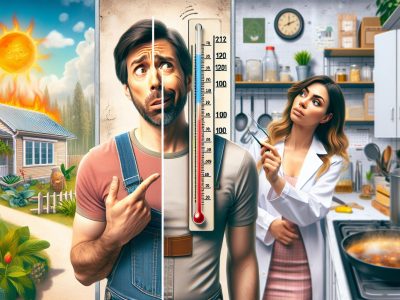
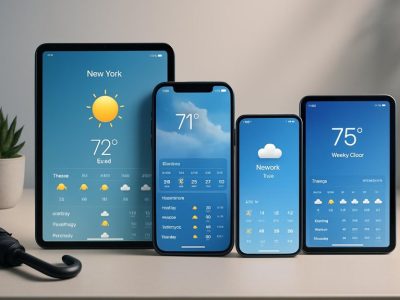
Picture stepping outside on a brisk morning—your breath curling in the air—and glancing at the weather app. The screen flashes a number, but is it a chilly 32°F or a mild 0°C? The world uses two distinct languages to measure something as universal as temperature, and switching between them can feel like translating poetry across cultures.
You might think it’s just a matter of numbers, but the difference between Fahrenheit and Celsius goes deeper than you’d expect. Understanding both scales gives you the power to decode travel forecasts, fine-tune recipes, and even connect with friends across continents. Unlocking this knowledge could make your daily routine smoother and your global adventures a little less confusing.
Understanding F and C: What Do They Stand For?
F and C, two symbols you see on weather apps and oven dials, stand for Fahrenheit and Celsius. With origins rooted in history, these scales reflects different perspectives on temperature measurement. Fahrenheit (F), named after the German physicist Daniel Gabriel Fahrenheit, splits the interval between freezing and boiling points of water into 180 parts. Celsius (C), known as Centigrade before, was introduced by the Swedish astronomer Anders Celsius in 1742—its scale sets the freezing point of water at 0° and boiling at 100° under standard atmospheric pressure (NOAA, 2023).
You encounter both every day, maybe when you step from your climate-controlled home in Texas to a snowy street in Toronto. For you, Fahrenheit typically feels more precise for daily weather, with a degree difference quickly shifting the perception from brisk to mild. Celsius, but, offers a logical water-based reference point, dividing temperature into neat hundreds and used internationally by over 90% of countries (World Meteorological Organization).
Picture baking cookies. A recipe calls for 350°F. Across the globe, a baker preheats her oven to 180°C for the same golden result. The difference in numbers can make you pause—does it means your cookies will burn in Paris if you follow the wrong scale? You’re not alone—food failures and overheated hotel rooms happened simply because F and C got muddled. why water boils at 212°F but only 100°C?
Making sense of these scales, you gain a clearer grasp of global standards, whether checking a fever, programming a smart thermostat, or comparing climate data. So, the next time you see both F and C on your phone, ask: which tells your story better—the American tradition, or the language of most of the world’s scientists? Your daily routines, travel adventures, or even cooking triumphs depend on knowing the difference between these two little letters.
Historical Background of Fahrenheit and Celsius
You probably wondered why your oven’s digital display sometimes flashes numbers that seem totally alien compared to your weather app. This whole mix up happened because of two people—Daniel Gabriel Fahrenheit and Anders Celsius—whose names landed on every thermometer across continents. Fahrenheit, a German physicist in the early 18th century, built a scale anchored by strange chemistry and his experiences with brine solutions and mercury. He picked 32°F as water’s freezing point, not because it feels logical, but because that’s what his experiment with salted ice showed. The boiling point, he set at 212°F, making a neat 180-degree span—a number chosen more for ease of division than direct natural reference [National Institute of Standards and Technology].
But picture yourself in Sweden about 20 years later, where Anders Celsius had grown frustrated with the complexity and lack of logic behind Fahrenheit’s system. Celsius, an astronomer obsessed with systems that mirrored the cosmos in clarity, decided to base his scale only on water. He set the freezing point at 0°C and boiling at 100°C. At first, Celsius even flipped the scale—water boiled at zero, and froze at one hundred. Can you picture explaining that at a 1742 dinner party? Later scientists reversed it to our current standard, making measuring weather, lab experiments, and culinary temperatures more intuitive for every user [International Bureau of Weights and Measures].
Today, historians and meteorologists still debate whether the seemingly arbitrary choice of Fahrenheit’s points or the tidy decimal system of Celsius makes for a better everyday tool. Was the Fahrenheit approach more adaptable for weather in Europe, or just a product of quirky experimentation? Consider an anecdote from the early United States: settlers preferred Fahrenheit because—you guessed it—the increments made winter temperature shifts easier to track, which mattered when you lived in a freezing wooden house.
When you next look at a temperature display or debate how hot your oven gets, question which scientific ancestry is hiding behind those digits. Is it a relic of Mercury and brine, or a story written in Swedish snow?
How F and C Are Measured
Temperature measurement methods can shape your understanding of weather, cooking, and even travel plans. Each system offers a unique view of the environment you interact with—sometimes feeling like you’re holding two very different keys to the same door.
Temperature Scale Definitions
Fahrenheit defines temperature using water’s freezing point at 32°F and boiling at 212°F, spaced over 180 divisions. Celsius benchmarks freezing at 0°C and boiling at 100°C, creating a direct water-based reference that simplifies calculations. Picture waking up in Boston and hearing it’s 50°F—a light jacket, please. Switch to Stockholm, and 10°C greets you with the same crisp air, but the value tells a different story if you haven’t memorized the scale.
Fahrenheit’s origin links to the physicist Daniel Gabriel Fahrenheit, whose mercury thermometer standardized weather reports across 19th-century America [National Institute of Standards and Technology]. Celsius traces its roots to Swedish astronomer Anders Celsius, whose inverted scale was later reoriented for intuitive use. Ask yourself: which scale lets you grasp cold or heat quickest if you’re reading a sign in Paris or a recipe in New York?
Conversion Formulas
Mathematically, the relationship between Fahrenheit and Celsius fuses their scales. You translate Fahrenheit to Celsius by subtracting 32, then divide by 1.8—(°F-32) ÷ 1.8 = °C. Reversing, multiply Celsius by 1.8, then add 32—(°C×1.8) + 32 = °F. Plug 212°F into the formula and see 100°C emerge, as if the equation’s magic bridges continents.
Cookbooks around the world list oven settings in both scales. For example, if a recipe calls for 180°C, you’ll set an oven in the US to 356°F. Scientists working internationally must constantly switch between scales to compare temperatures for experiments, making these formulas indispensable like traffic signs at a busy border.
Here’s a glance at the conversion:
Celsius (°C)
Fahrenheit (°F)
0
32
20
68
37
98.6
100
212
Do you ever wondered why the fever threshold is 100.4°F (38°C)? This difference not just exists in numbers, it shapes how societies interpret health, risk, and comfort. So next time you travel or cook, will these formulas act as your guideposts across the language of temperature?
Key Differences Between F and C
Comparing Fahrenheit (F) and Celsius (C) reveals both historical quirks and practical challenges. By recognizing unit intervals, reference points, and global usage, you get a clearer picture of their unique roles.
Unit Intervals and Reference Points
Unit intervals and reference points create the main structural differences between these two temperature scales. Fahrenheit divides the freezing and boiling points of water into 180 intervals—between 32°F and 212°F. Celsius, contrastingly, uses 100 intervals precisely from 0°C to 100°C. Water’s freezing and boiling marks define both scales, but their anchor points differ. For example, 0°C feels absolute—a baseline—while 32°F seems arbitrary unless you know its origin, tied to a saltwater brine experiment.
You could ask yourself, why did Anders Celsius pick such rounded numbers? Simplicity drove the decision: 0 and 100 fit with decimal thinking, making metric conversions quick. Fahrenheit’s system, originating in 1724, aimed for finer granularity. Each degree in F represents a smaller step, letting you track subtle shifts—an advantage that early chemists and meteorologists valued for precision. Still, this shiftiness can be confusing: Baking a cake at 350°F vs. 180°C isn’t a mere translation—it’s a mindset switch. Which feels more logical to you, the round figures or the granular steps?
Usage Around the World
Usage of F and C divides along geographic and cultural lines. Celsius dominates internationally—over 180 nations (including the UK, Australia, India, and Canada) rely on C for everything from school science to home heating. The metric system’s global spread during the 20th century pulled C along with it, making “What’s the temperature in C?” a daily refrain in most countries.
Fahrenheit, but, remains tightly woven into American life. In the US and a few Caribbean nations, weather forecasts, oven dials, and medical thermometers all stick to F. There’s a folklore around this: older Americans might remember cold winters recounted as “zero degrees”—meaning 0°F, not 0°C. That tiny semantic difference can lead to huge misunderstandings: if you landed in Chicago and saw 20°, without context, you could dress way too light for winter.
These global differences shape travel, science, and cross-cultural conversation. For instance, NASA missions use Celsius, but American TV meteorologists broadcast in Fahrenheit, forcing dual fluency for scientists and citizens. Next time you scroll your weather app, notice if it’s 68°F or 20°C—keep that system in mind, it shapes your entire day.
Practical Implications of the Difference Between F and C
The difference between Fahrenheit and Celsius shapes the way you make daily decisions, from what jacket you grab in the morning to how you prep your favorite stew. Temperature, an invisible thread, ties together weather, cooking, science, and even conversations across countries.
Everyday Examples
Choosing between F and C in daily scenarios often feels as natural as picking a side of the bed, but how these choices shape your experiences? Weather forecasts on your phone might show 68°F, making you reach for a light sweater, while a visitor from Berlin would see 20°C and wonder if that’s an ideal picnic day. Cooking books sometimes flip between American-style “Bake at 350°F” or the global 180°C; mistaking one for the other can lead to burnt cookies or ice-cold roast. Travelers crossing borders—picture, you land in Toronto, step outside, and the car dashboard reads -6°C. You pause, trying to remember, was that coat thick enough, or does -6 feel colder than 20°F? Some people even leave sticky notes near the oven or on the fridge, reminders for quick mental conversions.
Impact on Science and Industry
Scientific research and industrial processes hinge on precise and consistent temperature measurement, making the F and C distinction more than just a matter of convenience. Laboratories worldwide, from NASA to local environmental agencies, default to Celsius for experiments—water boils at 100°C, not 212°F, in the annals of academic journals and climate studies. Manufacturing sectors that assemble everything from pharmaceutical drugs to microprocessors share technical documentation in Celsius. This standardization reduces errors, which might lead to, for example, a failed chemical reaction or semiconductor defect that costs millions. Meanwhile, aviation and weather services in the United States report in both Fahrenheit and Celsius, sometimes causing confusion for international pilots and meteorologists. If you tour an oil refinery in Texas, you’ll hear both scales tossed around, sometimes in the same sentence, challenging even the most seasoned engineers.
Here’s a quick look at where each scale dominates:
Domain
Predominant Scale
Example
Weather Forecasts
Fahrenheit (US), Celsius (global)
85°F (US), 29°C (UK)
Cooking
Fahrenheit (US), Celsius (Europe, Asia)
400°F (NYC pizza), 200°C (Rome bread)
Scientific Research
Celsius
Boiling point of water: 100°C
Industry
Celsius (International), Fahrenheit (US only in niche cases)
Steel foundry: 1,370°C
The temperature scale you use—right down to a single degree—shapes how you interpret warmth, danger, or success, whether you’re testing engine coolant or baking bread. If the conversation shifts, ask yourself: which invisible metric guides your choices and how might your daily rhythm change if you switched sides?
Choosing the Right Temperature Scale
Selecting a temperature scale—Fahrenheit or Celsius—links deeply to your context, from the meteorology you follow to the stove you fire up on a chilly evening. You’re told it’s 30 outside: are you packing your parka, or searching for sunscreen? Fahrenheit (°F) skews toward the vivid, familiar to those living in the US and referencing weather broadcasts, with “room temperature” landing near 70°F, a number etched into American idiom. In Celsius (°C), that’s about 21°—a lower number, but the same comfort.
Cooking adds some spice to this debate. Open a US cookbook and recipes bursts with 350°F, 400°F, and more; swap in a UK or Australian source, and it sizzles with 180°C or 200°C. The wrong dial twist could char your cookies, underscoring why recognizing the symbols—°F or °C—in your kitchen means the difference between crispy perfection and sooty disappointment (Food Network, 2022).
Scientific labs embrace Celsius, tying research to the intuitive centigrade scale: 0°C for freezing, 100°C for boiling—a tight, logical interval adopted worldwide (NIST, 2023). When NASA calculates Mars lander survival, you’ll find temperatures plotted in Celsius, matching international standards.
Yet, Fahrenheit still carves a niche in storytelling and everyday perceptions. Meteorologists in Phoenix debate whether 100°F “feels” more impressive than 38°C, and old-timers in Boston recall blizzards as “zero degrees”—Fahrenheit, a mental threshold signaling true winter.
Schools introduce both systems, but students sometimes confuse scales. A student reading “It’s 40 degrees today!” may grab a winter coat in Texas and a bathing suit in Paris—an anecdote that reflects how deeply geography shapes perception.
Ask yourself: when did you last check the weather, and did the number spark clarity or confusion? Is your family rooting Thanksgiving turkey in Fahrenheit, or does your friend’s Italian grandmother bake bread using Celsius?
Travelers frequently face this fork-in-the-road. Backpack above the Arctic Circle, and a guide might announce “minus 20”—Celsius or Fahrenheit? You hesitate, realizing that a misplaced conversion can mean frostbite or a sweat-soaked hike.
Both scales illustrate how a simple number unveils stories, connections, and occasional mix-ups. Before you step out or strike up your stove, pausing to check your scale invites smoother journeys—whether across continents or just across your kitchen tiles. Where you reside, your professional context, and the people you communicate with, all hint at which temperature story suits your day best.
Context
Predominant Scale
Example Reference
US domestic weather, media
Fahrenheit
68°F (room temp)
Science, medicine, world travel
Celsius
20°C (room temp)
Cooking (US recipes)
Fahrenheit
350°F (baking)
Cooking (Europe, world recipes)
Celsius
180°C (baking)
International collaboration
Celsius
Used by WHO, NASA
You’ll find, eventually, that temperature scales aren’t just measures—they’re cultural lenses, memory builders, and sometimes, the punchline of your travel tales.
Conclusion
When you understand the difference between Fahrenheit and Celsius, you gain more than just a conversion skill—you open up new ways to connect with people, recipes, and places around the world. Whether you’re checking the weather or following a recipe, knowing both scales helps you avoid confusion and make smarter decisions every day.
Embracing both temperature systems lets you move seamlessly between cultures and experiences. So next time you see a number with an F or a C, you’ll know exactly what it means for your plans, your comfort, and your adventures.
To provide the best experiences, we use technologies like cookies to store and/or access device information. Consenting to these technologies will allow us to process data such as browsing behaviour or unique IDs on this site. Not consenting or withdrawing consent, may adversely affect certain features and functions.
Functional
Always active
The technical storage or access is strictly necessary for the legitimate purpose of enabling the use of a specific service explicitly requested by the subscriber or user, or for the sole purpose of carrying out the transmission of a communication over an electronic communications network.
Preferences
The technical storage or access is necessary for the legitimate purpose of storing preferences that are not requested by the subscriber or user.
Statistics
The technical storage or access that is used exclusively for statistical purposes.The technical storage or access that is used exclusively for anonymous statistical purposes. Without a subpoena, voluntary compliance on the part of your Internet Service Provider, or additional records from a third party, information stored or retrieved for this purpose alone cannot usually be used to identify you.
Marketing
The technical storage or access is required to create user profiles to send advertising, or to track the user on a website or across several websites for similar marketing purposes.