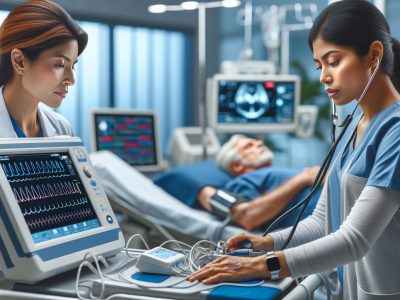
Diving into the world of medical technology, you’ll find a plethora of equipment and terms that might seem complex at first glance. Two such terms are EKG (Electrocardiogram) and telemetry – both crucial in heart health monitoring but often misunderstood or used interchangeably by many.
In this text, we’re set to demystify these two concepts for you. We’ll explore what they really mean, how they work differently yet collaboratively in providing vital data about your cardiovascular system’s functioning. So whether you’re an aspiring healthcare professional or just curious about the tech behind those beeping machines during hospital visits – buckle up! You’re on track to gain some enlightening insights into cardiac care technologies.
Understanding the Basics
Diving into the heart of medical technology, we begin our journey with a look at EKG and telemetry. Here’s what you need to know about these two critical components in cardiac care.
What Is an EKG?
An Electrocardiogram (EKG or ECG) is a diagnostic tool that records electrical activity within your heart over time. It uses electrodes placed on specific areas around your chest to capture this data. The information obtained provides insight into how well your ticker’s working, helping identify any abnormalities such as arrhythmias or signs of past myocardial infarctions (heart attacks). An example might be noticing erratic rhythms indicating atrial fibrillation – irregular beats which can lead to more serious complications if not managed correctly.
What Is Telemetry?
Telemetry involves real-time monitoring through remote means – think sending signals from one place for analysis elsewhere without direct contact required between patient and caregiver! In terms of healthcare specifically related to cardiovascular conditions, it implies using wireless devices attached directly onto patients’ bodies that continually monitor their heartbeat patterns over extended periods while they carry out everyday activities unrestrictedly. For instance, individuals suffering from chronic diseases like Congestive Heart Failure may benefit tremendously from continuous tracking provided by such systems as changes are detected instantly leading swiftly towards appropriate intervention steps being taken.
Key Differences Between EKG and Telemetry
Diving deeper into the specifics of these two healthcare technologies, you’ll find several key distinctions. They primarily differ in their usage and applications as well as technology and methods employed.
Usage and Applications
EKGs hold a prominent role during diagnostic procedures. For instance, when symptoms like chest pain or shortness of breath arise, an EKG provides crucial data for doctors to evaluate heart health swiftly. It’s also used before surgeries to assess cardiac risk.
Telemetry holds its fort in constant monitoring situations – think Intensive Care Units (ICUs) or step-down units where patients require close attention round-the-clock. If irregularities are spotted on telemetry readings such as rapid heartbeat episodes or dangerous arrhythmias among CHF patients – medical staff can intervene promptly.
Technology and Methods
An EKG utilizes electrodes attached directly onto your skin at specific locations around the heart area. These capture electrical signals that generate comprehensive wave patterns enabling physicians identify any deviations from normalcy quite effectively.
In contrast, telemetry relies upon wireless devices often placed inside a belt worn by the patient capturing continuous streams of vital signs data which is then transmitted remotely allowing real-time evaluation irrespective of distance between doctor’s station & patient’s location ensuring timely intervention whenever necessary!
Clinical Importance of EKG and Telemetry
The clinical significance of both EKG and telemetry extend far beyond their basic functionalities. They serve as essential tools for healthcare providers, facilitating early detection, diagnosis, continuous monitoring, treatment planning in a myriad heart conditions.
Monitoring Heart Health
EKGs offer snapshots into the state of your heart’s health by recording electrical signals at one particular point in time. This method is excellent for identifying irregular rhythms or patterns like arrhythmias that could indicate potential issues such as coronary artery disease (CAD), myocardial infarction (MI) – commonly known as a ‘heart attack’, or other cardiac abnormalities.
In contrast to an EKG’s momentary glimpse, telemetry provides ongoing surveillance with its wireless transmission capabilities. It keeps track on heartbeat regularity over extended periods – be it inside hospital settings or remotely from home through portable devices which are linked directly to medical professionals’ monitors 24/7.
This remote feature particularly proves invaluable under situations where you’re bedridden due to illness but still need constant observation – even if your doctor isn’t physically present nearby!
Role in Diagnosis and Treatment
From diagnostic standpoint too these systems show immense utility. An abnormal result during an EKG test can prompt further investigations leading towards definitive diagnoses so aiding physicians formulate effective treatment plans tailored according individual patient needs without delay ensuring optimal outcomes while minimizing complications risk factor-wise.
Innovations and Advancements
As we investigate deeper into the area of heart health monitoring, let’s examine recent developments in EKG technology as well as advancements within telemetry systems.
Recent Developments in EKG Technology
EKG technology has seen impressive progress over the years. For instance, smart devices such as wearable fitness trackers can now perform single-lead electrocardiograms (ECGs). This advancement makes it easier for individuals to monitor their own heart health on a daily basis.
Another breakthrough involves artificial intelligence (AI) and machine learning algorithms that help interpret complex cardiac rhythms from EKG readings with high accuracy. These innovative tools assist physicians by providing additional data points for diagnoses, reducing false positives and negatives if employed appropriately.
Also, portable handheld or pocket-sized ECG monitors have become increasingly common – they’re lightweight yet powerful diagnostic tools that provide rapid results anywhere at any time.
Advances in Telemetry Systems
Telemetry systems are also experiencing significant evolution due to technological advances like wireless networking capabilities allowing real-time patient monitoring remotely – even outside hospital settings! In fact, remote home-based care is one area where these innovations shine brightly; patients with chronic conditions no longer need frequent trips back-and-forth between clinics or hospitals thanks to constant virtual supervision offered through modern telemetry technologies.
Besides, integrating AI components into telemetry platforms allows automatic alerts when certain thresholds are crossed indicating possible emergencies thereby improving response times during critical situations so saving lives!
Conclusion
You’ve seen how EKG and telemetry serve critical roles in heart health management. They’re distinct yet complementary, with EKGs pinpointing irregular rhythms and telemetry offering constant wireless monitoring. It’s exciting to see the strides made in both fields, bringing innovations like wearable devices for on-the-spot ECGs or AI-powered interpretation of complex rhythms into play. Similarly, modernized telemetry systems now help real-time remote patient observation plus automatic alerts during crises — a significant leap forward especially for home-based care settings dealing with chronic conditions.
Remember this knowledge not only makes you more informed but also empowers your healthcare decisions about managing cardiac risks effectively. As technology continues evolving at an unprecedented rate it’ll be fascinating to witness what future developments lie ahead in these life-saving medical tools: the humble yet sophisticated EKG machine and its dynamic partner-in-care – Telemetry!
To provide the best experiences, we use technologies like cookies to store and/or access device information. Consenting to these technologies will allow us to process data such as browsing behaviour or unique IDs on this site. Not consenting or withdrawing consent, may adversely affect certain features and functions.
Functional
Always active
The technical storage or access is strictly necessary for the legitimate purpose of enabling the use of a specific service explicitly requested by the subscriber or user, or for the sole purpose of carrying out the transmission of a communication over an electronic communications network.
Preferences
The technical storage or access is necessary for the legitimate purpose of storing preferences that are not requested by the subscriber or user.
Statistics
The technical storage or access that is used exclusively for statistical purposes.The technical storage or access that is used exclusively for anonymous statistical purposes. Without a subpoena, voluntary compliance on the part of your Internet Service Provider, or additional records from a third party, information stored or retrieved for this purpose alone cannot usually be used to identify you.
Marketing
The technical storage or access is required to create user profiles to send advertising, or to track the user on a website or across several websites for similar marketing purposes.