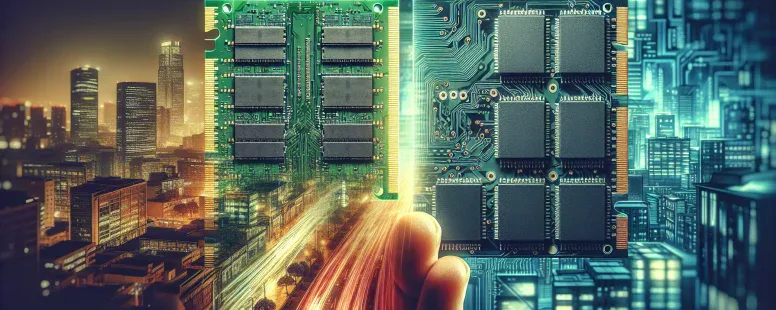
Picture your computer as a bustling city, where memory chips act like the traffic controllers ensuring everything flows smoothly. But not all memory is created equal—some work tirelessly yet take breaks, while others are quick and consistent but come at a higher cost. This is the essence of DRAM (Dynamic RAM) and SRAM (Static RAM), two key players in the world of digital storage.
You might wonder why we need both if they serve similar purposes. The answer lies in their unique strengths. DRAM offers high capacity at an affordable price, making it perfect for everyday tasks, while SRAM delivers blazing speed and reliability for critical operations. Understanding how these two types of memory differ can help you appreciate their roles in powering your devices, from smartphones to gaming consoles.
Overview Of DRAM And SRAM
Dynamic RAM (DRAM) and Static RAM (SRAM) are two fundamental types of memory used in computing devices. Understanding their distinctions helps you choose the right memory for specific applications.
What Is DRAM?
DRAM stores data using capacitors and requires constant refreshing to retain information. This design allows higher storage density, making it cost-effective for large-scale applications like personal computers, smartphones, and gaming consoles. For example, DRAM is found in your system’s main memory (RAM), enabling multitasking by temporarily storing active processes.
Due to its need for continuous refreshing, access times are slower than SRAM. But, its affordability makes it ideal where high capacity outweighs speed considerations.
What Is SRAM?
SRAM uses flip-flop circuits to store data without needing periodic refreshing. This results in faster access times compared to DRAM but at a higher manufacturing cost per bit. Devices like CPU caches rely on SRAM due to its speed and reliability when handling frequently accessed instructions.
Though bulkier than DRAM due to lower density, SRAM excels in performance-critical areas such as processors or high-end networking equipment where quick response times matter most.
Key Differences Between DRAM And SRAM
Understanding the differences between DRAM and SRAM helps in determining their suitability for various applications. Each memory type offers unique benefits based on speed, power consumption, cost, and storage density.
Speed
SRAM operates faster than DRAM due to its architecture. It uses flip-flop circuits that provide immediate data access without delays caused by refreshing processes. This makes SRAM ideal for CPU caches where rapid data retrieval is critical. In contrast, DRAM relies on capacitors requiring frequent refreshing cycles, which slows down its access time even though accommodating larger data volumes.
Power Consumption
DRAM consumes less power compared to SRAM during inactive periods because it only requires energy to refresh the capacitors periodically. But, under active usage conditions, its constant refreshing demands can lead to higher overall energy expenditure over time. On the other hand, SRAM maintains stored data without periodic refreshing but has a continuous power draw even when idle due to its static design.
Cost
SRAM production costs are significantly higher than those of DRAM since each bit of data in SRAM needs multiple transistors (typically 6 per cell) versus just one transistor and capacitor in DRAM cells. The reduced complexity of manufacturing gives DRAM a financial advantage for large-scale memory requirements like personal computers or gaming consoles.
Memory Type
Typical Production Cost Per Bit
Usage Examples
DRAM
Lower
PCs, laptops, gaming consoles
SRAM
Higher
CPU caches, networking equipment
Storage Density
DRAM offers higher storage density than SRAM because its cells occupy less physical space thanks to their simple design involving fewer components per cell. This allows manufacturers to fit more memory into smaller chips at lower costs. While this characteristic makes it suitable for devices prioritizing capacity over speed (e.g., desktops), you find that SRAM’s lower density limits its deployment mainly within high-speed environments like processors or routers.
Use Cases Of DRAM And SRAM
DRAM and SRAM serve distinct purposes based on their performance characteristics, cost, and storage capabilities. Knowing their applications helps in understanding how devices function effectively.
Common Applications Of DRAM
DRAM is widely used where high memory capacity at a lower cost is essential. It’s commonly found in personal computers, laptops, and gaming consoles as system memory (RAM), enabling the smooth execution of multiple applications simultaneously. For example, when running a video editing software alongside internet browsing, DRAM provides the necessary temporary storage for fast data retrieval.
In servers and data centers handling large-scale operations, DRAM supports high-capacity workloads due to its scalability. Cloud computing services benefit from its affordability and ability to manage extensive datasets efficiently.
Graphics cards also use DRAM—specifically GDDR (Graphics DDR)—to store textures and graphical data for rendering images quickly during gaming or 3D modeling tasks.
Common Applications Of SRAM
SRAM excels in scenarios requiring speed and reliability instead of high capacity. CPU caches use SRAM to store frequently accessed instructions close to the processor, reducing latency during computational tasks like video processing or real-time simulations.
Networking equipment such as routers relies on SRAM for buffering data packets due to its rapid access times that ensure minimal delays in communication systems. Similarly, embedded systems like microcontrollers employ SRAM for critical operations where consistent performance is crucial—for instance, in automotive control units managing engine functions.
High-performance electronics like solid-state drives (SSDs) integrate small amounts of SRAM as caching layers to accelerate read/write processes while maintaining low power consumption compared to alternative methods.
Advantages And Disadvantages Of DRAM And SRAM
Understanding the strengths and weaknesses of DRAM and SRAM is essential for choosing the right memory type. Each has unique characteristics that make it suitable for specific applications.
DRAM: Pros And Cons
DRAM offers high storage density, making it ideal for devices requiring significant memory capacity like PCs, gaming consoles, and servers. It’s cost-effective to manufacture due to its simple capacitor-based design. This affordability allows large-scale integration without inflating costs.
But, constant refreshing of data in DRAM increases latency and power consumption over time. For example, in high-performance gaming systems running resource-heavy graphics, this may slightly affect responsiveness compared to faster alternatives like SRAM. Also, while efficient during idle periods, frequent refresh cycles can impact energy efficiency when handling continuous data streams.
SRAM: Pros And Cons
SRAM excels in speed due to its flip-flop circuit architecture which eliminates the need for periodic refreshing. This makes it highly reliable for performance-critical tasks such as CPU caches or networking equipment where quick access times are vital. Its low-latency operation is crucial in embedded systems that demand real-time processing capabilities.
Yet, these advantages come at a higher cost because SRAM’s design involves more complex manufacturing processes. The lower storage density also limits its application to smaller-scale environments where speed outweighs capacity needs—such as SSD buffers or cache memory layers within processors. Also some users might find its continuous power draw less energy-efficient compared to DRAM under specific conditions.
Conclusion
Choosing between DRAM and SRAM depends on your specific needs, whether it’s balancing cost and capacity or prioritizing speed and reliability. Each type of memory plays a vital role in modern technology, powering everything from everyday devices to high-performance systems. By understanding their unique characteristics and use cases, you can make informed decisions that optimize performance for your applications.
To provide the best experiences, we use technologies like cookies to store and/or access device information. Consenting to these technologies will allow us to process data such as browsing behaviour or unique IDs on this site. Not consenting or withdrawing consent, may adversely affect certain features and functions.
Functional
Always active
The technical storage or access is strictly necessary for the legitimate purpose of enabling the use of a specific service explicitly requested by the subscriber or user, or for the sole purpose of carrying out the transmission of a communication over an electronic communications network.
Preferences
The technical storage or access is necessary for the legitimate purpose of storing preferences that are not requested by the subscriber or user.
Statistics
The technical storage or access that is used exclusively for statistical purposes.The technical storage or access that is used exclusively for anonymous statistical purposes. Without a subpoena, voluntary compliance on the part of your Internet Service Provider, or additional records from a third party, information stored or retrieved for this purpose alone cannot usually be used to identify you.
Marketing
The technical storage or access is required to create user profiles to send advertising, or to track the user on a website or across several websites for similar marketing purposes.