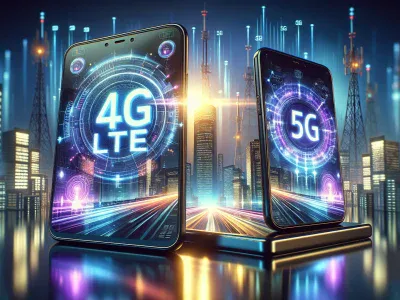
Picture streaming a blockbuster in seconds or joining a video call that feels like you’re in the same room—no lag no interruptions just pure speed. You’ve heard the buzz about 5G but then there’s this new term: 5G Ultra Wideband. What’s the real difference? Is it just marketing magic or a genuine leap into the future of connectivity?
Picture your phone as a sports car. Regular 5G gives you a thrilling ride on the open road but 5G Ultra Wideband rockets you onto the Autobahn—blazing past limits you didn’t know existed. Hidden beneath the tech jargon are surprising perks that could transform how you work play and stay connected. Ready to uncover what sets these two apart and why it matters for your digital life?
Understanding 5G Technology
Peel back the layers of 5G technology and quickly you’ll spot a web of networks connecting devices, cities, homes, and even cars. 5G, an evolution of wireless standards like 3G and 4G LTE, hinges on higher speeds, lower latency, and more reliable connections. Right now, when you video chat with your family cross-country, 5G’s underlying infrastructure guides each data packet almost like a traffic cop, keeping things smooth. Networks like Verizon and AT&T invest billions in 5G, betting on applications from remote surgery to smart transportation, as reported by GSMA Intelligence.
5G networks, using radio frequency spectrum bands, broadcast signals over short and long distances. Three key bands—low, mid, and high—exist. Low-band 5G (under 1 GHz), like the kind many rural areas use, stretches far but delivers speeds not much higher than 4G. Mid-band 5G (1–6 GHz), which you’ll see in many cities, balances speed and coverage, supporting things like HD streaming or cloud gaming. High-band 5G (millimeter wave, above 24 GHz), fuels speeds that can hit up to 3 Gbps, but the signal isn’t going to travel far through buildings or trees. Picture 5G as a busy train station: the low band is the longer, slower route, while the high band’s an express bullet train—fast but with fewer stops. why you sometimes have blazing speeds one block but just okay speeds, two blocks later? That’s because 5G’s effectiveness depends on location and signal type. Urban areas stack a lot of antennas on rooftops to push high frequencies, but even then, signals might compete with Wi-Fi, weather, or even glass windows, according to Qualcomm research.
Now think about latency. It’s the split-second delay between sending a request and getting a response—say, when you press play on a game, or stream soccer highlights. With 5G, the latency can drop under 10 milliseconds. Gamers and telemedicine services thrive because actions appear almost instantly.
So, while 5G keeps your world connected, it’s not just speed—its network architecture, bandwidth, and latency matter. Will robots someday control entire warehouses wirelessly, if you didn’t have 5G’s reliability? The answer’s unfolding around you—one antenna, one device, and one seamless connection at a time.
What Is 5G Ultra Wideband?
5G Ultra Wideband represents a segment of 5G technology that pushes boundaries on wireless connectivity. Verizon and AT&T, for instance, market Ultra Wideband as network slices built on millimeter wave (mmWave) and C-band spectrum. You see, those high-frequency bands open buckets of bandwidth—a veritable highway for network traffic. Standard 5G is like a multi-lane road in a suburban town; 5G Ultra Wideband transforms it into an eight-lane expressway spanning a bustling metropolis. Your phone, suddenly, feels like a sports car granted exclusive access to the fast lane, barely tapping brakes even during digital rush hour.
Frequency bands define the experience. 5G Ultra Wideband operates primarily in the 24–52 GHz (mmWave) and 3.7–4.2 GHz (C-band) ranges. The mmWave spectrum, for example, delivers peak speeds reaching 3 Gbps in optimal conditions—enough for you to download a high-definition movie in mere seconds. That speed is’t hypothetical; PCMag’s real-world tests in New York and Los Angeles documented bursts that regularly exceeded 1 Gbps outdoors (PCMag, 2023). Still, distance and physical barriers (buildings, trees) do impact mmWave signals, so coverage focuses on urban cores, stadiums, and arenas.
Latency also drops dramatically with Ultra Wideband. Rapid responsiveness feels almost uncanny; online gamers react as if they’re wired in. Surgeons leverage low-lag connections to perform remote operations, and industrial robots sync with millisecond precision. These advances illustrate the difference: where basic 5G improves speed and reliability, Ultra Wideband reshapes what digital tools can achieve in real-time. why your download speeds skyrocket at a music festival, but lag behind in a residential area? 5G Ultra Wideband answers that question: it’s a network geared toward environments that demand relentless speed and minimal congestion. Even as thousands of users compete for bandwidth in Times Square on New Year’s Eve, the connection holds steady—your video call doesn’t drop, your livestream doesn’t freeze, your AR game keeps running.
Carriers tout Ultra Wideband as the premium layer of next-gen wireless, but the day-to-day impact springs from these tangible network upgrades. Devices like the iPhone 14 Pro, Samsung Galaxy S23 Ultra, and newer flagship smartphones already support Ultra Wideband, provided your local cell towers broadcast those powerful frequencies.
Here’s how major components of 5G Ultra Wideband connect:
Component
Example Context
Speed/Latency
Coverage Area
mmWave spectrum
Urban downtown, stadiums
Up to 3 Gbps / <10ms latency
City blocks, small zones
C-band spectrum
Suburbs, city centers
300–900 Mbps / low latency
Miles-wide
UWB handsets
iPhone 14 Pro, Galaxy S23 Ultra
Leverage both high and mid bands
Dependent on market
You now stand at the threshold of the fastest mobile experience your phone can deliver, though, its power reaches you only wherever the infrastructure exists. So, next time you walk through a packed arena and your video call just doesn’t stutter, ask yourself—is Ultra Wideband the invisible force at play?
Key Differences Between 5G and 5G Ultra Wideband
You often see both “5G” and “5G Ultra Wideband” when picking a carrier or a phone, but these two networks don’t deliver the same experience. Each one shapes your real-world digital life in unique ways, from downloads at lightning speed to how well your phone works on a crowded city block.
Speed and Performance
5G Ultra Wideband delivers actual peak download speeds up to 3 Gbps, which is roughly 10x more than standard 5G’s theoretical top speed of 300 Mbps, according to Verizon and Ookla Speedtest Intelligence (2023). With Ultra Wideband, you could download an entire HD movie in about 10 seconds—picture watching last night’s game from the subway before hitting the next stop.
Latency also drops, so data arrives almost instantly. Standard 5G often hovers around 20–35 milliseconds, while Ultra Wideband reduces this to as low as 8 milliseconds. That means your Twitch streams, cloud gaming, and FaceTime calls feel crisp. Have you ever tried to play a real-time racing game and noticed even a split-second of lag ruins it? 5G Ultra Wideband was designed for just such high-stakes actions.
Coverage and Range
Regular 5G covers broad regions, including suburbs, highways, and rural zones, due to its use of low- and mid-band spectrum (600 MHz, 2.5 GHz). Ultra Wideband, but, relies on mmWave (24 GHz+) and C-band (3.7–4.2 GHz), which don’t travel far nor penetrate walls well. Walk into a stadium or bustling downtown, and Ultra Wideband turns your device into a high-speed data hub, but step just outside the coverage bubble, and it’s back to regular 5G speeds.
Providers like T-Mobile and AT&T expand Ultra Wideband footprints, yet real-world results vary. Ever noticed your speed tests spiking in airports or stadiums but dipping back to normal in quieter neighborhoods? That’s the effect of targeted mmWave deployment, built for dense crowds and data-hungry locations.
Use Cases and Applications
5G Ultra Wideband unlocks real-world scenarios where traditional 5G struggles. Think about telemedicine: a surgeon in New York guiding a procedure in Los Angeles, made possible because the data travels almost instantly and with minimal jitter. Or picture a concert with thousands all livestreaming, uploading, and gaming, yet no one complains about slow speeds—that’s Ultra Wideband in action.
Enterprises use Ultra Wideband to run AI factories, enabling sensors to sync without delay across sprawling plants. AR shopping, real-time multi-user VR, and next-gen smart vehicles all depend on the added speed and reliability. What do you think would your day-to-day look like when your wearables process biometric data instantly and traffic signals respond in real time to changing conditions?
Feature
5G Standard
5G Ultra Wideband
Max Download Speed
~300 Mbps
Up to 3 Gbps
Latency
20–35 ms
As low as 8 ms
Coverage Range
Wide (urban, rural)
Limited (urban, dense environments)
Main Applications
Browsing, Streaming
Telemedicine, Cloud gaming, AI/AR
Pros and Cons of 5G and 5G Ultra Wideband
Exploring the landscape of 5G networks, you’ll quickly notice how varied the user experiences can be. With standard 5G, coverage feels like a soft blanket subtly draping your city, touching most corners, though not always thick enough to keep you truly warm everywhere. In contrast, 5G Ultra Wideband (UWB) strikes like a spotlight—blazing fast and precise, illuminating only select, bustling avenues where bandwidth-hungry crowds converge.
You’ve probably asked: how does each network flavor shift your daily online journey? Think of streaming video calls while riding a train, or uploading massive files at a downtown café. With standard 5G, you might get a decent, if interrupted, connection, its stability rooted in mid-band frequencies but limited by speed ceilings. Ultra Wideband isn’t so patient—it races ahead with download speeds like 3 Gbps (Verizon, 2023), letting you download entire seasons of shows in mere seconds, but only if you’re lucky enough to stand at a crosswalk where that ultra-fast signal beams down.
Let’s break up the secrets of these technologies:
Pros of Standard 5G
Coverage Breadth
Standard 5G spreads over suburban and rural landscapes, ensuring nearly universal access. Commuters and rural users, for instance, often get reliable connections for basic browsing and maps (FCC, 2023).
Lower-Cost Devices
5G-compatible phones and routers generally cost less than premium UWB devices—so you’re not forced to spend big to join the next network generation.
Battery Efficiency
Standard 5G radios consume a bit less energy, so device batteries last longer in usage scenarios like social media browsing or checking email all day.
Cons of Standard 5G
Speed Limitations
Top download speeds typically peak at 150-300 Mbps, lagging behind the potential of fiber or cable in dense use cases. Downloads of huge software updates, for example, takes much longer.
Signal Fluctuation
Obstacles like buildings, trees, or even rain can interfere unpredictably with your connection.
Pros of 5G Ultra Wideband
Exceptional Speed
Ultra Wideband feels like a racecar blasting down a controlled track, allowing seamless 4K video streaming or instant app downloads on devices like the iPhone 15 Pro in real-world tests (PCMag, 2023).
Ultra-Low Latency
UWB cuts latency to under 10 ms, enabling uses like cloud gaming or AR remote collaboration that would falter on slower networks.
High Capacity for Crowds
Stadiums and arenas can serve thousands of users at once without congestion, keeping fans livestreaming in sync.
Cons of 5G Ultra Wideband
Coverage Gaps
Millimeter wave and C-band signals struggle to penetrate walls and travel short distances—people in buildings or rural zones rarely experiencing these benefits.
Battery Drain
Processing ultra-fast data streams taxes phone chips—users notice their phones running hotter and draining faster whenever UWB is active.
Higher Device Costs
Devices with full UWB support usually cost more. Selecting a premium plan or device adds another layer to your budget.
Why does the difference matter? For some, it’s the thrill of instant downloads, for others, it’s simply having bars of signal on dusty backroads. Have you wondered which scenario fits your lifestyle and devices? Coverage maps from providers like AT&T or T-Mobile reveal how the reality on the ground rarely matches bold claims in ads and on billboards. Maybe you’re ready to chase city-edge coverage—or perhaps you’re happy with a steady signal that never quite soars but can keeps up with your needs.
Feature
Standard 5G
5G Ultra Wideband
Typical Max Speed
150–300 Mbps (OpenSignal, 2023)
Up to 3 Gbps (Verizon, 2023)
Coverage Area
Urban, suburban, rural
Urban, stadiums, public venues
Latency
20–40 ms
<10 ms
Device Cost
Lower
Higher
Battery Usage
Moderate
High during data-intensive tasks
Signal Reliability
Generally stable, fluctuates in dense areas
Strong in hotspots, weak indoors and rural
How to Choose the Right Option for You
Navigating the 5G landscape feels a bit like picking the right car on a highway built for the future—are you the commuter looking for steady coverage everywhere, or the racing enthusiast eager for that turbo boost in the fast lane? Location tells part of your story. If you mostly hang out in cities—think places like downtown Los Angeles or Manhattan—5G Ultra Wideband opens doors to peak experiences, like streaming 4K video without buffering while walking through a crowded stadium or nailing that headshot in real-time gaming on public Wi-Fi. Rural or suburban coverage, though, still leans heavily on regular 5G, which carries further, like long-haul trucks covering the country.
Device capability sometimes gets overlooked in the excitement. That shiny new flagship phone? Many models—like the iPhone 15 Pro and Samsung Galaxy S24 Ultra (source: Apple and Samsung official specs)—support Ultra Wideband. Some budget or mid-range devices, though, only take you as far as standard 5G. Flip over your box or check settings before committing, so you’re not surprised when your phone doesn’t hit promised speeds—people do overlook this and end up frustrated.
Usage scenarios pull you in different directions. For most daily routines—think email, browsing, or social media—standard 5G’s almost always plenty. Picture a nurse quickly updating charts on hospital Wi-Fi, or a student catching a bus while watching TikTok. Toss in heavy lifting—video conferencing with multiple camera feeds, AR/VR in real estate tours, smart city applications—and Ultra Wideband suddenly worth the extra investment. Did you know several hospitals in Chicago (source: FierceHealthcare, 2023) already rely on UWB for telemedicine, showing that healthcare transformation is happening now, not someday?
Cost factors matter too. Devices that harness UWB are pricier, and data plans occasionally reflect premium access. Battery drain sneaks up if you’re always in high-speed zones. Is it worth the upgrade? Only you can weigh the cost against your hunger for speed, but missing out on potential game-changing apps might cost more in productivity or creativity.
Coverage maps from providers, like those shown by Verizon and AT&T, sometimes mislead. Drill down to your daily zip codes—your office, your gym, your kid’s school—rather than generic city-wide promises. The citywide blanket can be just an illusion until you dig deeper.
Ask yourself: How do I use my phone? Does blazing speed truly impact your life or is reliability what gets you through the day? Reflect on your digital expectations, be honest about your geography, and don’t just buy the shiniest toy because the ads tell you it’s the future. Reality, sometimes, is more nuanced than the commercials show.
Conclusion
Choosing between 5G and 5G Ultra Wideband comes down to your unique needs and where you live or work. If you’re in a city and crave lightning-fast speeds for gaming or streaming Ultra Wideband could be a game changer. For those in less populated areas standard 5G may deliver all the speed and reliability you need.
As 5G technology evolves staying informed about coverage and device compatibility will help you get the most out of your mobile experience. Consider your habits and environment so you can make the right choice for your connected lifestyle.
To provide the best experiences, we use technologies like cookies to store and/or access device information. Consenting to these technologies will allow us to process data such as browsing behaviour or unique IDs on this site. Not consenting or withdrawing consent, may adversely affect certain features and functions.
Functional
Always active
The technical storage or access is strictly necessary for the legitimate purpose of enabling the use of a specific service explicitly requested by the subscriber or user, or for the sole purpose of carrying out the transmission of a communication over an electronic communications network.
Preferences
The technical storage or access is necessary for the legitimate purpose of storing preferences that are not requested by the subscriber or user.
Statistics
The technical storage or access that is used exclusively for statistical purposes.The technical storage or access that is used exclusively for anonymous statistical purposes. Without a subpoena, voluntary compliance on the part of your Internet Service Provider, or additional records from a third party, information stored or retrieved for this purpose alone cannot usually be used to identify you.
Marketing
The technical storage or access is required to create user profiles to send advertising, or to track the user on a website or across several websites for similar marketing purposes.