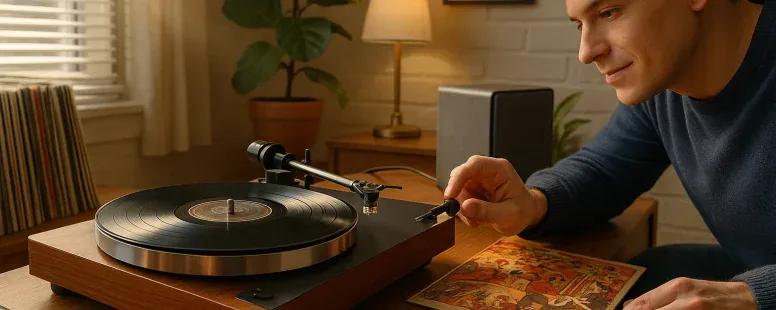
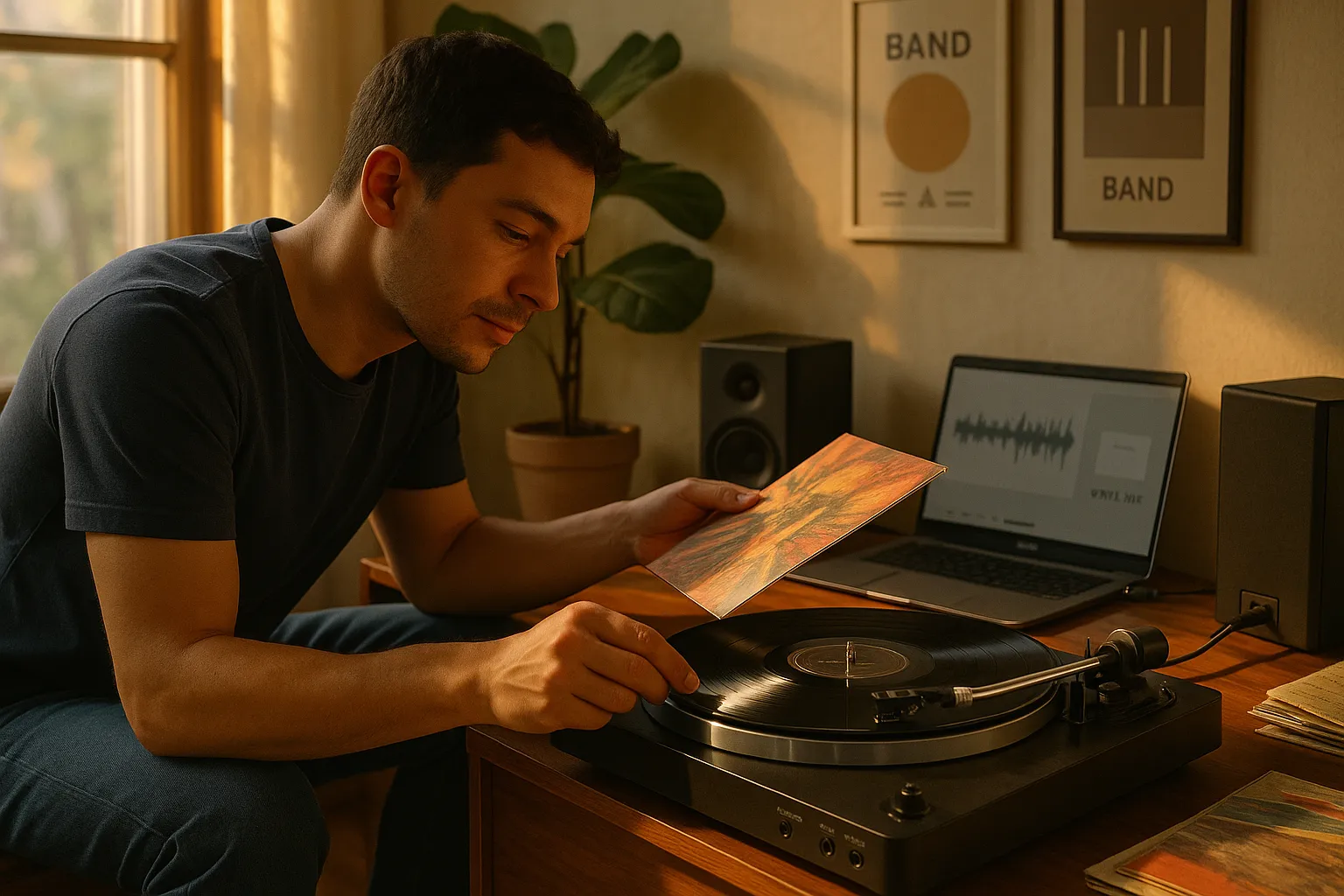
Vinyl opens a different kind of listening, warmer textures, subtle surface noise, and an active ritual that pulls you closer to the music. If you want to start with vinyl, a beginner turntable gives you the most direct path: simple setup, sensible features, and a sound upgrade over laptop-sourced audio. This guide helps you choose the best beginner turntable, explaining key parts, showing vetted picks across budgets, and walking you through setup and care so your first records sound their best.
Why Start With Vinyl? Benefits Of A Beginner Turntable
Fact: A good beginner turntable makes vinyl listening accessible and rewarding. Vinyl gives fuller midrange and tactile engagement that streaming often flattens: you touch the sleeve, cue the tonearm, and listen with intent. For many, that change turns casual music into a hobby.
Audio clarity: Even entry-level turntables reproduce warmth and detail that compressed digital files miss. Brands like Audio-Technica and Pro-Ject deliver clear, musical sound at modest prices.
Tactile experience: Handling records builds a connection to albums. You learn album sequencing, appreciate artwork, and develop listening focus.
Learning curve: A beginner turntable teaches basic audio mechanics, cartridge alignment, tracking force, and anti-skate, skills that let you upgrade later with confidence.
Practical benefits: Most beginner models include built-in preamps or USB outputs for digitizing collections. That means you can play records on powered speakers or convert favorites to files without extra gear.
Surprising upside: Vinyl often encourages you to slow down. That habit improves music discovery and helps you notice production choices, songwriting details, and nuances you had missed before.
How To Choose The Right Beginner Turntable
Fact: Choose a turntable by matching features to how you’ll use it. Start by deciding whether you need portability, digitization, or room-grade sound.
Drive Type: Belt Drive Vs. Direct Drive
Belt drive models isolate the platter from motor vibration. They usually sound quieter and suit home listening. Direct drive gives faster start-up and constant speed, preferred for DJing and mixing. If you plan to DJ, pick direct drive: if you value quiet playback, choose belt drive.
Cartridge And Stylus Basics
Clear answer: The cartridge and stylus shape sound most. Moving-magnet (MM) cartridges are common on beginners models: they are affordable and replaceable. Moving-coil (MC) offer more detail but cost more and need special preamps. Replace stylus regularly, it protects your records.
Speed Options And Pitch Stability
Fact: Most records use 33 1/3 RPM and 45 RPM. Some singles and older discs use 78 RPM. If you collect 7″ singles or older shellac records, choose a turntable with all needed speeds. Pitch stability matters: look for reviews that measure wow and flutter: better stability keeps music in tune.
Built-In Preamp, Outputs, And Connectivity
Answer: A built-in phono preamp simplifies setup. If your amplifier or powered speakers have a phono input, you can skip the internal preamp: otherwise pick a turntable with a switchable preamp or plan to buy an external phono stage. USB outputs let you digitize records: Bluetooth gives convenience but may compress audio.
Budget Brackets: What To Expect At Each Price Point
Fact: Price correlates with parts and refinement. Under $150: basic, often with built-in preamp, decent for casual listening. $150–$400: better tonearms, improved cartridges, and lower vibration. $400–$800: higher-quality platters, upgradeable cartridges, and measurable speed accuracy. Above $800: serious parts for long-term audiophile upgrades. Choose based on how long you’ll keep the setup and whether you plan upgrades.
Top Beginner Turntable Picks (With Key Specs)
Fact: Specific models deliver consistent value for new listeners. Below are vetted picks that cover budgets and use cases.
Affordable Entry-Level Pick, Key Specs And Who It’s For
Model: Audio-Technica AT-LP60X
Key specs: Belt drive, built-in switchable phono preamp, 33/45 RPM, removable headshell, factory-mounted MM cartridge.
Who it’s for: You want plug-and-play simplicity, small budget, and casual listening. The AT-LP60X is quick to set up and reliable for newcomers.
Midrange Best Value, Key Specs And Who It’s For
Model: Fluance RT81
Key specs: Belt drive, solid MDF plinth, Ortofon OM10-compatible cartridge, 33/45 RPM, RCA outputs (phono) and ground.
Who it’s for: You want a clear step-up in sound and upgrade options. The RT81 gives better tonearm geometry and a swappable cartridge at a fair price.
Audiophile-Approachable Option, Key Specs And Who It’s For
Who it’s for: You plan to keep vinyl long-term and might upgrade cartridges. These models reward small tweaks with noticeable sonic gains.
Compact/Portable Option, Key Specs And Who It’s For
Model: Sony PS-LX310BT
Key specs: Belt drive, Bluetooth output, 33/45 RPM, built-in preamp, compact footprint.
Who it’s for: You need wireless convenience for small apartments or dorms and value simplicity over upgrade paths.
Used Or Refurbished Alternatives To Consider
Fact: Buying used can get you higher-tier components for the same money. Look for Technics SL-1200 series for direct drive durability, or older Sansui and Pioneer decks for solid parts. Check service history, replace belts, and inspect the stylus before purchase.
First-Time Setup: Step-By-Step Essentials
Fact: A deliberate setup improves sound and prevents record wear. Follow steps in order and take your time.
Unboxing, Placement, And Leveling
Place the turntable on a firm, level surface away from speakers to avoid feedback. Use a small spirit level on the platter: adjust whatever feet the model provides. Remove transport bolts (if present) before use.
Installing And Aligning The Cartridge
Start with the cartridge mounted to the headshell. Align it using a simple protractor (provided with many turntables or printable online). Correct alignment keeps distortion low near the grooves’ inner tracks.
Setting Tracking Force, Anti-Skate, And Speed
Set the tracking force to the cartridge maker’s recommendation using the counterweight. Adjust anti-skate to match tracking force. Verify speed with a strobe disc or smartphone app and fine-tune if the pitch is off.
Connecting To Speakers Or A Receiver (With/Without Preamp)
If your turntable has a built-in preamp, connect RCA cables to any line input. If not, route the output to a phono input on a receiver or to an external phono preamp before your amplifier. For USB or Bluetooth models, follow the manufacturer’s pairing or driver instructions.
Maintenance And Care For Longevity
Fact: Regular maintenance preserves sound and prevents damage. Clean both records and stylus regularly and perform routine checks.
Cleaning Records And The Stylus
Use a carbon fiber brush before each play to remove dust. Deep clean with a record cleaning solution or a basic vacuum-based record cleaner for very dirty discs. Clean the stylus with a dedicated stylus brush or gel cleaner: brush from back to front to avoid damage.
Routine Checks: Tracking Force, Belt Condition, And Speed Accuracy
Check tracking force monthly, especially after moving the deck. Inspect belts for cracking and replace them every few years if you hear slipping. Verify speed accuracy every few months with a reference tone or app.
Storage, Dust Covers, And Environmental Tips
Keep records vertical and away from heat sources. Use inner sleeves and outer covers to limit dust. Always lower the dust cover during play only if the manufacturer advises: sometimes leaving it open reduces resonance, but it also invites dust.
Accessories Worth Buying For Beginners
Fact: A small set of accessories greatly improves listening and record lifespan.
Cleaning Kits, Record Sleeves, And Brushes
Buy a quality carbon-fiber brush, a record-cleaning solution, and anti-static inner sleeves. These items cut surface noise and reduce stylus wear.
Replacement Cartridges, Phono Preamp Options, And Cables
Keep a spare MM stylus on hand. Consider an external phono preamp like the Schiit Mani or Cambridge Audio Alva for better sound than many built-in preamps. Use well-shielded RCA cables to cut hum.
Isolation Feet, Mats, And Stands
Isolation feet reduce vibration from speakers and foot traffic. Rubber or cork mats change tonal balance slightly: experiment to hear differences. Dedicated stands raise the turntable and keep it away from vibration sources.
Common Beginner Mistakes To Avoid
Fact: Avoiding a few common errors prevents damage and improves sound right away.
Skipping Setup Checks And Rushing The Cartridge Alignment
Many beginners skip alignment and wonder why inner tracks sound distorted. Take 10–20 minutes to align properly: the payoff is cleaner imaging and less wear.
Using Dirty Records Or A Worn Stylus
Playing dirty records damages both the groove and the stylus. Replace a worn stylus promptly: it’s cheaper than replacing favorite records.
Overlooking Compatibility With Existing Audio Gear
Check whether your receiver has a phono input. If not, you will need a phono preamp or a turntable with a built-in preamp. Also check speaker power and placement to avoid feedback and thin sound.
To provide the best experiences, we use technologies like cookies to store and/or access device information. Consenting to these technologies will allow us to process data such as browsing behaviour or unique IDs on this site. Not consenting or withdrawing consent, may adversely affect certain features and functions.
Functional
Always active
The technical storage or access is strictly necessary for the legitimate purpose of enabling the use of a specific service explicitly requested by the subscriber or user, or for the sole purpose of carrying out the transmission of a communication over an electronic communications network.
Preferences
The technical storage or access is necessary for the legitimate purpose of storing preferences that are not requested by the subscriber or user.
Statistics
The technical storage or access that is used exclusively for statistical purposes.The technical storage or access that is used exclusively for anonymous statistical purposes. Without a subpoena, voluntary compliance on the part of your Internet Service Provider, or additional records from a third party, information stored or retrieved for this purpose alone cannot usually be used to identify you.
Marketing
The technical storage or access is required to create user profiles to send advertising, or to track the user on a website or across several websites for similar marketing purposes.