What Is Older: Christianity or Islam?
In a world rich with diverse cultures and beliefs, the timeline of religions often sparks curiosity. Imagine tracing the footsteps of ancient communities, observing their rituals and witnessing the birth of their faiths. Christianity and Islam, two of the world’s major religions, share historical and theological connections while also standing distinct in their origins. What if we told you that these faiths, each with powerful narratives, have inspired billions? As we explore their histories, we’ll uncover not just the timelines, but the significant people, texts, and events that have shaped our understanding. Let’s embark on this journey through time, seeking to understand the roots of our beliefs and the profound impacts they’ve had on societies throughout the ages.
Historical Context of Christianity

Origins and Foundational Texts
Christianity began in the 1st century CE, rooted in Jewish traditions. It originated from the teachings of Jesus of Nazareth, who is considered the central figure of the faith. The foundational texts of Christianity include the Old Testament, which overlaps with the Hebrew Bible, and the New Testament, which chronicles the life of Jesus and the early church. The Gospels, Matthew, Mark, Luke, and John, serve as the core narratives detailing Jesus’s life, death, and resurrection.
Development of Early Christian Communities
As Jesus’s teachings spread, small communities of believers began to form. These early Christians faced persecution, yet their faith continued to grow, leading to the establishment of churches throughout the Roman Empire. Communities often gathered in homes, sharing meals and engaging in prayer and worship. This fellowship was crucial for nurturing the faith among believers and fostering a sense of belonging.
Key Figures and Events in Early Christianity
Prominent figures like the Apostle Paul played a pivotal role in spreading Christianity beyond Jewish communities, emphasizing the message’s universality. Key events include the Council of Jerusalem around 50 CE, which addressed the place of Gentiles in the faith. Over the years, Christianity endured significant challenges, including persecutions and theological disputes, eventually leading to its recognition as a major religion by the Roman Empire in the 4th century CE.
Historical Context of Islam

Origins and Key Texts of Islam
Islam emerged in the 7th century CE, emanating from the teachings of the Prophet Muhammad, who is regarded as the final prophet in a long line that includes figures from the Abrahamic tradition. The Qur’an, believed to be the literal word of God as revealed to Muhammad, serves as the central religious text of Islam. Alongside it, Hadith, collections of sayings and actions of Muhammad, provides important guidance for Muslims.
Formation of the Early Muslim Community
The early Muslim community began in Mecca, where Muhammad preached monotheism in a polytheistic society. Following opposition, he and his followers migrated to Medina in 622 CE, marking the beginning of the Islamic calendar. This move not only provided safety but also allowed the community to flourish and spread rapidly.
Significant Figures and Events in Early Islam
Key figures such as Abu Bakr, the first caliph, and Uthman, the third caliph, were crucial in promoting and expanding Islam. The early Muslim conquests in the 7th and 8th centuries led to the establishment of vast empires, helping to spread Islamic teachings across North Africa, the Middle East, and beyond.
Comparative Chronology of Christianity and Islam
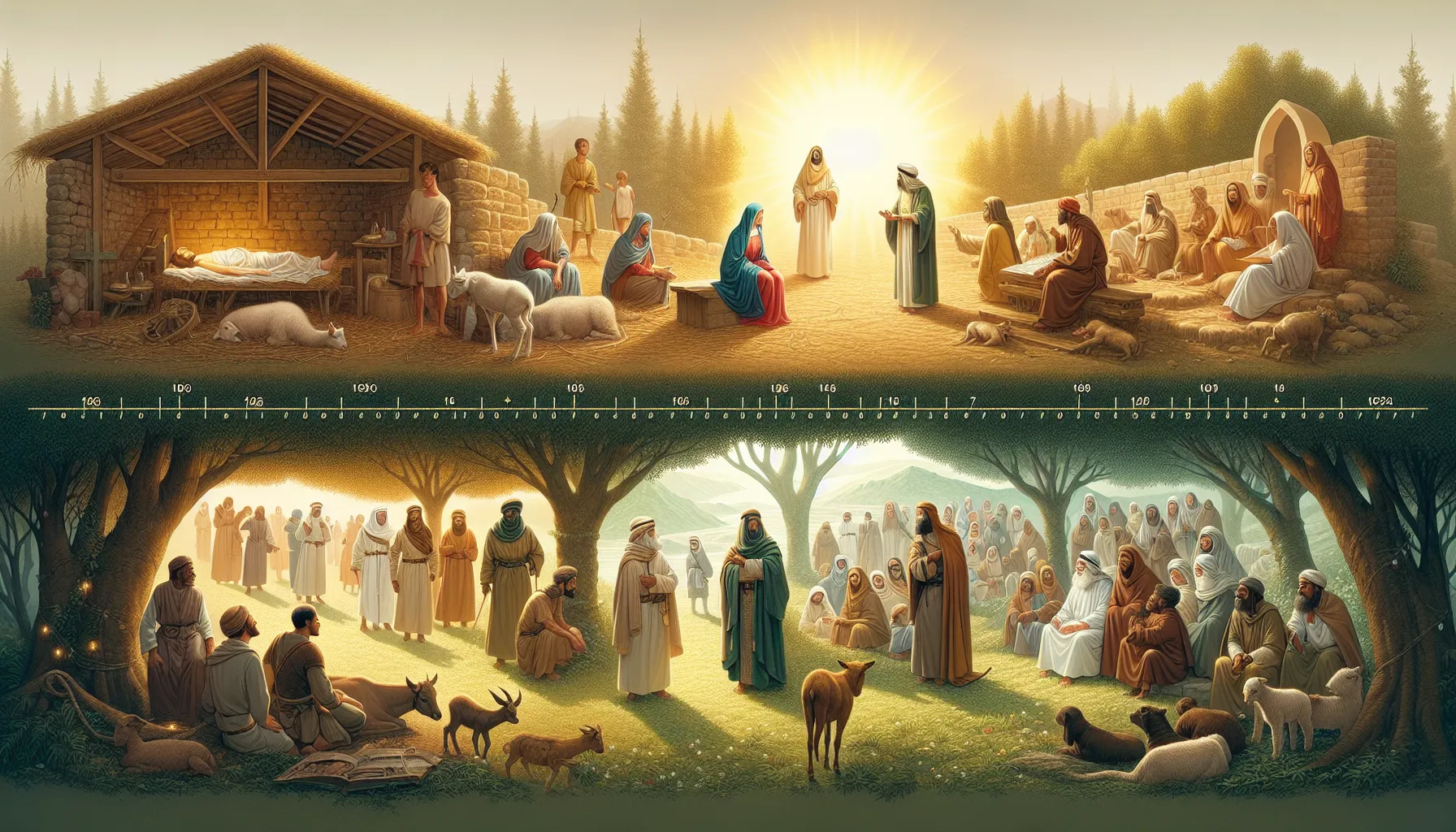
Timeline of Key Events in Christianity
- Circa 4 BCE: Birth of Jesus.
- Circa 30-33 CE: Jesus’s crucifixion and resurrection.
- Circa 50 CE: The formation of early Christian communities.
- 313 CE: Edict of Milan, legalizing Christianity in the Roman Empire.
- 380 CE: Christianity becomes the state religion of the Roman Empire.
Timeline of Key Events in Islam
- 570 CE: Birth of Muhammad.
- 610 CE: Muhammad receives his first revelation.
- 622 CE: Hijra (migration) to Medina.
- 632 CE: Death of Muhammad and the beginning of the Rashidun Caliphate.
- 661-750 CE: Umayyad Caliphate expands Islam across vast territories.
Cultural and Historical Impact of Both Religions

Spread of Christianity and Its Influence
Christianity’s spread was marked by missionary activities across Europe, leading to significant cultural shifts. The religion influenced art, philosophy, and law, intertwining deeply with Western civilization. The establishment of schools and universities by the Church helped not only educate but also preserve knowledge through the Dark Ages.
Spread of Islam and Its Influence
Similarly, Islam’s expansion transformed regions through trade, scholarship, and conquest. The Islamic Golden Age, characterized by advancements in science, mathematics, and art, showcased the religion’s profound impact on global development. Stories of explorers like Ibn Battuta and scholars like Avicenna reveal the significant role of Islam in fostering a rich intellectual tradition.
Concluding Thoughts on the Age of Christianity and Islam
As we peel back the layers of history, we see that Christianity predates Islam by several centuries, establishing a foundation that would influence numerous aspects of culture and society. But, Islam, emerging in the 7th century, quickly became a dominant force, reshaping the course of history in its own right. The interplay of these religions is not merely one of age but rich in shared narratives, theological dialogues, and mutual influences. Understanding this history invites us to appreciate not just the age of these faiths, but their enduring impacts on humanity. To explore related ancient faiths, read about what is older: Zoroastrianism or Judaism, discover what is older: Zoroastrianism or Hinduism, and see how their scriptures compare in our article on what is older: the Bible or the Quran.
by Ellie B, Site owner & Publisher

- Japanese Maple Bloodgood Vs. Atropurpureum - March 9, 2026
- Best Alternatives To Chrome - March 9, 2026
- The Difference Between Sunrise and Dawn, Explained Like You’Re Busy - March 9, 2026