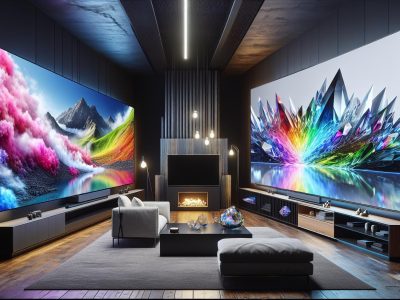
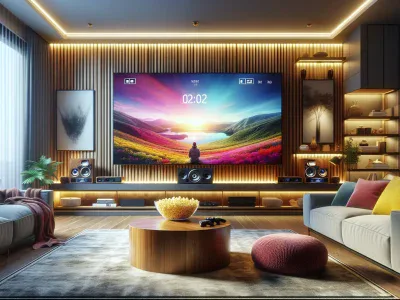
When navigating the myriad of options in modern television technology, you may encounter terms like UHD and QLED, and understanding these can be the key to transforming your viewing experience. Both UHD (Ultra High Definition) and QLED (Quantum Dot LED) offer impressive advancements in display technology that cater to different needs and preferences. Diving into their distinctions and specialties can help you make an educated choice, whether you’re setting up a home theater, boosting your professional presentations, or simply indulging in the latest binge-worthy series.
Defining UHD and QLED
What is UHD?
Ultra High Definition (UHD) represents the next evolutionary step in television resolution compared to standard HD. It offers a resolution of 3840×2160 pixels, four times the clarity of traditional Full HD screens. This enhanced resolution delivers sharper images, crisp details, and a more immersive visual experience, making UHD ideal for larger screen sizes and close viewing.
What is QLED?
Quantum Dot LED (QLED) technology, developed and popularized by manufacturers such as Samsung, enhances the performance of traditional LED displays by utilizing a layer of quantum dots. These dots emit precise colors when exposed to light, resulting in superior brightness, deeper contrast, and a wider color spectrum. Although primarily associated with Ultra HD resolutions, QLED focuses on color and brightness enhancements rather than resolution alone.
Key Features of UHD and QLED Technology
Resolution and Picture Quality
UHD excels in delivering an incredibly detailed and realistic image, particularly on large screens. On the other hand, QLED enhances the overall visual appeal with its exceptional brightness, stand-out contrast ratios, and accurate color reproduction, making it particularly suited for vibrant, brightly-lit environments.
Color and Brightness Enhancements
Quantum dots distinguish QLED, providing a vivid viewing experience that standard UHD cannot match. These microscopic particles enable a greater volume of colors and brighter displays, making QLED panels an excellent choice for HDR (High Dynamic Range) content.
Comparison: UHD and QLED in Practical Scenarios
Best Use Cases for UHD
UHD is particularly beneficial for users seeking detailed, clear visuals for watching movies, editing photos or videos, or playing visually immersive games. It is especially advantageous for larger screen formats in subdued lighting conditions to appreciate the finer image details fully.
Best Use Cases for QLED
With its superior brightness and vivid color capabilities, QLED shines in brightly-lit spaces, such as living rooms with plenty of natural light. It is also well-suited for users who prioritize HDR content, as the technology enhances contrast and makes HDR-supported visuals even more engaging.
Factors to Consider When Choosing Between UHD and QLED
Budget and Cost Implications
When deciding between UHD and QLED, understanding your budget constraints is crucial. While UHD televisions provide excellent value for standard resolution enhancement, QLED TVs, due to their additional technological layers, generally come with a higher price tag but can be worth the investment for superior color and brightness.
Intended Usage Environment
Consider your usage environment, such as lighting conditions and viewing habits. If your space is well-lit and you consume a lot of HDR content, QLED might be the better choice. On the other hand, for dimmer setups or tasks requiring high resolution detailing, UHD becomes a practical option.
To provide the best experiences, we use technologies like cookies to store and/or access device information. Consenting to these technologies will allow us to process data such as browsing behaviour or unique IDs on this site. Not consenting or withdrawing consent, may adversely affect certain features and functions.
Functional
Always active
The technical storage or access is strictly necessary for the legitimate purpose of enabling the use of a specific service explicitly requested by the subscriber or user, or for the sole purpose of carrying out the transmission of a communication over an electronic communications network.
Preferences
The technical storage or access is necessary for the legitimate purpose of storing preferences that are not requested by the subscriber or user.
Statistics
The technical storage or access that is used exclusively for statistical purposes.The technical storage or access that is used exclusively for anonymous statistical purposes. Without a subpoena, voluntary compliance on the part of your Internet Service Provider, or additional records from a third party, information stored or retrieved for this purpose alone cannot usually be used to identify you.
Marketing
The technical storage or access is required to create user profiles to send advertising, or to track the user on a website or across several websites for similar marketing purposes.