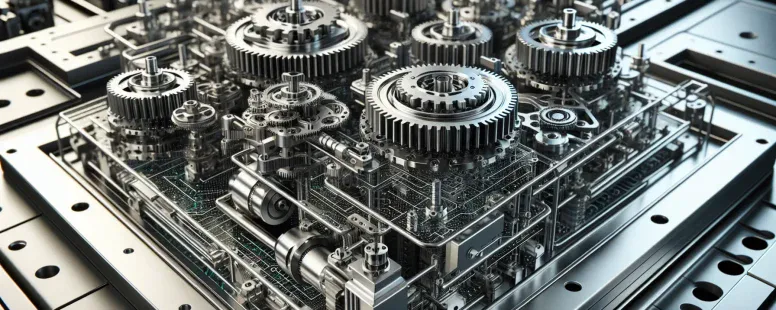
Picture a world where everything operates in perfect harmony, each part seamlessly interacting with another. Systems surround you—your body, the technology you use, even the universe itself. But have you ever stopped to consider what truly defines a system? Is it possible for a system to exist with just one solitary object, or does it inherently require multiple components working together?
This question isn’t just theoretical; it’s at the heart of understanding how things function and connect. From ecosystems to machines, every system seems to rely on relationships between its parts. Yet, could an isolated entity still qualify as a “system”? The answer might surprise you and challenge how you view the interconnectedness of everything around you.
By diving into this concept, you’ll uncover insights that redefine your perspective on systems—whether they’re physical structures or abstract ideas—and reveal why this question matters more than you’d expect.
Understanding Systems And Their Components
A system represents an organized structure where elements interact to achieve a purpose. This interaction often defines the existence and functionality of systems.
What Defines A System?
A system is defined by its components, relationships, and purpose. It requires interconnected parts working in unison rather than isolation. For example, in a computer system, hardware (CPU, memory) and software (operating systems) collaborate to process data.
Without interactivity among components, the concept of “system” becomes invalid. In ecosystems, plants rely on sunlight for photosynthesis while animals depend on plants for oxygen or food.
In abstract systems like economies, currency flows between consumers and businesses based on supply-demand dynamics. These examples underline the importance of connections within any system.
The Role Of Objects In A System
Objects serve as fundamental units within systems. They contribute specific functions that support overall goals. For instance:
Mechanical Systems: Gears in clocks ensure accurate timekeeping by transferring motion.
Biological Systems: Cells perform specialized tasks like energy production or replication.
Technological Systems: Sensors in smart devices collect environmental data for processing.
But if isolated from their interactions with other objects these elements lose systemic relevance. A single gear without others cannot form a clock mechanism; similarly one cell alone doesn’t constitute an organism’s full biology.
Exploring The Claim: True Or False
The claim “a system must contain more than one object” raises questions about the definition and characteristics of a system. Examining this statement involves exploring its accuracy across different contexts.
Analyzing The Statement
A system is defined by its components, their relationships, and a specific purpose. While many systems consist of multiple interconnected objects, this isn’t universally required. For instance, in abstract systems like mathematical models or theoretical frameworks, a single entity can function as a complete system when it possesses internal interactions or processes.
Consider the example of an isolated atom. It forms a self-contained quantum system governed by principles like wave-particle duality and energy states without relying on external entities. But, for physical systems such as machines or ecosystems, interaction between multiple objects is essential to achieving the desired functionality.
Examples Of Systems With A Single Object
Some systems can operate with only one object under certain definitions. A black hole represents an astrophysical system characterized by properties like mass, spin, and charge affecting spacetime around it. Although no other object interacts directly within its event horizon, it’s still studied as a dynamic part of broader cosmic mechanics.
Another example includes standalone computational simulations modeling solitary phenomena (e.g., singular harmonic oscillators). These simulations represent closed-system conditions where all relevant aspects are confined within one virtual environment.
Systems With Multiple Objects
Most functional systems rely on interactions between two or more components to achieve objectives. In ecological networks (e.g., predator-prey relationships), organisms depend on mutual exchanges for survival and balance within habitats.
Similarly, mechanical assemblies like engines require parts such as pistons and cylinders working in tandem to produce motion or energy conversion efficiently. Human circulatory systems involve organs (e.g., hearts) collaborating with vessels to distribute blood throughout bodies—a critical process enabling life functions.
Factors Influencing System Composition
The composition of a system depends on various elements, shaping how its components interact and fulfill their purpose. These factors determine whether a system requires multiple objects or can exist as a singular entity.
Purpose And Functionality
A system’s purpose drives the necessity for its components. If achieving a goal involves interconnected actions, more than one object is often required. For instance, in an ecosystem, plants produce oxygen while animals consume it—creating balance through mutual dependence. In contrast, abstract systems like algorithms perform tasks independently within predefined parameters, demonstrating functionality without external connections.
Consider mechanical devices like engines. Here, pistons and cylinders work together to generate motion; removing any part disrupts the operation entirely. But, single-object systems such as magnetic fields exhibit internal dynamics that define their existence without involving additional entities.
Complexity And Interconnectivity
The complexity of interactions influences whether multiple objects form a system. In highly interconnected setups like transportation networks or neural pathways, numerous components collaborate to maintain efficiency and reliability. Removing one element often affects overall performance significantly.
On the other hand, simpler systems operate with minimal or no interdependency among parts. A solitary celestial body can represent an isolated gravitational field—a self-contained dynamic unit studied within astrophysics.
Practical Applications And Implications
Understanding whether a system must contain more than one object has direct relevance across various fields. This insight influences how systems are identified, analyzed, and optimized in practical contexts.
Real-World Examples
In ecological studies, systems like rainforests demonstrate the necessity of multiple objects. Trees interact with animals, fungi, and microorganisms to sustain biodiversity. Without these interactions, the ecosystem collapses, showing that interconnectedness defines such systems.
Technological applications offer contrasting perspectives. A single microchip can function as an isolated system due to its internal circuitry facilitating data processing. But, when integrated into devices like smartphones or computers, it becomes part of a larger system requiring collaboration between components for optimal performance.
Consider transportation networks as another example. They rely on vehicles interacting with infrastructure (roads, bridges) and control systems (traffic lights) to operate effectively. If any component fails or isolates itself from others’ influence—for instance if traffic signals malfunction—the entire network’s efficiency declines.
Importance Of Recognizing System Boundaries
Recognizing boundaries ensures accurate definitions and evaluations of systems within specific contexts. In project management frameworks like Agile or Scrum methodologies defining clear system limits helps teams stay focused on objectives while avoiding scope creep—when too many unrelated elements disrupt progress.
Scientific research highlights boundary recognition in experiments involving closed vs open thermodynamic environments; closed-system models simplify analysis by isolating variables whereas open-systems require accounting external influences complicating predictions but reflecting real-world dynamics better suited certain scenarios depending needs context constraints aims etc…
Conclusion
Understanding whether a system must contain more than one object challenges you to think critically about the dynamics of components and interactions. While many systems thrive on collaboration between multiple elements, others demonstrate that a single entity can sometimes function as a complete system in specific contexts.
By exploring real-world examples and abstract models, you gain valuable insight into how systems operate across diverse fields. This perspective not only broadens your understanding but also highlights the importance of defining boundaries and relationships when analyzing any system’s functionality or purpose.
To provide the best experiences, we use technologies like cookies to store and/or access device information. Consenting to these technologies will allow us to process data such as browsing behaviour or unique IDs on this site. Not consenting or withdrawing consent, may adversely affect certain features and functions.
Functional
Always active
The technical storage or access is strictly necessary for the legitimate purpose of enabling the use of a specific service explicitly requested by the subscriber or user, or for the sole purpose of carrying out the transmission of a communication over an electronic communications network.
Preferences
The technical storage or access is necessary for the legitimate purpose of storing preferences that are not requested by the subscriber or user.
Statistics
The technical storage or access that is used exclusively for statistical purposes.The technical storage or access that is used exclusively for anonymous statistical purposes. Without a subpoena, voluntary compliance on the part of your Internet Service Provider, or additional records from a third party, information stored or retrieved for this purpose alone cannot usually be used to identify you.
Marketing
The technical storage or access is required to create user profiles to send advertising, or to track the user on a website or across several websites for similar marketing purposes.