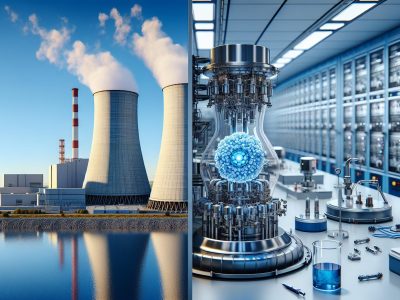
The unraveling of nuclear science has provided humanity with profound methods to harness nature’s most fundamental forces, enabling remarkable advancements in energy production and technological applications. Among these phenomena are nuclear fusion and nuclear fission, processes that lie at the heart of harnessed nuclear power. Understanding their principles, applications, and potential for future development can give you unique insights into the progression of scientific endeavors and their impact on our world.
What Are Fusion and Fission?
Fundamentals of Nuclear Fusion
Nuclear fusion is the process in which two light atomic nuclei combine to form a heavier nucleus, accompanied by the release of a substantial amount of energy. This process, which powers stars, including our Sun, involves overcoming the repulsive electrostatic forces between nuclei to enable their bonding. Fusion reactions require extremely high temperatures and pressures to occur, conditions that provide the needed energy for nuclei to collide and bond.
Key Concepts of Nuclear Fission
In contrast, nuclear fission occurs when a heavy atomic nucleus splits into two lighter nuclei, releasing energy along with neutrons. This process typically involves the absorption of a neutron by the nucleus, rendering it unstable and causing it to split. Fission serves as the basis of current nuclear reactors, where the energy released is utilized for electricity generation and other applications.
The Historical Context of Both Processes
Evolution of Nuclear Research
The study of atomic nuclei can be traced back to the early 20th century, with pioneering scientists like Ernest Rutherford and Marie Curie laying the groundwork for modern nuclear science. The discovery of the neutron by James Chadwick in 1932 was a pivotal advancement, enabling a deeper understanding of atomic structures and interactions.
Milestones in Fusion and Fission Development
The practical realization of nuclear fission occurred in the 1930s and 1940s, with its first prominent application being during World War II. In contrast, the pursuit of nuclear fusion as a practical energy source has required extended research due to the complex conditions necessary for sustaining reactions. Even though this, milestones such as the demonstration of controlled plasma confinement represent significant accomplishments in fusion research.
Comparative Analysis of Fusion and Fission
Energy Production Efficiency
Both fusion and fission release immense energy per reaction. But, fusion reactions offer the potential for even higher energy yield per unit of fuel when compared to fission, making it an appealing option for future energy solutions.
Safety and Environmental Impacts
Fusion is considered inherently safer than fission due to the absence of the risk of a runaway chain reaction and minimal long-lived radioactive waste production. Fission reactors, although efficient, pose significant challenges in radioactive waste management and safety protocols to prevent accidents.
Current and Future Applications
While fission is actively employed in nuclear power plants globally to provide electricity, fusion research is pushing the boundaries of creating a sustainable and virtually limitless energy supply. Advancements in tokamak reactor designs and magnetic confinement technology bring humanity closer to practical fusion energy systems.
The Potential of Advanced Fusion Research
Innovative Experiments and Achievements
Recent experiments at facilities like ITER and the National Ignition Facility have marked a promising trajectory towards achieving net-positive fusion energy output. Innovations in material science and computational simulations have also significantly contributed to understanding and optimizing fusion process dynamics.
Challenges Facing Fusion Advancement
Even though progress, considerable challenges remain in achieving and sustaining the conditions required for fusion. Addressing issues like plasma confinement, materials’ resilience under extreme environments, and cost-effective scalability are central to research efforts.
To provide the best experiences, we use technologies like cookies to store and/or access device information. Consenting to these technologies will allow us to process data such as browsing behaviour or unique IDs on this site. Not consenting or withdrawing consent, may adversely affect certain features and functions.
Functional
Always active
The technical storage or access is strictly necessary for the legitimate purpose of enabling the use of a specific service explicitly requested by the subscriber or user, or for the sole purpose of carrying out the transmission of a communication over an electronic communications network.
Preferences
The technical storage or access is necessary for the legitimate purpose of storing preferences that are not requested by the subscriber or user.
Statistics
The technical storage or access that is used exclusively for statistical purposes.The technical storage or access that is used exclusively for anonymous statistical purposes. Without a subpoena, voluntary compliance on the part of your Internet Service Provider, or additional records from a third party, information stored or retrieved for this purpose alone cannot usually be used to identify you.
Marketing
The technical storage or access is required to create user profiles to send advertising, or to track the user on a website or across several websites for similar marketing purposes.