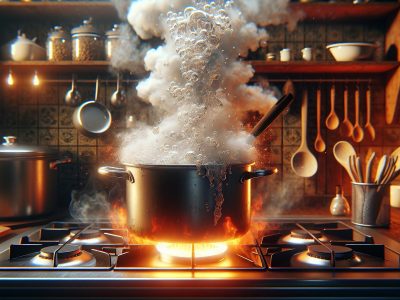
Picture a puddle disappearing under the sun’s warmth or water bubbling away in a boiling pot. Both seem like magic acts, yet they’re rooted in fascinating science. why these processes happen differently? Vaporization and evaporation might sound similar, but they unfold in unique ways that shape our everyday experiences.
From the gentle escape of molecules on a sunny day to the intense transformation during boiling, understanding these differences reveals how nature works at both subtle and dramatic levels. Whether you’re curious about weather patterns or simply want to grasp what’s happening in your kitchen, knowing how vaporization and evaporation differ can open your eyes to the hidden dynamics around you.
Understanding Vaporization
Vaporization refers to the process where a substance changes from its liquid or solid state into a gas. This transformation occurs when particles gain enough energy to overcome intermolecular forces.
Definition and Process
Vaporization involves adding heat or reducing pressure to enable molecules in a liquid or solid to escape into the gaseous phase. Two key factors are temperature and energy input. For instance, when water boils at 212°F (100°C), it undergoes vaporization as heat energy breaks molecular bonds.
The process can occur rapidly, such as boiling water on a stove, or more gradually under specific conditions like sublimation of dry ice at room temperature. Unlike evaporation, which happens only at the surface and below boiling point, vaporization encompasses phenomena occurring throughout the entire volume of the material.
Types of Vaporization
Evaporation: A slow surface-level phenomenon where molecules transition into gas without reaching boiling point. For example, puddles disappearing after rain is due to evaporation caused by sunlight heating water molecules.
Boiling: A rapid process beginning when a liquid reaches its boiling point under given atmospheric pressure. Bubbles forming within hot water demonstrate this type of vaporization distinctly.
Sublimation: The direct conversion of solids into gases bypassing the liquid form entirely; an example is frozen carbon dioxide (dry ice) turning directly into vapor under normal atmospheric conditions.
Exploring Evaporation
Evaporation is a natural process that occurs around you every day. It’s responsible for drying wet clothes, forming rain clouds, and even cooling your body through sweat.
Definition and Process
Evaporation refers to the transformation of a liquid into vapor at its surface without reaching its boiling point. Unlike boiling, which involves the entire liquid volume, evaporation happens only at the liquid’s exposed surface. Molecules with higher kinetic energy escape into the air when they overcome cohesive forces within the liquid.
For example, water in an open container gradually disappears as it evaporates into the surrounding atmosphere. The rate depends on variables like temperature and airflow. This process plays a significant role in Earth’s water cycle by transferring moisture from oceans, lakes, and rivers into the air.
Factors Affecting Evaporation
Several factors influence how quickly evaporation occurs:
Temperature: Higher temperatures increase molecular energy levels, enabling more particles to escape from the surface.
Surface Area: Liquids spread over larger areas evaporate faster because more molecules are exposed to air.
Air Movement: Wind or moving air removes saturated vapor near a liquid’s surface, accelerating evaporation.
Humidity: High humidity slows evaporation since moist air already contains substantial water vapor.
An example highlighting these factors is drying laundry on a sunny day versus in humid weather—the former dries quicker due to increased heat and reduced atmospheric moisture.
Key Differences Between Vaporization And Evaporation
Vaporization and evaporation are distinct processes within the phase change phenomena, differing in terms of temperature, states of matter, speed, and practical applications.
Temperature Requirements
Vaporization involves both boiling and evaporation. Boiling occurs when a liquid reaches its boiling point (e.g., 100°C for water), while evaporation happens below the boiling point at any temperature. For example, water boils on a stove at high heat but evaporates from a glass left uncovered.
Evaporation depends on factors like ambient temperature. Higher temperatures increase molecular kinetic energy, accelerating the process. In contrast, vaporization during boiling requires consistent external heating to sustain the phase transition.
States of Matter Involved
Both vaporization and evaporation involve liquids transforming into gases. But, vaporization also includes solid-to-gas transitions through sublimation (e.g., dry ice turning into carbon dioxide gas). Evaporation exclusively concerns surface molecules escaping as gas without involving solids.
For instance, ice sublimating directly in subzero conditions is vaporization but not evaporation. Similarly, sweat drying from your skin represents evaporation rather than complete vaporization since it doesn’t involve other state changes.
Speed and Rate of Process
Vaporization can be rapid or slow depending on whether it’s boiling or sublimation—boiling speeds up under sustained heat; sublimation is slower due to lower energy inputs. Evaporation is inherently gradual as only surface molecules escape incrementally over time.
Consider steaming water: bubbles form rapidly during boiling while an open puddle dries slowly through evaporation under sunlight exposure alone.
Practical Examples
Boiling water for tea illustrates vaporization at its most visible form: steam rising immediately after reaching 100°C shows rapid liquid-to-gas conversion. Sublimation appears less commonly yet dramatically with materials like frozen carbon dioxide (dry ice) producing dense fog-like vapors in contact with air.
Evaporation plays vital roles in everyday life too: wet clothes drying outside after laundry day or sweat cooling your body post-exercise highlight this slower surface-level transformation’s significance across routine activities.
Real-World Applications
Understanding how vaporization and evaporation function reveals their significant roles across various industries and natural processes. These phenomena are essential in technology, weather systems, and everyday life.
Applications of Vaporization
Vaporization is vital for energy production in power plants. In thermal power stations, water undergoes boiling to produce steam that drives turbines, generating electricity efficiently. This process highlights the practical significance of vaporization in meeting global energy demands.
In aerospace engineering, liquid fuels like hydrogen and oxygen vaporize to create high-energy propulsion systems used in rockets. This controlled phase change ensures optimal performance during launches.
Pharmaceuticals rely on sublimation as a form of vaporization during freeze-drying (lyophilization) to preserve medications without compromising their chemical stability. For instance, vaccines often undergo this process for long-term storage.
Applications of Evaporation
Evaporation plays a critical role in agriculture through irrigation practices like drip systems, where water evaporates slowly into the air while nourishing crops. You observe this effect when soil feels drier under sunny conditions compared to cloudy days.
Cooling technologies use evaporation extensively; air conditioners use refrigerants that absorb heat from indoor spaces by evaporating at low temperatures within coils. Similarly, sweating cools your body as moisture on skin surfaces absorbs heat while turning into vapor.
Salt extraction benefits from evaporation ponds where seawater gradually evaporates under sunlight leaving salt crystals behind. This age-old technique supports industries producing table salt or industrial-grade sodium chloride products worldwide.
Conclusion
Understanding the differences between vaporization and evaporation gives you a deeper appreciation for their roles in both nature and technology. These processes influence everything from weather patterns to industrial innovations, showcasing their significance in everyday life.
By recognizing how factors like temperature and energy impact these phenomena, you can better grasp their applications across various fields. Whether it’s watching laundry dry or marveling at advancements in science, the principles of vaporization and evaporation are all around you, shaping your world in remarkable ways.
To provide the best experiences, we use technologies like cookies to store and/or access device information. Consenting to these technologies will allow us to process data such as browsing behaviour or unique IDs on this site. Not consenting or withdrawing consent, may adversely affect certain features and functions.
Functional
Always active
The technical storage or access is strictly necessary for the legitimate purpose of enabling the use of a specific service explicitly requested by the subscriber or user, or for the sole purpose of carrying out the transmission of a communication over an electronic communications network.
Preferences
The technical storage or access is necessary for the legitimate purpose of storing preferences that are not requested by the subscriber or user.
Statistics
The technical storage or access that is used exclusively for statistical purposes.The technical storage or access that is used exclusively for anonymous statistical purposes. Without a subpoena, voluntary compliance on the part of your Internet Service Provider, or additional records from a third party, information stored or retrieved for this purpose alone cannot usually be used to identify you.
Marketing
The technical storage or access is required to create user profiles to send advertising, or to track the user on a website or across several websites for similar marketing purposes.