You’ve probably seen them, those winged critters that suddenly appear and swarm around your home. But are they termites or flying ants? These two insects might seem similar at first glance, but there’s a world of difference between them.
Understanding Termites and Flying Ants
Diving deeper into the world of termites and flying ants, it’s vital to recognize their distinctive characteristics.
Termite Overview
Termites are fascinating insects. They belong to the insect order Isoptera that has approximately 2,750 different species worldwide. Mostly found in warm climates, they’re recognized for their unique social structure similar to bees or ants: workers, soldiers, reproductives (kings and queens).
Termite colonies can survive for decades under ideal conditions; a queen termite may live up to 50 years—the longest lifespan among all known insects! But what truly sets them apart is their diet—they feed primarily on cellulose from dead plants and trees.
On closer inspection though—you’ll see more distinct features—like straight antennae and uniform waist which helps distinguish these silent destroyers from other common household pests like carpenter ants.
Flying Ants Overview
Flying ants come in various types too with over 12 thousand ant species across the globe—with many displaying flight during specific life cycles stages typically called ‘nuptial flights.’ These airborne members aren’t always present but emerge only when new colonies need founding—an event commonly referred as swarming season occurring usually after rainfalls in summer months.
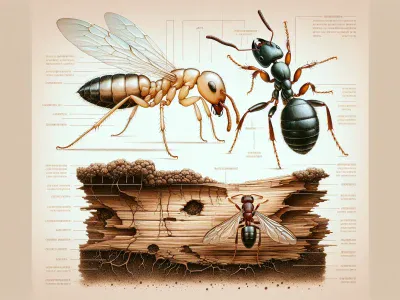
Ant anatomy significantly differs from termites by having elbowed antennae along with segmented waists – creating an hourglass shape if viewed sideways! Also unlike termites who shed wings soon after nuptial flights ,ants retain theirs until death—a feature crucially helpful while distinguishing between these two often misidentified creatures!
Physical Attributes Comparison
When it comes to distinguishing termites from flying ants, the devil’s in the details. It is these small but crucial physical features that set them apart.
Termite’s Physical Features
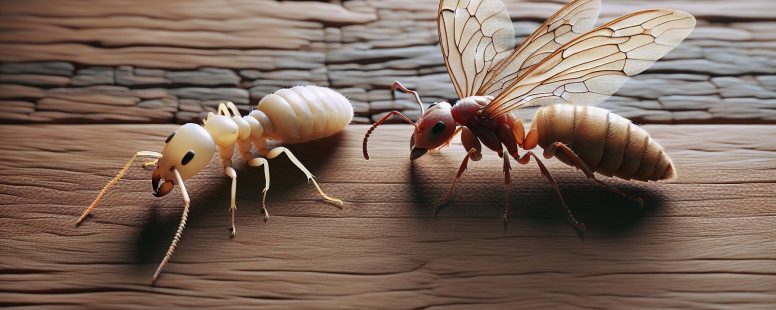
Let’s first turn our attention to termites. Termites possess straight antennae as if they’re saluting Mother Nature herself. They also have a broad waist – there’s no pinching or constriction here! If you observe their wings closely, you’ll find two sets of identical size and shape – symmetry at its finest!
Also, a termite exhibits body segments that blend seamlessly into each other; indeed, one might say it presents an ‘uninterrupted’ silhouette. In terms of coloration too, they don’t show off much variety: shades range between pale white and light brown only.
Remember how we mentioned queen termites can live up to 50 years? Their robust exoskeletons provide vital protection against predators throughout this extended lifespan.
Flying Ants’ Physical Features
Now let us shift focus towards flying ants which boast their own unique attributes worth noting down for your insect identification checklist.
Flying ants sport elbowed antennae – quite unlike the ramrod-straight ones found on termites! These insects are known for segmented waists creating what looks like an hourglass figure when viewed from above- now isn’t nature fascinating?
Besides ,these critters exhibit significant variation in wing length with front pair noticeably larger than rear ones offering yet another point of differentiation compared to uniformly sized termite wings . Plus remember those retained post-mating flights earlier discussed? Yes ant wings remain attached till death providing easy identifiers even after mating episodes .
Behavioral Patterns of Termites and Flying Ants
Understanding the behavioral patterns of termites and flying ants allows for accurate identification. Let’s investigate deeper into these behaviors.
Termite’s Behavior
Termites, belonging to approximately 2,750 species worldwide, display remarkable social behavior with complex roles including workers, soldiers and reproductives within their colonies. Interestingly enough, they communicate using pheromones – chemical signals that help in coordinating activities like food searching or alerting others about potential threats.
Being detritivores by nature means feeding primarily on dead plants materials abundant in cellulose such as wood is a key aspect of termite behavior. This dietary preference leads them to cause significant damage to wooden structures – be it your home furniture or forest ecosystems!
Another peculiar attribute includes mound-building exhibited by some species creating huge nests reaching heights up-to eight meters! The construction process involves intricate tunnel systems ensuring temperature regulation necessary for survival – an architectural feat not seen elsewhere among insects!
Finally but importantly- unlike most insects preferring light conditions; you’ll find termites are predominantly nocturnal meaning active during night-time which further aids concealment from predators hence increasing longevity leading queen termites living upto five decades under favorable circumstances.
Flying Ant’s Behavior
On contrary stands out the vastly different world encompassing over 12k species known collectively as ‘Flying Ants’. Their flight period called ‘nuptial flights’ generally occur post summer rainfalls indicating mating season has begun where males & females take off high above ground level aiming at finding suitable partners.
Unlike non-flying worker ants performing majority tasks around colony maintenance; flying ant’s main objective centers towards reproduction thereby securing future generations before meeting inevitable death after successful mating mission completion whereas female counterparts lose wings becoming new queens starting fresh colonies providing continuity necessary for survival amidst challenging natural habitats,
Also distinct features set apart this group namely elbowed antennae coupled with segmented waists presenting hourglass shaped figures & unequal wing lengths where front pair outweighs rear ones in size. Another distinguishing feature is their ability to retain wings until death unlike termites shedding them after nuptial flights.
Damage Caused by Termites and Flying Ants
Building on the understanding of termites’ and flying ants’ distinctive characteristics, let’s investigate into how these insects can potentially impact your home.
Damages Caused by Termites
Termites, being detritivores consuming cellulose from dead plants and trees, pose a significant threat to wooden structures. Their voracious appetite for wood often leads them to cause severe damage that compromises the structural integrity of homes.
For instance, subterranean termites build intricate tunnel systems in soil around houses which serve as pathways for feeding on timber foundations. These termite species alone are responsible for billions of dollars worth of property damages every year across America according to National Pest Management Association (NPMA). Also, drywood termites infest furniture pieces causing hollow sections within; rendering it unstable over time if left untreated.
Plus to direct destruction caused through their eating habits – their mound-building activity alters world patterns influencing water drainage so impacting ecosystem balance negatively.
Termite Species
Typical Damage
Subterranean Termite
Structural damage due decayed timber foundation
Drywood Termite
Furniture instability due hollowness
With this knowledge at hand you’re better equipped spotting potential signs early enough before extensive harm occurs.
Damages Caused by Flying Ants
Flying ants primarily focus upon reproduction rather than feasting like their termite counterparts during nuptial flights post summer rainfalls but don’t mistake them as harmless critters completely!
While they aren’t typically associated with damaging household infrastructure directly unlike aforementioned pests – carpenter ant species excavate nests inside moist decaying woods leading slow yet substantial deterioration nonetheless.
The University Of Kentucky College Of Agriculture reports about homeowner experiences where invading swarms invade indoor spaces creating nuisance apart discomfort posed via occasional bites when threatened!
But main concerns arise when a fertile female locates suitable nesting spot post mating; starting new colonies causing continual structural degradation if left unchecked.
Ant Species
Typical Damage
Carpenter Ant
Slow deterioration of decaying wood
The key here is identifying early signs – sawdust-like material indicating nest excavation activity or witnessing swarms within property premises, which signal possible infestation.
Pest Control Measures
After understanding the differences between termites and flying ants, it’s crucial to know how you can protect your home from these insects.
Controlling Termites
Termite control involves a multi-faceted approach that includes preventive measures, regular inspections, and professional pest management services.
Preventive Measures
Taking steps to prevent termite infestations is essential. Avoid storing wood near your house or on the ground as this attracts termites. Ensure proper ventilation in crawl spaces under houses because high humidity creates an ideal environment for subterranean termites.
Regular Inspections
Regularly inspecting your property allows early detection of any potential issues related to termite presence. Look out for mud tubes on walls or wooden structures since they serve as bridges between their colony and food source.
Professional Services
In case of severe infestation, professionals provide treatment options such as liquid pesticides (termiticides), bait systems or fumigation depending upon the extent of damage done by these pests.
Handling Flying Ants
Dealing with flying ants often requires specific techniques due to their unique life cycle stages involving nuptial flights during mating season.
Home Remedies
Home remedies like vinegar solution could be used against small numbers of flying ants indoors but won’t eradicate a full-blown ant problem entirely.
Commercial Products
There are commercial products available like sprays which act immediately when sprayed directly onto visible swarms during flight seasons providing temporary relief.
Hiring Professionals
When facing larger colonies established within homes causing significant discomfort; hiring professional pest controllers becomes necessary who use specialized tools/methods ensuring effective elimination process without endangering humans living inside premises using eco-friendly methods where possible.
Conclusion
So, you’ve seen how termites and flying ants are more than just pesky bugs—they’re fascinating creatures with unique characteristics. Termites’ straight antennae, broad waist, matching wings and wood-devouring habits set them apart from the elbowed-antennae’d hourglass-shaped flying ants who retain their unequal wings for life.
It’s these subtle differences that can help you tell a termite from an ant on sight—an invaluable skill when early detection could save your home from severe damage! Remember to keep an eye out for signs of infestation like sawdust-like debris or insect swarms.
Your proactive approach is crucial in managing both insects. Simple measures such as avoiding close-to-home wood storage and ensuring good ventilation go a long way toward preventing problems. And if it gets too much? Don’t hesitate to call in professional pest control—sometimes experts really do know best!
You now have the knowledge—it’s time to use it wisely!
Last Updated: August 11, 2025 at 7:22 am by Ellie B, Site owner & Publisher
To provide the best experiences, we use technologies like cookies to store and/or access device information. Consenting to these technologies will allow us to process data such as browsing behaviour or unique IDs on this site. Not consenting or withdrawing consent, may adversely affect certain features and functions.
Functional
Always active
The technical storage or access is strictly necessary for the legitimate purpose of enabling the use of a specific service explicitly requested by the subscriber or user, or for the sole purpose of carrying out the transmission of a communication over an electronic communications network.
Preferences
The technical storage or access is necessary for the legitimate purpose of storing preferences that are not requested by the subscriber or user.
Statistics
The technical storage or access that is used exclusively for statistical purposes.The technical storage or access that is used exclusively for anonymous statistical purposes. Without a subpoena, voluntary compliance on the part of your Internet Service Provider, or additional records from a third party, information stored or retrieved for this purpose alone cannot usually be used to identify you.
Marketing
The technical storage or access is required to create user profiles to send advertising, or to track the user on a website or across several websites for similar marketing purposes.