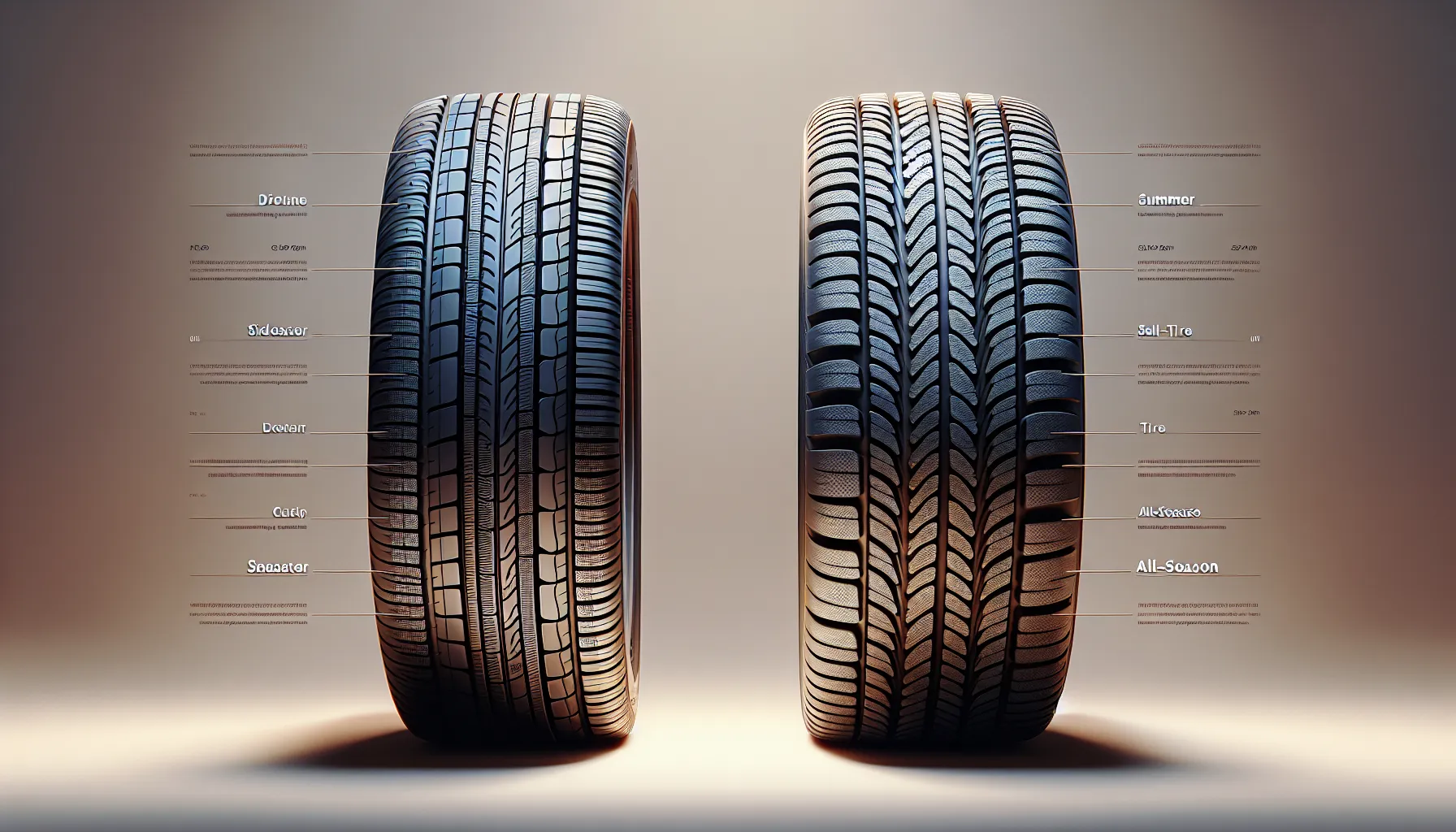
When considering the optimal tires for your vehicle, the choice isn’t as straightforward as it may initially appear. Tires serve as your vehicle’s only contact with the road, meaning the right selection plays a pivotal role in safety and performance. Among the numerous options available, two popular categories stand out: summer tires and all-season tires. Understanding the distinctions between these two types is essential to ensure you make an informed choice that suits your driving habits and the climate in which you operate your vehicle.
Understanding Tire Categories
Defining Summer Tires
Summer tires, as their name suggests, are designed for warm weather conditions. They feature a specific tread pattern and rubber compound engineered to provide optimal grip and handling on dry and wet roads during temperatures above 45°F (7°C). Their design focuses on performance, offering higher speed and precision for car enthusiasts and everyday drivers alike.
Defining All-Season Tires
All-season tires aim to deliver versatility by functioning adequately across a broad range of weather conditions. They combine elements of summer and winter tires, including a moderate tread design and a rubber compound suitable for varying temperatures. While not specialize in extreme cases, they balance convenience for drivers frequently transitioning between differing climate scenarios.
Key Features of Summer and All-Season Tires
Tread Design and Rubber Composition
Summer tires possess a slicker tread pattern with fewer sipes, allowing for a larger contact area with the road. This enhances traction on dry surfaces while their specialized rubber remains pliable in warm temperatures. Conversely, all-season tires sport deeper grooves and more sipes, facilitating decent traction during light snow or wet conditions while maintaining adequate durability in warmer climates.
Performance in Different Weather Conditions
The performance of summer tires excels in warm seasons, providing precise handling and shorter braking distances on hot pavements. But, their efficiency decreases when temperatures plummet. All-season tires, designed for adaptability, offer dependable grip across mild seasonal changes, though they tend to compromise certain performance aspects, such as cornering precision or maximum grip, in comparison to seasonal alternatives.
Longevity and Maintenance Requirements
The lifespan of tires depends significantly on their type and usage. Summer tires, due to their softer rubber compound, may wear faster when subjected to frequent high-speed driving or rough pavements. In contrast, all-season tires often exhibit improved longevity under average driving conditions. But, both require regular maintenance checks, such as alignment, rotation, and inspecting tread depth to ensure safe and efficient use.
When to Choose Summer Tires vs. All-Season Tires
Factors to Consider Based on Driving Requirements
When selecting tires, think about your driving preferences and frequency. Opt for summer tires if you value performance, responsiveness, and drive primarily in warm climates. For general commuting and versatility with minimal tire changes during the year, all-season tires are a practical choice.
Climate Conditions and Average Temperatures
The environmental conditions directly influence tire efficacy. In regions with moderate temperature variations, all-season tires provide a convenient and capable solution. But, in areas characterized by hot summers and highways requiring enhanced traction, summer tires offer unparalleled benefits in terms of safety and control.
Published: January 21, 2026 at 10:06 am by Ellie B, Site owner & Publisher
To provide the best experiences, we use technologies like cookies to store and/or access device information. Consenting to these technologies will allow us to process data such as browsing behaviour or unique IDs on this site. Not consenting or withdrawing consent, may adversely affect certain features and functions.
Functional
Always active
The technical storage or access is strictly necessary for the legitimate purpose of enabling the use of a specific service explicitly requested by the subscriber or user, or for the sole purpose of carrying out the transmission of a communication over an electronic communications network.
Preferences
The technical storage or access is necessary for the legitimate purpose of storing preferences that are not requested by the subscriber or user.
Statistics
The technical storage or access that is used exclusively for statistical purposes.The technical storage or access that is used exclusively for anonymous statistical purposes. Without a subpoena, voluntary compliance on the part of your Internet Service Provider, or additional records from a third party, information stored or retrieved for this purpose alone cannot usually be used to identify you.
Marketing
The technical storage or access is required to create user profiles to send advertising, or to track the user on a website or across several websites for similar marketing purposes.