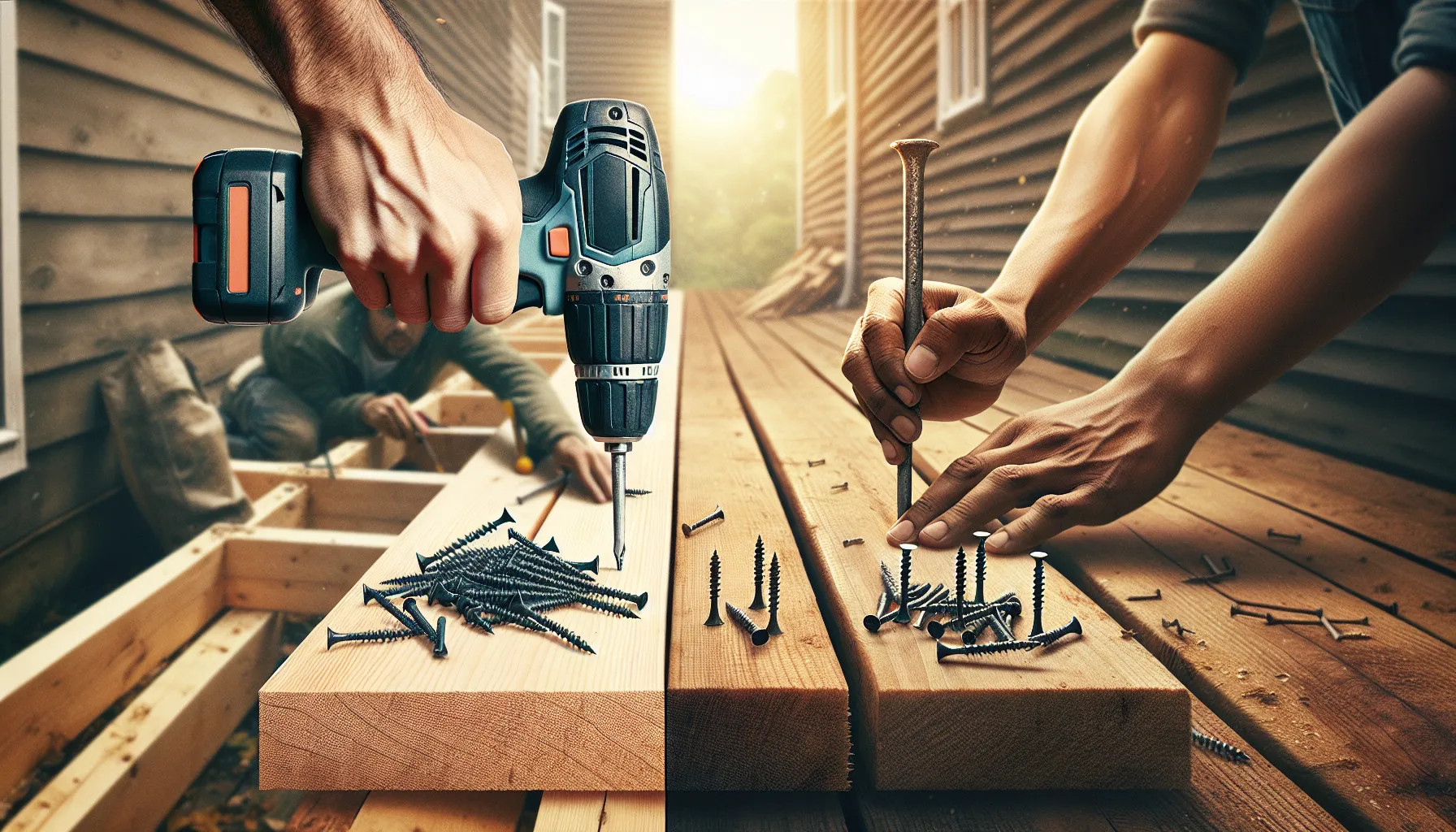
When constructing a deck, every decision you make can influence the durability, aesthetics, and function of the final structure. A critical yet often overlooked choice involves selecting between screws and nails. Each has its own benefits and limitations, impacting not only the process of building but also the long-term performance of your deck. Understanding these differences will empower you to make an informed choice tailored to your specific project needs.
Understanding Screws and Nails
Definitions and Basic Characteristics
Screws are fasteners with a helical thread designed to secure materials by threading into them, providing a strong grip and often featuring a flat or rounded head for specific applications. Nails, on the other hand, are straight and slender with a smooth or textured shank, used primarily for quick and friction-based joining of materials.
Material Composition
While screws are commonly made from stainless steel, brass, or alloy steel, offering superior resistance to rust and wear, nails often come in carbon steel with diverse coatings like galvanization to enhance durability.
Common Applications
Decking Installation
Screws are frequently chosen for decking due to their ability to stay securely in place, minimizing the risk of loosening over time, which is often crucial for maintaining the structural integrity of the deck.
Other Uses in Construction
Nails have long been valued in tasks like framing and paneling, where speed and efficiency of installation outweigh the need for removability or long-term resistance to environmental factors.
Comparing Strength and Durability
Load-Bearing Capacity
Screws generally provide a superior load-bearing capacity compared to nails due to their threaded design, which distributes weight more evenly and resists shear forces more effectively.
Resistance to Weather and Corrosion
High-quality screws, especially those with corrosion-resistant coatings, are better suited for outdoor applications, ensuring longevity even in harsh climate conditions compared to standard nails.
Ease of Use and Installation
Differences in Application Techniques
The installation process for screws requires precise alignment and typically a powered screwdriver, while nails can be hammered in quickly, though with less precision.
Required Tools and Time Investment
Using screws often necessitates additional tools, like a proper drill or driving bits, and is more time-consuming, whereas nails may only require a hammer, offering speed and simplicity.
Cost Considerations
Longevity vs. Initial Expense
While screws can be more expensive initially, their durability may offset costs over time, especially in projects requiring long-term resilience. Nails, being less expensive upfront, might demand more frequent replacements.
To provide the best experiences, we use technologies like cookies to store and/or access device information. Consenting to these technologies will allow us to process data such as browsing behaviour or unique IDs on this site. Not consenting or withdrawing consent, may adversely affect certain features and functions.
Functional
Always active
The technical storage or access is strictly necessary for the legitimate purpose of enabling the use of a specific service explicitly requested by the subscriber or user, or for the sole purpose of carrying out the transmission of a communication over an electronic communications network.
Preferences
The technical storage or access is necessary for the legitimate purpose of storing preferences that are not requested by the subscriber or user.
Statistics
The technical storage or access that is used exclusively for statistical purposes.The technical storage or access that is used exclusively for anonymous statistical purposes. Without a subpoena, voluntary compliance on the part of your Internet Service Provider, or additional records from a third party, information stored or retrieved for this purpose alone cannot usually be used to identify you.
Marketing
The technical storage or access is required to create user profiles to send advertising, or to track the user on a website or across several websites for similar marketing purposes.