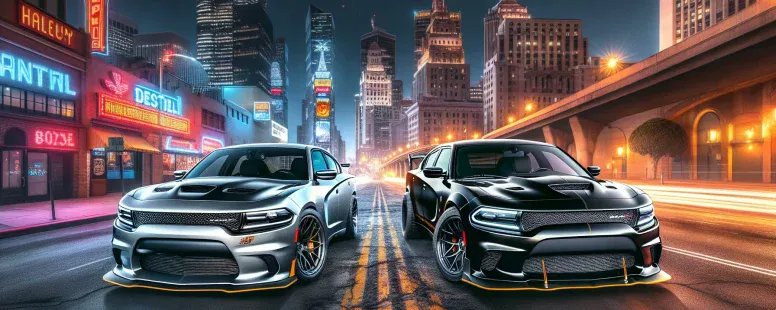
Picture yourself gripping the wheel as the engine growls beneath you—muscle car dreams brought to life. But as the road stretches ahead and your pulse quickens you face a thrilling dilemma: Scat Pack or Hellcat? These names spark curiosity and ignite debates among car enthusiasts everywhere.
You might think the difference is all about horsepower but there’s more lurking under those bold hoods. From the subtle nuances in design to the way each car commands the pavement both offer surprises that go beyond raw speed. Ready to uncover which beast truly matches your wild side? The answer might just change the way you see American muscle forever.
Overview of the Scat Pack and Hellcat
Dodge Scat Pack and Hellcat models define American muscle, but they’re not same animals under the hood or on the street. When your hands grip the wheel of a Scat Pack Charger, you’ll feel a 6.4-liter HEMI V8’s 485 horsepower vibrating through your spine. Hellcat, though, doubles down: its 6.2-liter supercharged HEMI V8 roars with up to 807 horsepower in Redeye editions, according to Dodge (2023).
You may ask, “Is the Scat Pack just a Hellcat’s little brother?” They share DNA, yet their personalities clash like rival siblings at a family barbecue. Scat Pack targets classic muscle purists—think quarter-mile warriors, straight-line thunder, no-nonsense control. Hellcat? That’s the wild child, a supercharged rebel who growls at every traffic light, always itching to leave black marks and echos in the neighborhood.
What does this mean for your daily drives or night-time runs? Scat Pack’s power curve brings usable muscle for real-world situations like sharp turns and surprise green lights. Hellcat’s vast power, meanwhile, can sometimes spins tires before traction even catches up—the Hellcat almost too much for narrow urban roads, but on open highways and drag strips, it’s king.
These muscle machines don’t just roar—look at their bodies. Widebody kits, dual hood scoops, and bumblebee badging set Scat Pack apart. Hellcat’s aggressive grille, wider tires, and snarling badges warn: “This cat bites.” In dealership showrooms, watch folks gravitate first to the Hellcat’s bold presence—it’s a natural conversation starter.
If you dream of old-school Dodge Charger days, automatic growl and physical intimidation, Scat Pack calls your name. If you crave the experience of wrestling pure supercharged chaos, badge screaming “SRT,” then Hellcat dares you to hold on.
So, which growl gets your heart racing? Would you harness track-day precision, or take on the brute force and startling presence of the Hellcat legend? Both choices echo Mopar’s promise: every drive, a story.
Engine Performance and Power
Muscle cars don’t just purr — they roar. You can feel the difference between a Scat Pack and a Hellcat the second you touch the throttle. If you ever wondered what it’s like to harness thunder, start by looking under their hoods.
Horsepower and Torque Comparison
You see, Scat Pack’s 6.4-liter HEMI V8 pumps out 485 horsepower and 475 lb-ft of torque. That’s strong, no question — think about passing traffic on the highway, or hearing your tires chirp at a green light. Picture cruising past a row of SUVs, the exhaust notes bouncing off every mailbox. These numbers invite everyday heroes; it’s muscle for the practical enthusiast.
Slide over to the Hellcat. This beast houses a supercharged 6.2-liter HEMI V8, generating 717 horsepower in base form and up to 807 horsepower in the Redeye version. With torque numbers climbing to 707 lb-ft, suddenly the lane next to you seems more like prey than competition. If you ever tried to control a wild stallion, you’ll understand the Hellcat’s challenge. Jalopnik reports drivers catching a wide grin — or a white-knuckle grip — especially when the rear tires break loose under heavy acceleration.
Model
Engine
Horsepower
Torque (lb-ft)
Scat Pack
6.4L Aspirated
485
475
Hellcat
6.2L Supercharged
717-807
650-707
Acceleration and Top Speed
Most people ask: which one’s faster? Car and Driver’s tests found the Scat Pack can hit 0-60 mph in about 4.3 seconds. It’s quick, responsive, linear in delivery. Picture launching away from an on-ramp with a confidence that’s almost smug. Top speeds hover around 176 mph, which beat anything you’d meet at most red lights.
But the Hellcat changes the whole conversation. A 0-60 mph time trims to 3.6 seconds in the standard Hellcat and as low as 3.4 seconds in the Redeye. Push harder, and you’re chasing 199 mph on the speedometer, with only the bravest finding the limit. Some drivers have described Hellcat launches like strapping yourself to a rocket at Cape Canaveral — you don’t just drive, you blast off.
Realistically, you’ll ask yourself: do you want the street king that turns heads at every intersection, or do you crave the mythic rush of supercharger whine and tire smoke? In either cockpit, your heart beats faster — but the stories you’ll tell? Those are worlds apart.
Design and Features
You can’t truly grasp the difference between Scat Pack and Hellcat without seeing how design and features split these cousins apart. Think of every curve, badge, stitch, and screen—they’re more than simple details, they signal attitude and intent on America’s roads.
Exterior Styling Differences
You notice the Scat Pack’s cues first—bumblebee badging on the fenders, bold 392 HEMI callouts, and simple angry lines. Widebody options look like flared muscles, giving cars like the 2024 Dodge Charger Scat Pack a broader stance that isn’t just for show—it means actual performance on the pavement. Real owners like Chris, who swapped from an SXT, say that the “Scat Pack turns heads at every gas pump,” especially with Go Mango or F8 Green colors.
Switch to the Hellcat and, well, things get louder. Supercharged badges glow with menace. Hood scoops gulp air with two nostrils and “SRT” logos stake their claim. Tires, sized up to 305-section on the widebody, bulge underneath charged fenders—almost as if the car is flexing, waiting to pounce. Anyone seeing a bright Hellcat Charger in Destroyer Gray feels the message: this car is untamed. Auto journalists (Car and Driver, 2022) consistently rank the Hellcat’s visual aggression as unmatched in its class.
Interior Comfort and Technology
Scat Pack interiors strike that balance between driver focus and comfort. You get Alcantara and houndstooth suede seats, a flat-bottom steering wheel, and real aluminum accents. Uconnect infotainment screens (up to 8.4 inches) quickly respond to your touch—navigation, Apple CarPlay, and performance pages all accessible. In long commutes, dual-zone climate and solid sound systems (Alpine standard, Harman Kardon optional) keep passengers from complaining.
Hellcat brings more: heated and ventilated Laguna leather seats, red seatbelts, and SRT badging stitched everywhere. Uconnect upgrades to performance tracking, SRT drive modes, and even Valet mode—handy if you don’t want your mechanic running a 10-second quarter mile. Some drivers suggest the Hellcat’s cabin feels a bit over the top, with all that branding and bright contrasting trim, but fans say it fits the “go big or go home” attitude. An eight-speaker Alpine system is standard, but, for true immersion, step up to the 19-speaker Harman Kardon setup.
Feature
Scat Pack Example
Hellcat Example
Exterior Badges
Bumblebee, 392 HEMI
Supercharged, SRT, Hellcat
Wheel/Tire Setup
20×9″ wheels, 245-series tires
20×11″ wheels, 305-series tires
Seats
Cloth/Alcantara, houndstooth
Heated/ventilated Laguna leather
Infotainment
Uconnect 8.4″, Performance pages
Uconnect 8.4″, SRT Drive Modes
Audio
Alpine 6/9 speakers
Alpine 8 speakers, HK 19 option
Climate
Dual-zone auto
Dual-zone auto
Do you think more tech means more fun, or does it distract from the raw experience? You might love the Hellcat’s extras, but for some, the tactile simplicity of Scat Pack interiors feels right—just driver, car, and the road stretching out, endless, as daylight fades.
Handling and Driving Experience
Handling differences between the Scat Pack and Hellcat shape your every twist and turn. You’ll sense the contrast from the first corner—precision and power dance a different tune in each one, inviting you to discover which rhythm fits your driving story.
Suspension and Braking
Scat Pack uses an adaptive suspension, performance-tuned to suit street and track settings. You get Bilstein dampers, multi-link rear geometry, and the confidence to push briskly through winding roads. Hellcat amplifies this foundation with a stiffer setup, wider rubber, and stronger sway bars—a recipe that’s born for speed, but can feel harsh on weekday roads. Brembo six-piston brakes on both ensure immediate response, but Hellcat’s system handles heat better under high-speed abuse, like lapping the drag strip. Multiple owners claim, in forums like DodgeTalk, that the Hellcat’s heavier nose shifts its braking balance—you’ll feel the weight when you haul it down from triple digits.
Price and Value
Price and value shape the story behind every Scat Pack and Hellcat out on the open road. You’ll notice muscle cars have personalities, but their price tags also speak volumes about their character and the driving community they attract.
MSRP and Cost of Ownership
Scat Pack and Hellcat, when compared head-to-head, show clear differences in price and ownership costs. The 2024 Dodge Charger Scat Pack carries a starting MSRP around $50,500, while the Challenger variant hovers in the same ballpark (Edmunds). In contrast, a base-model Hellcat calls for nearly $72,000, and the notorious Hellcat Redeye tops the $85,000 mark, sometimes even climbing to $90,000 after options (Kelley Blue Book). Picture rolling up to the dealership—one price could buy you a loaded midsize SUV, while the other gets you a full-bore supercharged animal.
Scat Pack’s running costs reflect its balance between power and practicality. Insurance premiums often stay $500 to $800 less each year than the Hellcat due to lower risk profiles; Hellcats attract attention not just from fans, but from insurers worried about speed. Fuel expenses widen the gap: Scat Pack owners see about 15 mpg city/24 highway, Hellcat drivers dip as low as 13 mpg city/21 highway, and Redeye users often report less, especially when you are tapping deep into those horses.
Think about maintenance, too—Scat Packs use less expensive tires and brakes, and owners report fewer wear-and-tear items per 10,000 miles compared to Hellcats, whose supercharged engines require premium fluids and beefier components. If you crave always-on-dramatics, Hellcat costs stack up faster than you may predict.
Resale Value and Market Demand
Resale value often surprises new muscle car buyers—Scat Packs, particularly well-kept, low-mileage examples with special trim (like the “Shaker”) attract strong resale offers, sometimes retaining up to 70% of original value after three years (iSeeCars.com). Hellcats, a darling among collectors, also retain value when cared for, though high-mileage or heavily modified examples can drop sharply in value.
Market demand for both stays fiery, but scarcity plays larger with Hellcats. Dodge ended Hellcat production in 2023, which sparked auction frenzies; some limited-edition Redeyes sell above original MSRP. Scat Packs flood the used market more frequently, making prices somewhat stable.
Which would you rather park in your garage—a muscle machine with reasonably predictable costs and easier resale, or a rare, supercharged beast whose value dances with the whims of collectors and speed junkies? Think about who buys these cars: Scat Pack enthusiasts chase the primal joy of big V8 power, Hellcat devotees line up at auctions with nostalgia and adrenaline pulsing in their veins.
Your choice extends beyond sticker shock—it’s a reflection of how you view value, thrill, and your place in an American muscle car legend’s legacy.
Which Is Right for You?
Picture you’re gripping the thick, contoured steering wheel of a Scat Pack, thunder of the 485-horse V8 rumbling beneath your fingertips, every tap of the throttle translated instantly to the pavement. That’s everyday muscle car magic—track-ready but grounded, its adaptive suspension smoothing rough city roads and the widebody stance hugging sharp turns. Maybe you like answering every traffic light with a knowing smirk, its iconic bumblebee badge winking at purists who nod in respect. There’re plenty drivers who just wants the muscle experience without the need to reign in 700+ horses every day.
Contrast that with the Hellcat—it’s the fire-breathing beast waiting for any excuse to unleash its 717+ horsepower supercharged fury. Drop your foot, and reality stretches, the horizon rushing in with a soundtrack more thunderous than any city block deserves. Some say owning a Hellcat is like keeping a storm caged under your hood—unpredictable, raw, and never subtle. If you crave dominance at the drag strip or want every car meet to pause when you arrive, this entity’s for you. Insurance agents might not celebrate your choice, but fellow enthusiasts definitely will.
Your decision might also hinge on something subtler: how do you want your car to define your daily life? If you value balance, pragmatic power, and enough comfort for a spontaneous road trip, the Scat Pack delivers. Want a reliable daily driver that can still make muscle legends out of any errand? That’s the 392’s wheelhouse. Meanwhile, those obsessed with raw numbers or gospel-choir exhaust notes gravitate to the Hellcat—the rare machine that lets you toy with the very limits of street legality. Be prepared, its supercharger whine and cannon-like acceleration demand your respect and focus, not a novice’s passing curiosity.
Industry voices echo the divide. Car and Driver lauds the Scat Pack’s “accessible exhilaration” and “practical bite,” while MotorTrend casts the Hellcat as “a sledgehammer for the senses,” thrilling but relentless (Car and Driver, 2023, MotorTrend, 2022). Owners’ forums pulse with stories about choosing garage queen over daily hero, budget over bravado. Ask yourself—are you chasing numbers or memories, policing your insurance bills, or chasing down new bests at the drag strip?
There is no wrong path printed on asphalt—just the one that matches your heartbeat. If the muscle car legacy calls your name, pick the badge that’ll keep you grinning most, keys in hand, engine warm, future wide open.
Conclusion
Choosing between the Scat Pack and Hellcat is all about matching your driving dreams to the right machine. Whether you’re drawn to the balanced punch of the Scat Pack or the wild energy of the Hellcat you’re stepping into a legacy of American muscle.
Think about what excites you most behind the wheel and what fits your lifestyle best. Both options deliver unforgettable experiences—it’s just a matter of which thrill you want to chase.
To provide the best experiences, we use technologies like cookies to store and/or access device information. Consenting to these technologies will allow us to process data such as browsing behaviour or unique IDs on this site. Not consenting or withdrawing consent, may adversely affect certain features and functions.
Functional
Always active
The technical storage or access is strictly necessary for the legitimate purpose of enabling the use of a specific service explicitly requested by the subscriber or user, or for the sole purpose of carrying out the transmission of a communication over an electronic communications network.
Preferences
The technical storage or access is necessary for the legitimate purpose of storing preferences that are not requested by the subscriber or user.
Statistics
The technical storage or access that is used exclusively for statistical purposes.The technical storage or access that is used exclusively for anonymous statistical purposes. Without a subpoena, voluntary compliance on the part of your Internet Service Provider, or additional records from a third party, information stored or retrieved for this purpose alone cannot usually be used to identify you.
Marketing
The technical storage or access is required to create user profiles to send advertising, or to track the user on a website or across several websites for similar marketing purposes.