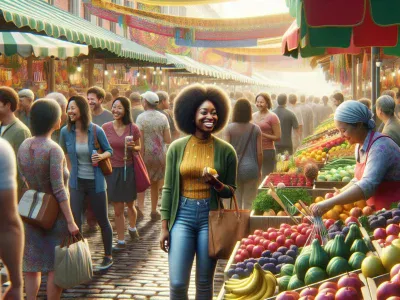
Picture walking through a vibrant city street—faces, voices, and traditions weaving together like a living tapestry. Each person carries a story shaped by roots deeper than skin color or birthplace. But what truly sets race apart from ethnicity, or why these words, often used interchangeably, hold distinct meanings?
Peeling back these layers reveals more than just definitions; it opens doors to understanding identity, belonging, and the hidden threads that connect us all. Grasping the difference between race and ethnicity doesn’t just satisfy curiosity—it empowers you to navigate conversations with empathy and insight, breaking down barriers and building bridges in ways you might not expect.
Understanding Race and Ethnicity
Race describes how society groups people by physical traits. These traits, like skin color or facial structure, have been used, sometimes arbitrarilly, to draw lines between groups since the 17th century (see Omi & Winant, 2014). When you walk through a city, think about how you might notice hair textures or eye colors before you even hear someone speak—the concept of race acts on a visual level, shaping first impressions. Ask yourself: Does seeing someone with lighter or darker skin make you question where they’re from? Millions do just that daily, often unconsciously.
Ethnicity connects you to your shared ancestry, cultural history, language, and customs (Cornell & Hartmann, 2007). Maybe your grandparents spoke Yiddish at home, or perhaps your family gathers for Lunar New Year celebrations. Unlike race, ethnicity leans on beliefs, traditions, and stories. 2 people can share the same race but practice different religions, speak separate languages, and cook unique foods—their ethnicity carves out their belonging. How do you relate to your heritage? Picture being asked about your “ethnic background” on a survey and seeing options like Irish, Somali, or Colombian.
Sometimes, the boundaries between race and ethnicity blur. For example, in the United States, “Hispanic” appears as an ethnicity on the census, distinct from categories like White or Black. Yet, people often conflate “Hispanic” with a racial identity. Have you noticed how a Brazilian and a Peruvian might both identify as Latino, but possess different racial ancestries, histories, and lived realities?
These concepts influence opportunity, belonging, and exclusion. In schools, neighborhoods, and even hospitals, racial and ethnic labels shape policy. Harvard sociologist Dr. Mary Waters points out that how you answer the questions, “What are you?” or “Where are you from?” changes with context and audience. Thinking about your own identifiers, would you describe yourself the same way in a job interview as you would at a family reunion?
Critical examination of race and ethnicity reveals their complex, sometimes arbitrary, roles. They’re not mere checkboxes but living categories that shape lives, communities, and your place within them.
Defining Race
Race as a social construct groups people by visible traits, examples like skin color, hair texture, and bone structure. Your everyday encounters with these traits might shape assumptions before a word’s even spoken.
Historical Perspectives on Race
Historical perspectives on race highlight society’s attempts to classify humans since the 17th century. Early European explorers and colonizers divided people based on physical attributes. For instance, colonial laws in Virginia (late 1600s) sorted individuals as “white,” “black,” or “Indian,” leading to legal inequalities and social hierarchies (source: Smithsonian National Museum of African American History and Culture).
Pseudoscientific theories like phrenology and eugenics popular in the 19th century promoted a hierarchy among races using flawed data. You can see the legacy of those origins in systems that still shape access to housing, education, and healthcare for different communities. why certain neighborhoods remain divided by appearance? That pattern often comes from historical legislation.
Even so, individuals resisted being boxed in. Stories of mixed-race families in places like New Orleans’ Creole community highlight how culture, language, and racial labels intertwined, blurring the lines imagined by lawmakers. Could race be more than what you see in a mirror?
Modern Concepts of Race
Modern concepts of race treat it less as biology and more as a lens society uses to organize and, sometimes, discriminate. Genetic science reveals over 99.9% of human DNA is shared, with greater variation within so-called races than between them (source: Human Genome Project).
Yet, marketers might study trends among “Asian” consumers, or medical researchers could point to higher rates of sickle cell trait among people of African descent. These examples show that, even though its shaky scientific basis, race influences policy, identity, and opportunity everywhere you look.
Do you recall when, in 2020, the U.S. Census updated its race question? Millions marked more than one box, reflecting growing recognition that people can’t always fit into a single racial label. Even celebrities like Tiger Woods and Kamala Harris illustrate how identities can defy simple categorization—reminding you that race is less a truth of nature, more a story told through history, power, and context.
Race, when understood through today’s lens, exists as both a tool for social categorization and a spectrum shaped by shared experience and perception. Rethinking it challenges you to look past surfaces—and maybe question your own perceptions.
Defining Ethnicity
Ethnicity links you to shared ancestry, cultural origins, and traditions that shape social identity. Unlike race’s focus on physical markers, ethnicity weaves complex threads of language, practices, and common history.
Key Elements of Ethnicity
Ethnicity draws upon semantic entities like language, religion, and national origin. For example, you might identify as Irish American because of your family’s Irish ancestry, Saint Patrick’s Day customs, and Gaelic phrases echoing at family gatherings. Anthropologists (Cornell & Hartmann, 2007) describe ethnicity as an ongoing negotiation between self-identification and outside recognition. Consider: can two siblings from an Arab American household choose different ethnic labels, based on their affinity to unique cultural traditions or peer influences?
Ethnic group membership involves both inherited and chosen aspects. Sometimes, collective memory about migration, shared myths, or foodways—think Indian curries or Jamaican jerk chicken—serve as anchors for ethnic belonging. But, boundaries shift over generations; what you claim as your ethnicity might not mean the same in your grandparents’ village. Ethnic identity’s porous border raises questions: Do you get to claim a heritage purely by ancestry, or does sustained participation matter more?
Cultural and Social Dimensions
Ethnicity expresses itself through lived customs and social scripts, not just checkboxes on forms. Practices like speaking Tagalog in Filipino American homes, celebrating Lunar New Year in Chinese American communities, or observing Hanukkah in Jewish families create visible signs of difference. These practices, evolving across continents, impart resilience and adaptability, not just in the diaspora but also in homelands.
Interethnic marriages, urbanization, and social mobility often mix traditions, generating hybrid identities—like Cuban-Chinese Americans who blend arroz con pollo with mooncakes at family reunions. Institutions, such as churches or cultural centers, reinforce ethnic bonds, sometimes mediating access to health care, jobs, or education. According to the Pew Research Center, 60% of U.S. Latinos in 2022 said they most often describe themselves by their family’s country of origin, not pan-ethnic labels.
Uncertainty and belonging coexist within ethnicity. It mediates exclusion and solidarity, often yielding moments of ambiguity: Is your identity defined by your community, or do you shape it, yourself? As you recognize the power of ethnicity, the question’s not whether customs make you who you are, but how you choose which parts of your heritage to perform, reclaim, or rewrite.
Key Differences Between Race and Ethnicity
Understanding race and ethnicity means looking beyond labels you might picked up in school or from media. Distinguish these terms and you’ll unravel threads that shape identity, belonging, and opportunity.
Biological vs. Cultural Distinctions
Race relies on visual cues, like skin tone, eye shape, or hair texture, that society often uses to sort people. Scientists, like those at the Human Genome Project, discovered over 99.9% of genes are shared across all humans (National Human Genome Research Institute). So, the physical traits associated with race represents just tiny fragments of your DNA, though society often treats them as major identity markers. Picture standing in line at a passport office: the agent can guess your race just by glancing up, but not your values or language.
Ethnicity runs deeper than appearance, threading together culture, language, food, and rituals learned at home or in communities. For example, ethnicity can unite you through music, like samba for Brazilians or bagpipes among Scots, or through food, like savory kimchi for Koreans. These bonds form stories passed at family tables, guiding values and shaping how joy and grief are shared. You might not look like your cousins from the old country, but ethnic ties can bridge time and distance.
Examples Illustrating the Difference
If you ask a new friend, “Where are you from?” and they reply “Black,” they’re using a racial category. If they answer, “Ethiopian,” they’re sharing an ethnic one. Consider John, whose parents emigrated from Nigeria. In the US, others may see John as Black first, categorizing him by race. But at family reunions, Yoruba traditions—language, food, dance—define his ethnicity. Like, his aunt’s egusi soup or the storytelling that reveals his clan’s lineage. Can you picture how different doors open or close for John based on which category people see first?
Another example: “Hispanic” is an ethnicity on US Census forms, not a race. Two neighbors—one of Indigenous Peruvian descent, one of Afro-Cuban heritage—may both identify as Hispanic, sharing customs like quinceañeras or Spanish-language novelas, though their physical features and racial backgrounds differ sharply.
Ask yourself: Have you ever felt more connected to people who shared your holidays or language, than those with the same skin color? Race might set the stage in public—the billboard—while ethnicity, like the backstage crew, shifts scenery and writes the script.
If you flip through family photos, do you see loved ones who fit the checkboxes at school? Or do traditions—Easter bread, Ramadan fasts, Diwali lamps—hold the stronger threads? These tangible customs and intangible ancestral ties offer a richer view of who you are, beyond what anyone see at first glance.
Why the Difference Matters Today
You live in a world where the vocabulary you choose—race or ethnicity—reshapes conversations, policies and relationships every day. These terms guide social interactions, influence how institutions work and affect whether doors open or close for you and your neighbors.
Social Implications
Understanding the distinction between race and ethnicity shapes how you navigate prejudice, justice, and belonging. Picture this: walking into a classroom, you see students grouped by what appears to be skin color. Teachers might label this “diversity,” but does it truly reflect the varied languages, beliefs, or histories in the room? According to the Pew Research Center, about 24% of US adults report experiencing discrimination based on perceived race, while fewer describe encounters based on ethnic markers like language or tradition.
Entities like the U.S. Equal Employment Opportunity Commission (EEOC) distinguish between racial and ethnic discrimination, demonstrating how legal categories affect recourse and remedy. Consider a police stop: judgments may rest on visible traits—race—though the individual’s cultural origins—ethnicity—might hold the key to understanding their lived experience. How often do headline debates about fairness miss the nuances you live every day? Could your story be misunderstood if someone only sees your race, missing the song and ritual that tie you to your heritage?
Impact on Identity and Policy
Blurred lines between race and ethnicity lead you to complex identity choices. Checkboxes on census forms force millions of Americans—Hispanic and Latino individuals, multiethnic families—to compress rich backgrounds into rigid labels. For example, the US Census treats “Hispanic or Latino” as ethnicity, not race, but many people write in additional descriptors, resisting oversimplification (U.S. Census Bureau).
Policy consequences spring from these classifications. In healthcare, health outcomes for Black Americans often reflect systemic biases linked to race, like access to care and environmental exposure (CDC, 2022). Yet ethnicity—a Hmong grandmother’s home remedy, a Somali refugee’s dietary laws—shapes medical treatment plans, too. Are you seen as fully yourself if policies count only your skin color or surname?
Shifting policies sometimes try to keep up. Affirmative action, hate crime investigation, and educational funding rely on these categories, but confusion around them can lead to exclusion and controversy. How would resources flow, if institutions asked more than a surface question? What if you could shape categories—race, ethnicity, both or neither—to fit your truth, not just history’s shadow?
You shape society’s understanding by using language that honors these differences. Every form you fill, story you tell, or policy you support, you can demand nuance instead of stereotype—because the difference between race and ethnicity isn’t minor, it’s how you claim space, dignity and justice.
Conclusion
Recognizing the difference between race and ethnicity empowers you to approach identity with greater respect and sensitivity. When you challenge old assumptions and embrace the complexity of these concepts you help create a more inclusive world.
By staying curious and open-minded you’re better equipped to understand not only your own story but also the diverse experiences of those around you. This awareness can reshape conversations and drive positive change in your community.
To provide the best experiences, we use technologies like cookies to store and/or access device information. Consenting to these technologies will allow us to process data such as browsing behaviour or unique IDs on this site. Not consenting or withdrawing consent, may adversely affect certain features and functions.
Functional
Always active
The technical storage or access is strictly necessary for the legitimate purpose of enabling the use of a specific service explicitly requested by the subscriber or user, or for the sole purpose of carrying out the transmission of a communication over an electronic communications network.
Preferences
The technical storage or access is necessary for the legitimate purpose of storing preferences that are not requested by the subscriber or user.
Statistics
The technical storage or access that is used exclusively for statistical purposes.The technical storage or access that is used exclusively for anonymous statistical purposes. Without a subpoena, voluntary compliance on the part of your Internet Service Provider, or additional records from a third party, information stored or retrieved for this purpose alone cannot usually be used to identify you.
Marketing
The technical storage or access is required to create user profiles to send advertising, or to track the user on a website or across several websites for similar marketing purposes.