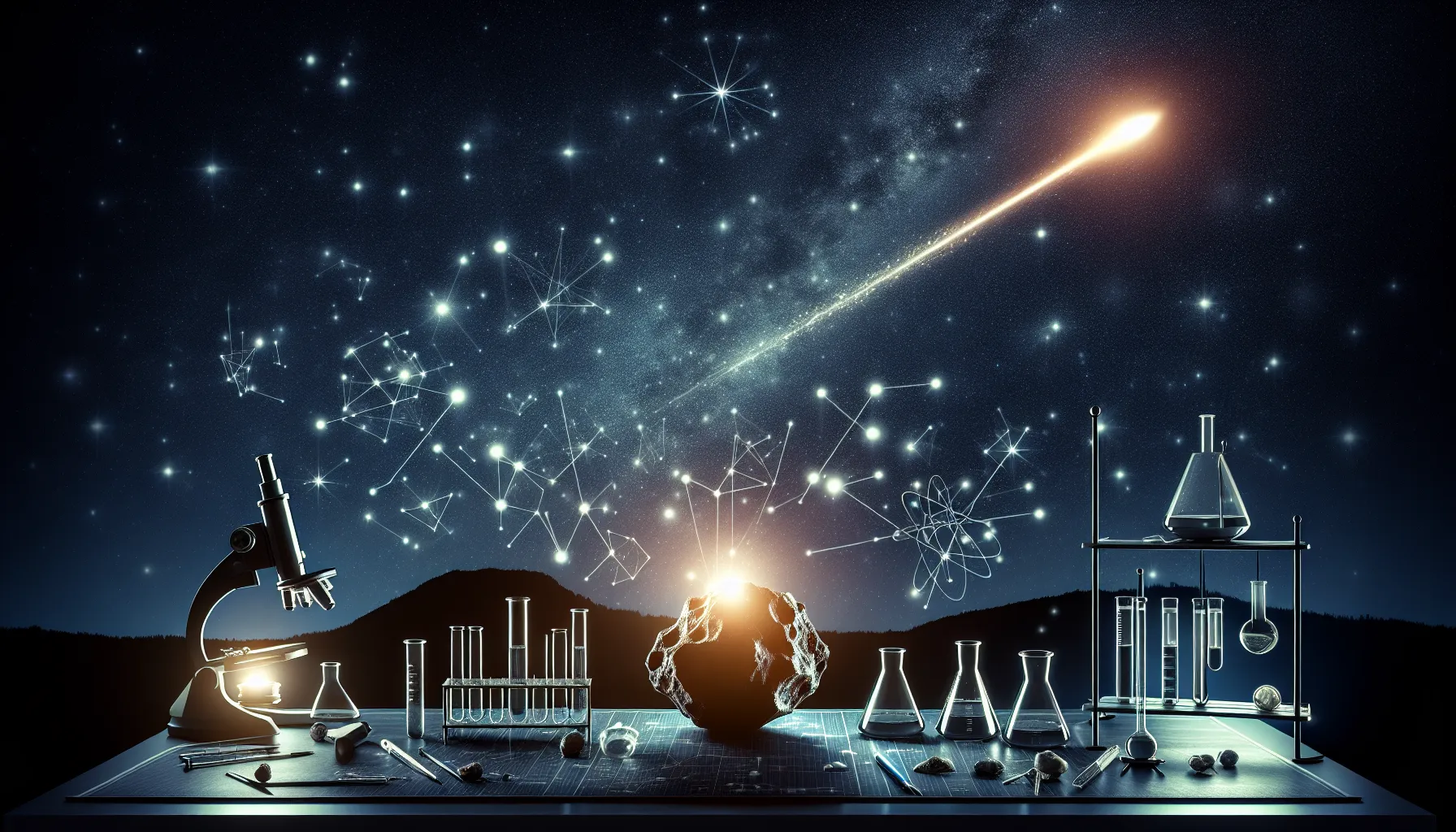
Our universe contains a multitude of fascinating phenomena, each shedding light on the workings of space and time. Among these are meteors and meteorites, celestial objects that capture our imagination and enhance our understanding of cosmic events. While the terms ‘meteor’ and ‘meteorite’ are often used interchangeably in everyday language, their distinctions are profound and noteworthy, carrying implications for both scientific research and human curiosity.
Understanding the Terminology
What Is a Meteor?
A meteor, colloquially known as a “shooting star,” is the streak of light that occurs when a meteoroid enters the Earth’s atmosphere. As it races through the sky, friction causes it to burn, creating a brilliant display visible from the ground.
Characteristics and Observation
Meteors are brief flashes of light seen predominantly during nighttime. They range in brightness and can appear as part of a meteor shower, fascinating observers and astronomers alike.
What Is a Meteorite?
Once a meteoroid survives its fiery journey through the atmosphere and lands on Earth’s surface, it earns the title of “meteorite.” These fragments of extraterrestrial material can be studied to learn more about the origins of our solar system.
Formation and Identification
The remnants form varied shapes and sizes, often enriched with cosmic minerals. Identification of meteorites involves analyzing their structure for distinctive patterns, such as the Widmanstätten lines resulting from long-term cooling of metallic crystals in space.
Similarities Between Meteors and Meteorites
Shared Origins and Compositions
Meteors and meteorites originate from similar space rocks, primarily asteroids and comets. Their compositional similarities reveal insights into the primordial materials that formed our planets.
Interactions with Earth’s Atmosphere
Both meteors and meteorites experience interaction with Earth’s atmosphere. While meteors provide a visual spectacle, meteorites endure and bring with them chemical and isotopic compositions from space.
Key Differences Between Meteors and Meteorites
Physical State and Location
The primary distinction lies in their state and position: meteors are luminous paths seen traversing the atmosphere, whereas meteorites are tangible, solid objects found on the Earth’s surface.
Impact on Science and Study Applications
Meteors provide valuable atmospheric data and contribute to the understanding of celestial motion. Meteorites, being physical samples, enable laboratory analyses that inform theories about our solar system’s formation and history.
The Importance of Understanding Space Phenomena
Scientific Significance and Exploration
Studying meteors and meteorites fuels our understanding of extraterrestrial phenomena, influencing astrobiology and planetary sciences. These studies are crucial to unraveling the narrative of the universe.
Cultural and Educational Emphasis
Meteor showers and recovered meteorites inspire myths, stories, and educational pursuits, connecting scientific intrigue with social and cultural significance.
To provide the best experiences, we use technologies like cookies to store and/or access device information. Consenting to these technologies will allow us to process data such as browsing behaviour or unique IDs on this site. Not consenting or withdrawing consent, may adversely affect certain features and functions.
Functional
Always active
The technical storage or access is strictly necessary for the legitimate purpose of enabling the use of a specific service explicitly requested by the subscriber or user, or for the sole purpose of carrying out the transmission of a communication over an electronic communications network.
Preferences
The technical storage or access is necessary for the legitimate purpose of storing preferences that are not requested by the subscriber or user.
Statistics
The technical storage or access that is used exclusively for statistical purposes.The technical storage or access that is used exclusively for anonymous statistical purposes. Without a subpoena, voluntary compliance on the part of your Internet Service Provider, or additional records from a third party, information stored or retrieved for this purpose alone cannot usually be used to identify you.
Marketing
The technical storage or access is required to create user profiles to send advertising, or to track the user on a website or across several websites for similar marketing purposes.