Ever gazed up at the night sky and wondered about its many mysteries? You’re not alone. Our universe is a vast, complex world of cosmic events – some that we witness regularly, like new moons and lunar eclipses. But do you truly understand what sets these two phenomena apart?
Understanding Lunar Phases
Diving deeper into our cosmic neighborhood, it’s time to shed light on the differences between a new moon and lunar eclipse.
What Is a New Moon?
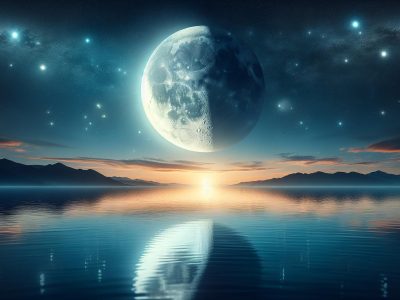
A new moon occurs when Earth’s satellite is positioned directly between Earth and the Sun. This alignment results in the side of the moon that faces us being cast in shadow—so appearing dark from our perspective.
Imagine you’re standing at night under an open sky; gaze up towards where you know the Moon should be—it’s there, yet invisible against its own backdrop—the vast expanse of space itself! It might seem like magic but this invisibility act happens once every 29.5 days—that’s how long it takes for one full lunar cycle or ‘lunation’. Remember though, even though seeming completely absent during these periods called “new moons,” our faithful companion hasn’t disappeared altogether!
What Is a Lunar Eclipse?
In contrast to a new moon phase stands another fascinating phenomenon—a lunar eclipse. A lunar eclipse transpires when Earth finds itself precisely sandwiched between Sun and Moon—an occurrence only possible during Full Moons—not New ones as with previous case.
Picture yourself again beneath twilight skies observing not just any Full Moon—but one slowly disappearing before your very eyes! You watch as shadows creep across her surface until she plunges into total darkness emerging moments later bathed in eerie red glow—the signature hue of Total Lunar Eclipses also known fondly among stargazers as Blood Moons!
To clarify further: while both phenomena involve alignments involving same celestial bodies (Earth, Sun &Moon) they are fundamentally different events occurring due entirely separate mechanisms within cyclical rhythm celestial dance above.
Key Differences Explained
Visibility of Each Phenomenon
In observing these celestial events, you’ll notice a stark contrast in visibility. During a new moon, the side facing Earth remains unlit, making it nearly invisible against the night sky except on rare occasions when sunlight reflects off earth’s surface onto the moon — an effect known as “earthshine.” But, during a lunar eclipse, although obscured by Earth’s shadow initially – or umbra – , there emerges an awe-inspiring spectacle whereupon our Moon dons shades of deep red and orange hues—known widely as ‘Blood Moon.’ It’s not only visible but also becomes quite remarkable for its unique appearance.
Positions of The Sun, Earth and Moon
The alignment or position between these three heavenly bodies forms another key difference. When we talk about New Moons; they’re formed with the sun-earth-moon aligned consecutively giving us this seemingly blank canvas in space due to lack of direct sunlight falling upon it from our viewpoint here on earth.
Meanwhile for Lunar Eclipses; your view captures that Full-Moon phase nestled directly opposite to Sun with mother-Earth comfortably sitting right smack-dab in-between! As such while witnessing one unfold before your eyes- you’d be staring straight into depths through planet’s darkened-shadow cast all across moons’ facade!
Frequency Of Occurrence
Speaking frequency-wise – those elusive Lunar eclipses happen less often than their counterpart: 2-to-5 times annually at most versus roughly once each month (or even twice if counting Blue Moons) experienced via typical New Moon cycles occurring every 29.53 days precisely according to NASA figures provided below:
Celestial Event
Average Number Per Year
New Moo
12
Lunar Eclipse
2 To 5
Impact on Astrology and Culture
Lunar eclipses and new moons, while distinct celestial phenomena, both hold significant sway over cultural beliefs and astrological interpretations.
Lunar Eclipse in Folklore and Science
In many cultures worldwide, lunar eclipses carry a potent symbolism of transformation. They’ve often been viewed as harbingers of change – but not necessarily negative ones. For instance, Inuit folklore tells tales where the eclipse represents a resetting or cleansing period.
Scientists also pay close attention to these events for reasons beyond their aesthetic appeal. The changing colors during an eclipse offer valuable insights into Earth’s atmosphere condition based on the specific shades observed.
Consider NASA’s “Danjon Scale,” used to classify lunar eclipses by color—from bright copper red (a healthy atmosphere) to dark grayish brown (potential volcanic activity). It underscores how scientific observation can intertwine with natural phenomena traditionally veiled in mysticism.
New Moon Symbolism and Beliefs
The appearance of a new moon likewise stirs spiritual significance across numerous societies. Some view it as symbolic of fresh starts or beginnings due to its connection with renewal cycles—it is the first phase after all! Hindu tradition associates each monthly new moon day (‘Amavasya’) with ancestral remembrance rites known as ‘Shradh.’
Scientifically speaking though, this phase presents opportunities too—providing optimal conditions for activities requiring minimal light interference like astronomical observations or certain types of photography such should you fancy exploring your creative side under darker skies!
From mystical meanings behind traditional stories down towards tangible applications within modern science fields—you’ll find that both lunar eclipses & new moons impact astrology & culture more than what initially meets the eye.
Conclusion
So you’ve journeyed through the captivating phenomena of lunar eclipses and new moons. You now understand how their unique alignments lead to a darkened moon or an awe-inspiring Blood Moon. Your knowledge extends beyond simple observation, recognizing these events’ impacts on astrology and cultural beliefs around transformation and fresh beginnings. Remember, it’s not just about what we see in our night sky but also the profound implications they have scientifically and mystically intertwined in societies across the globe! Now that you’re equipped with this understanding, each new moon or lunar eclipse will hold greater depth for your personal reflection – truly showcasing nature’s spectacular celestial performance.
To provide the best experiences, we use technologies like cookies to store and/or access device information. Consenting to these technologies will allow us to process data such as browsing behaviour or unique IDs on this site. Not consenting or withdrawing consent, may adversely affect certain features and functions.
Functional
Always active
The technical storage or access is strictly necessary for the legitimate purpose of enabling the use of a specific service explicitly requested by the subscriber or user, or for the sole purpose of carrying out the transmission of a communication over an electronic communications network.
Preferences
The technical storage or access is necessary for the legitimate purpose of storing preferences that are not requested by the subscriber or user.
Statistics
The technical storage or access that is used exclusively for statistical purposes.The technical storage or access that is used exclusively for anonymous statistical purposes. Without a subpoena, voluntary compliance on the part of your Internet Service Provider, or additional records from a third party, information stored or retrieved for this purpose alone cannot usually be used to identify you.
Marketing
The technical storage or access is required to create user profiles to send advertising, or to track the user on a website or across several websites for similar marketing purposes.