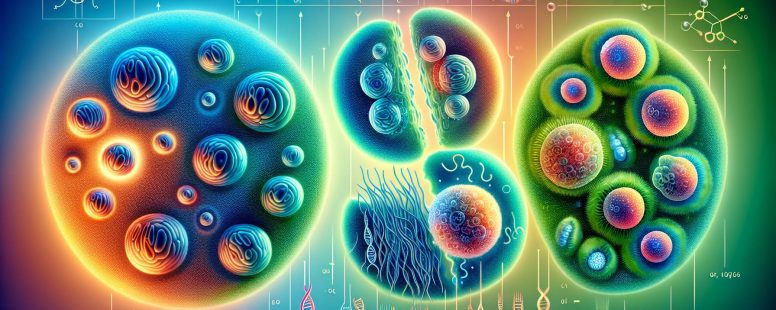
Ever wonder why you’re unique, unlike any other person on the planet? Or how a single cell can develop into a complex organism like a human being? The secret lies in two fundamental biological processes: meiosis and mitosis. These mechanisms of cellular division are at the heart of life’s greatest mysteries.
Understanding Cell Division
Cell division forms the basis of life. It’s through these intricate processes that organisms grow, reproduce and maintain their biological systems.
A Brief Overview of Mitosis
Mitosis is a type of cell division resulting in two daughter cells each having the same number and kind as chromosomes as the parent nucleus. This process plays a critical role in growth, development, healing or repair within multicellular organisms. For example, when you cut your finger, mitotic cell divisions are triggered to replace lost skin cells.
It involves five stages: prophase (chromosomes condense), metaphase (chromosomes align at center), anaphase (sister chromatids separate) telophase(cytoplasm divides), cytokinesis(final separation).
Stages
Description
Prophase
Chromosomes Condense
Metaphase
Chromosome Align At Center
Anaphse
Sister Chromatids Separate
Telophose
Cytoplasm Divides
Cytokinesi Final Separation
At end stage it ensures exact replication so no genetic material gets lost during division – maintaining genetic consistency across all body’s cells.
A Brief Overview Of Meiosis
Meiosis differs from mitosis significantly; this specialized form of cellular reproduction gives rise to gametes – sperm or eggs containing half set DNA required for sexual reproduction.
Unlike its counterpart which results identical offspring nuclei , meiotic cycle produces four non-identical ones with only one chromosome copy per pair due genetics shuffling during crossing over event leading variability among progenies enhancing survival probabilities under diverse environmental conditions .
Just like Mitosis there also sequential steps including Prophase I Metapahse Anapse Telophasis but twice , making total eight phases :
1st Round : separates homologous pairs ,
2nd round : splits sister chromatids into individual chromosomes creating haploid child rather than diploid as in mitosis.
These processes underline uniqueness individuals organisms driving biodiversity on Earth. Understanding them unravels some life’s greatest mysteries.
Going Deeper into Mitosis
Diving deeper, let’s unravel the complexities of mitosis. This process is not just about dividing and multiplying cells; it forms a fundamental pillar for life itself.
Steps Involved in Mitosis
Mitotic cell division involves five critical stages that ensure genetic consistency across all body cells:
Prophase: Here, chromosomes condense while spindle fibers form at opposite poles.
Metaphase: Chromosomes align along the metaphase plate as spindle fibers attach to their centromeres.
Anaphase: Sister chromatids separate and move towards opposite ends due to shortening of spindle fibres.
Telophase: Nuclear envelope reforms around each set of separated sister chromatids now considered full-fledged chromosomes.
Cytokinesis seals the deal by splitting one cell into two daughter cells identical to parent nucleus.
The result? Two new cells with an exact replica of parental DNA – perfect for growth or repairing damaged tissues!
Key Features Of Mitosis
Several attributes define this unique type of cellular division:
Genetic Uniformity: The resulting offspring from mitotic divisions are genetically uniform – clones, if you will!
Cellular Growth & Repair: It facilitates organismal development by adding more units (cells) identical to pre-existing ones ensuring continuity in function and structure across generations within an individual organism’s lifetime!
Uninterrupted Cycle: Once initiated during early embryonic stage post fertilization until death there isn’t any break making it a continuous cycle contributing perpetually toward organic evolution!
Remember these points when thinking about how your body grows or recovers after injury—it’s all thanks largely due entirely because our amazing microscopic world operates under strict guidelines coded within genes providing us miraculous healing powers on autopilot mode round-the-clock!
These insights should provide you with enough understanding why mitotic cell division is such a crucial process for all multicellular organisms, including humans.
Going Deeper into Meiosis
Having understood the intricacies of mitosis, it’s time to investigate further into its counterpart – meiosis. This specialized form of cell division plays a significant role in biodiversity and is responsible for creating unique individuals.
Steps Involved in Meiosis
Unlike mitosis that completes in one round, meiosis undergoes two rounds resulting in four daughter cells from a single parent cell. Each step serves an essential purpose towards maintaining genetic diversity among offspring:
Meiosis I:
Prophase I: Homologous chromosomes pair up forming tetrads during synapsis with crossing over taking place.
Metaphase I: Tetrads align at the metaphase plate; orientation happens randomly increasing genetic variability.
Anaphase I: Spindle fibers pull apart homologous pairs each moving towards opposite poles.
Telophase 1 & Cytokinesis : The nuclear membrane reforms followed by cytokinesis leading to two haploid daughter cells.
Meiosis II:
Similar to Mitosis but without DNA replication,
“
Step
Description
Prophase II
Chromosomes condense again as spindle apparatus re-forms
Nuclear envelope forms around each set of chromosomes before splitting via cytokinesis
The end result? Four genetically diverse haploid gametes ready for fertilization.
Key Features of Meiosis
Distinguishable aspects mark this process quite differently compared to its close relative –mitosis:
Genetic Variation: Through processes like crossing-over and independent assortment during Meiotic divisions , there’s creation substantial variation amongst offsprings.
Reduction Division: Meiosis reduces chromosome number by half in new cells, critical for sexual reproduction to maintain the species’ chromosome count from generation to generation.
Gamete Formation: Unlike mitosis that aids growth and repair, meiosis results specifically in the formation of sperm or egg cells.
Understanding these key aspects not only reveals how life continues with such diverse variations but also opens up potential doors towards comprehending more complex biological phenomena.
The Main Differences between Mitosis and Meiosis
Understanding the main differences between mitosis and meiosis offers insights into life’s most fundamental processes. Let’s investigate deeper into these dissimilarities.
Differences in Steps
The steps involved in both cellular division processes are markedly different, because of their distinct purposes.
Mitotic divisions entail a single cycle composed of five stages: prophase, metaphase, anaphase, telophase, and cytokinesis – all aimed at producing two genetically identical daughter cells from one parent cell for growth or repair.
Contrastingly, meiotic divisions encompass two cycles—Meiosis I & II—with eight phases cumulatively designed to create four unique haploid gametes (sperm or eggs) essential for sexual reproduction. Notably during Prophase I of Meiosis I crossing over occurs where DNA is exchanged leading to genetic diversity among offspring.
Differences in Outcome
While both forms contribute significantly towards maintaining life as we know it; they differ substantially with regards to their outcomes too.
During mitosis each produced daughter cell carries an exact copy of parental DNA ensuring uniformity across body tissues aiding tissue growth and regeneration by supplying additional cells when needed like healing wounds.
On the other hand ,meioses results not just four but also varied sex cells carrying half number chromosomes than normal body cells setting stage fertilization so variability survival probabilities progeny crucial biodiversity planet Earth you see.
Difference in Purpose Life
Dissimilarity extends purpose biological phenomena add value existence every living entity around us .
A closer look reveals that while mitosis concerns itself mainly with organismal development through facilitating uninterrupted cellular growth repairing damaged tissues its role doesn’t end there extending maintenance overall homeostasis individual throughout lifetime very critical organ systems function optimally,
In contrast ,the primary aim behind occurrence meiotic process lies production diverse pool gametes pivotal propagation species fueling continuation chain generations importantly adding element novelty life’s rich world through contribution genetic variation hence resilience ecosystem.
Practical Applications and Implications of Mitosis and Meiosis
Mitosis and meiosis, two fundamental biological processes, are crucial for life as we know it. From growing a tiny seed into a towering tree to the diversity that makes every human unique – these cell division mechanisms hold the key.
Importance in Growth and Development
For an organism’s growth from its embryonic stage or healing wounds on your skin after you’ve had a minor scrape, mitosis is essential. This type of cell division replicates cells perfectly; maintaining genetic consistency across all body tissues plays an integral part in development stages throughout one’s lifetime.
Consider how our bodies repair themselves when injured: If you get cut or bruise yourself somehow, it isn’t magic that heals those injuries over time — It’s mitosis at work! Cells around damaged areas divide rapidly through this process until they fill up where tissue was lost due to injury. That’s why many refer to mitosis as nature’s regeneration tool!
Further importance lies within plant species too – vegetative propagation uses this mechanism extensively by creating identical offsprings from parent plants via root stems or leaves like strawberries do with their stolons (horizontal aerial roots).
Importance in Genetic Variations
Meiosis comes into play when discussing sexual reproduction – providing variability necessary for evolution among progeny while increasing survival probabilities during environmental changes. Unlike mitoses’ perfect replication method which results in genetically identical daughter cells—meiotic divisions resultantly lead towards genetic shuffling thereby generating offspring with differing traits than parents—an excellent example can be found observing peas Mendel used his historic experiments identifying hereditary patterns wherein each pea pod produced held uniquely characteristic seeds even though coming same parent plant.
Real-Life Examples of Mitosis and Meiosis
Let’s investigate into some practical examples that highlight the fundamental role these two cell division processes play in our everyday life.
Illustrations of Mitosis
Mitotic divisions are constantly at work within your body, assisting growth, development, healing. Here are a few instances where mitosis plays an integral part:
Skin Regeneration: When you suffer from injuries like cuts or burns on your skin surface, it’s mitotic divisions that come to the rescue by rapidly producing new cells for wound repair.
Hair Growth: Ever wondered how hair grows? The answer is through continuous cycles of mitoses occurring in follicle cells located at the base of each hair strand.
Plant Propagation: In plant biology too we see this process happening – vegetative propagation such as cloning plants via cuttings relies heavily on mitotic division.
Instances Where Meiosis Occurs
Now let’s turn to meiotic occurrences which can be seen distinctly during sexual reproduction across various species:
Genetic Variation Among Offspring: During human reproduction for instance; sperm and egg cells produced have diverse genetic makeup thanks to crossing over events during meiosis I phase providing unique combination possibilities with every offspring generation.
Bee Colonies Formation: Female queen bees lay both fertilized eggs (which undergoes meiosis resulting female workers) along with unfertilized ones – undergoing no cellular reduction leading male drones showcasing dramatic illustration about significance behind haploid-diploid system underpinning social structure among insects!
Visualizing the Process: Mitosis Vs Meiosis
Mitosis and meiosis, although similar in concept as cellular division processes, are quite distinct when visualized. They’re both crucial to life but serve different purposes.
Understanding Mitosis Through Visualization
Imagine mitosis as a process of cloning where one cell becomes two identical ones. Picture each stage with chromosomes condensing during prophase, aligning at metaphase plate during metaphase, sister chromatids separating into anaphases moving towards opposite poles, nuclear envelope reformation around these separated chromatids (telophase), and finally cytokinesis leading to formation of two identical daughter cells. Each step is like watching a well-choreographed dance – precise and uniform – ensuring consistency across all body cells.
Decoding The Complexity Of Meiosis
Now consider meiosis; it’s akin to shuffling a deck of cards resulting in unique combinations every time you deal them out! Envision genetic information from parents being shuffled up for increased diversity within offspring species survival probabilities enhanced through this variability factor.
The first round of separation occurs in Meiosis I: Tetrads form crossing over takes place among homologous chromosome pairs which then get pulled apart before forming 2 haploid daughter cells post telophase I & Cytokinesis.
Meiotic second round (Meiosis II) doesn’t involve DNA replication instead focuses on pulling apart sister chromatid pairs yielding four genetically diverse gametes following Telophase II & final cytokinetic split!
To differentiate between these processes visually just remember this:
Mitotic visualization: It’s about duplication – creating clones for growth repair purposes!
Meiotic visualization: It’s all about variation generation – making unique game-changing plays evolution adaptation by dealing new hands each time!
Understanding Their Significance in Human Reproduction and Health
Delving deeper into the significance of mitosis and meiosis, you’ll find their profound impact on human reproduction and health. Both processes play pivotal roles in creating new life – one through growth and repair, another via sexual reproduction.
Mitotic Contribution to Healing
Mitosis serves a central role within your body’s maintenance system. Picture this: after suffering an injury like a scrape or cut, it’s the process of mitosis that replenishes damaged cells with identical ones to heal wounds. The same occurs for routine cellular turnover such as shedding skin cells daily – all thanks to millions upon millions of micro-level events involving prophase, metaphase, anaphase, telophase followed by cytokinesis occurring round-the-clock!
Besides,malignancies can be linked back directly to abnormalities during cell division via mitosis leading eventually cancerous tissues.The comprehension about these abnormal patterns have been instrumental behind advancements about targeted therapies,treatments including radiation therapy,and chemotherapy which rely heavily on disrupting actively dividing malignant cells.
Notably,the science surrounding stem cell research & regenerative medicine stands largely dependent around comprehending intricacies related towards regulation plus control over how precisely do our bodily-cells divide,differentiate,grow also die.Without understanding these finer details,it wouldn’t be possible advancing therapeutic applications revolving around harnessing power inherent inside pluripotent stem cells having potential transforming into virtually any other type present across human anatomy hence paving way for innovative treatments combating previously incurable conditions.
Meiotic Role in Genetic Diversity
Turning attention now toward meiosis,you’d discover it bears equal importance albeit vastly different context.You see,in contrast ensuring uniformity vital organ development,sustaining overall healthiness;meiosis is entirely centered facilitating variability providing unique combinations genetic material imperative biodiversity,equally survival species.Essentially,this biological mechanism underpins very fabric evolution-enabling adaptation changing environments so contributing resilience amongst human population against diverse threats such diseases,predation,climate change.
Imagine this: each time sperm cell fertilizes egg,incredibly complex process crossing over takes place.This natural shuffling event occurring during Prophase I under meiosis recombines parental genes ensuring offspring inherit unique mix traits from both parents.In essence,it’s like nature’s version lottery where possibilities are limitless contributing enormously towards diversity seen within humanity.Besides,this genetic variability provided through meiosis offers buffer resistance against certain inherited disorders promoting overall healthiness species-level.
Clinical Implications
Besides,studies around fertility treatments including in-vitro fertilization (IVF) rely heavily understanding mechanisms underlying Meiotic divisions especially processes involving formation gametes – ovum plus sperms.Understanding how these cells divide,recombine also differentiate is critical not just successful conception but also healthy development resulting embryo.Besides,knowledge surrounding chromosomal abnormalities can lead birth defects miscarriages and often they’re result irregularities during Meiotic phases hence research aimed improving success rates assisted reproductive technologies could benefit greatly deepening knowledge about finer details involved within cellular division via meiosis.
Summarising,the significance of mitosis along with the contribution made by its counterpart -meiosis- cannot be overstated.Their roles extend far beyond simple biological processes.They encompass everything ranging from individual growth, healing to broader aspects concerning evolution,human reproduction biodiversity.Importantly,a deeper comprehension about their operations helps lay foundation for numerous clinical applications targeting improved healthcare outcomes across various domains.
Conclusion
By now you’ve got a firm grasp on how mitosis and meiosis play pivotal roles in life as we know it. The way they help growth, healing, genetic diversity and reproduction are truly fundamental to our existence. It’s clear that the uniformity produced by mitosis supports your body’s daily needs for new cells while ensuring accurate DNA replication.
On the other hand, meiosis is all about variation – producing unique sex cells that give rise to diverse offspring through sexual reproduction. This process fuels evolution itself making each one of us unique!
The practical applications stemming from these processes are far-reaching too: everything from regenerating skin after an injury or aiding hair growth via mitotic cell division; right up to contributing towards advanced fertility treatments like IVF using knowledge derived from understanding meiotic mechanisms!
So next time when you look at yourself in mirror remember this intricate dance between constancy provided by Mitosis and change brought upon by Meiosis has made you who you’re today!
To provide the best experiences, we use technologies like cookies to store and/or access device information. Consenting to these technologies will allow us to process data such as browsing behaviour or unique IDs on this site. Not consenting or withdrawing consent, may adversely affect certain features and functions.
Functional
Always active
The technical storage or access is strictly necessary for the legitimate purpose of enabling the use of a specific service explicitly requested by the subscriber or user, or for the sole purpose of carrying out the transmission of a communication over an electronic communications network.
Preferences
The technical storage or access is necessary for the legitimate purpose of storing preferences that are not requested by the subscriber or user.
Statistics
The technical storage or access that is used exclusively for statistical purposes.The technical storage or access that is used exclusively for anonymous statistical purposes. Without a subpoena, voluntary compliance on the part of your Internet Service Provider, or additional records from a third party, information stored or retrieved for this purpose alone cannot usually be used to identify you.
Marketing
The technical storage or access is required to create user profiles to send advertising, or to track the user on a website or across several websites for similar marketing purposes.