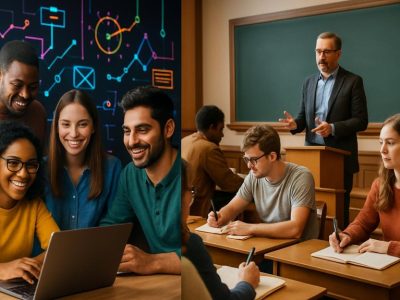
Picture standing in a library, surrounded by countless books filled with wisdom from every corner of the world. Now think about sitting in a classroom, listening to lectures and completing assignments. Both scenarios seem similar, yet they reflect two distinct paths: one leading to knowledge and the other to education. But where the line between them truly lies?
Knowledge is like an endless ocean—boundless, self-driven, and deeply personal. Education, on the other hand, feels more structured—a guided journey with milestones and checkpoints. While they often intertwine, their purposes and impacts can be surprisingly different.
Understanding Knowledge
Knowledge represents the understanding and awareness gained through experiences, study, or reasoning. It’s vast and transcends formal instruction, making it a deeply personal accumulation of insights.
Definition Of Knowledge
Knowledge is the assimilation of facts, truths, and principles acquired through cognitive processes like perception and analysis. Unlike education’s structured format, knowledge grows continuously without predefined boundaries. For example, learning about climate change by reading articles or observing environmental patterns adds to your knowledge base independently.
Features Of Knowledge
Dynamic Nature: Knowledge evolves as new information emerges. For instance, technological advancements redefine existing scientific understandings.
Personal Relevance: What you know often reflects your interests or needs. A chef might focus on culinary techniques while an engineer explores structural designs.
Transferability: Knowledge can be shared but retains its subjective interpretation by individuals receiving it.
Application-Oriented: It finds use in real-world scenarios like solving problems or making decisions.
Sources Of Knowledge
Sources encompass formal and informal channels contributing to intellectual growth:
Experiences: Direct involvement in activities teaches lessons unavailable in textbooks—like managing crises during travel.
Books And Research Papers: Reading literature in science or humanities enriches conceptual clarity.
Observation And Interaction: Watching nature documentaries or engaging with diverse communities widens perspectives.
Media And Technology: Platforms such as educational podcasts offer accessible insights on various topics.
These sources collectively shape what you understand beyond structured education systems.
Understanding Education
Education refers to the structured process of acquiring knowledge, skills, values, and attitudes through formal or informal methods. It establishes a foundation for intellectual and social development.
Definition Of Education
Education is the organized transmission of information and competencies designed to prepare individuals for societal participation. Formal education typically occurs in schools, universities, or training programs where instructors guide learners systematically. Informal education arises from experiences like mentorships or self-directed learning outside traditional institutions.
For example, attending high school provides foundational subjects like mathematics and literature under teacher supervision, whereas watching instructional videos online exemplifies informal educational pathways. Both modes aim to enhance understanding but differ in delivery mechanisms and contexts.
Characteristics Of Education
Structured: Education follows predefined curricula tailored to specific goals such as literacy development or professional proficiency.
Certifiable: Successful completion often results in certifications validating expertise; diplomas are common examples.
Progressive: Content becomes more advanced across levels (e.g., elementary to postgraduate studies).
Unlike self-acquired knowledge which may lack documentation, education emphasizes accountability through assessments like exams or project evaluations.
Types Of Education
Formal: Delivered within institutions with fixed timetables and syllabi; includes primary schooling up through higher education.
Informal: Occurs via experiences without rigid frameworks—learning a language while traveling demonstrates this type.
Non-formal: Organized yet flexible activities outside formal systems; community workshops on financial management illustrate non-formal approaches.
Each type serves distinct purposes but collectively contributes toward holistic growth by addressing cognitive abilities alongside practical applications.
Key Differences Between Knowledge And Education
Knowledge and education differ in their purpose, methods of acquisition, and practical applications. Understanding these distinctions helps you appreciate how both contribute to personal and societal growth.
Purpose Of Knowledge Vs Education
The purpose of knowledge revolves around personal enlightenment and intellectual curiosity. It’s about understanding concepts, solving problems, or gaining insights through experience or reasoning. For instance, learning how plants grow through observation reflects the intrinsic value of knowledge.
Education’s purpose is more systematic. It aims to equip individuals with specific skills and qualifications for societal roles. Schools teach mathematics not just for its theoretical beauty but to prepare students for practical needs like budgeting or engineering tasks.
Acquisition Process
You acquire knowledge informally through experiences such as reading books, observing nature, or engaging in discussions. This process is unbound by structure; a traveler may learn about cultures organically during a journey without formal instruction.
Education follows a structured approach involving curricula, teaching methods, and assessments. Institutions like schools and universities design programs to deliver information progressively—starting from foundational topics like basic arithmetic before moving on to advanced subjects like calculus.
Practical Applications
Knowledge finds use in diverse real-world scenarios without requiring formal frameworks. A self-taught coder applying programming skills to develop apps exemplifies this flexibility.
Importance Of Both In Personal Development
Knowledge and education play complementary roles in shaping your personal development. Knowledge empowers you to think critically, solve problems, and adapt to new situations by drawing on real-world experiences or acquired insights. Education provides the structured framework needed to build foundational skills, establish discipline, and achieve specific goals.
Critical Thinking: Education fosters critical thinking by teaching analytical methods, but knowledge enhances this ability through practical application. For instance, while an economics course teaches market theories, firsthand trading experience cultivates nuanced decision-making skills.
Personal Growth: Knowledge encourages self-reflection and continuous learning outside formal settings. Reading philosophy or exploring diverse cultures can expand perspectives that formal education might not address directly.
Skill Acquisition: Education equips you with technical competencies required for professional success. But, applying these skills in varied contexts—like resolving workplace conflicts—relies heavily on experiential knowledge.
Adaptability: Combining structured learning with informal insights ensures adaptability in dynamic environments. While a degree outlines theoretical frameworks for engineering processes, troubleshooting unexpected machinery issues often demands intuitive understanding gained from hands-on practice.
Both elements together create a balanced approach to intellectual growth and practical competence across personal and societal spheres.
Conclusion
Understanding the difference between knowledge and education helps you appreciate their unique roles in shaping personal and professional growth. While education provides a structured foundation, knowledge enriches your perspective through experience and curiosity. Together, they create a powerful synergy that fuels both intellectual development and practical application.
By embracing both elements, you can cultivate critical thinking, adaptability, and lifelong learning. This balance not only prepares you for societal participation but also empowers you to navigate real-world challenges with confidence and insight.
To provide the best experiences, we use technologies like cookies to store and/or access device information. Consenting to these technologies will allow us to process data such as browsing behaviour or unique IDs on this site. Not consenting or withdrawing consent, may adversely affect certain features and functions.
Functional
Always active
The technical storage or access is strictly necessary for the legitimate purpose of enabling the use of a specific service explicitly requested by the subscriber or user, or for the sole purpose of carrying out the transmission of a communication over an electronic communications network.
Preferences
The technical storage or access is necessary for the legitimate purpose of storing preferences that are not requested by the subscriber or user.
Statistics
The technical storage or access that is used exclusively for statistical purposes.The technical storage or access that is used exclusively for anonymous statistical purposes. Without a subpoena, voluntary compliance on the part of your Internet Service Provider, or additional records from a third party, information stored or retrieved for this purpose alone cannot usually be used to identify you.
Marketing
The technical storage or access is required to create user profiles to send advertising, or to track the user on a website or across several websites for similar marketing purposes.