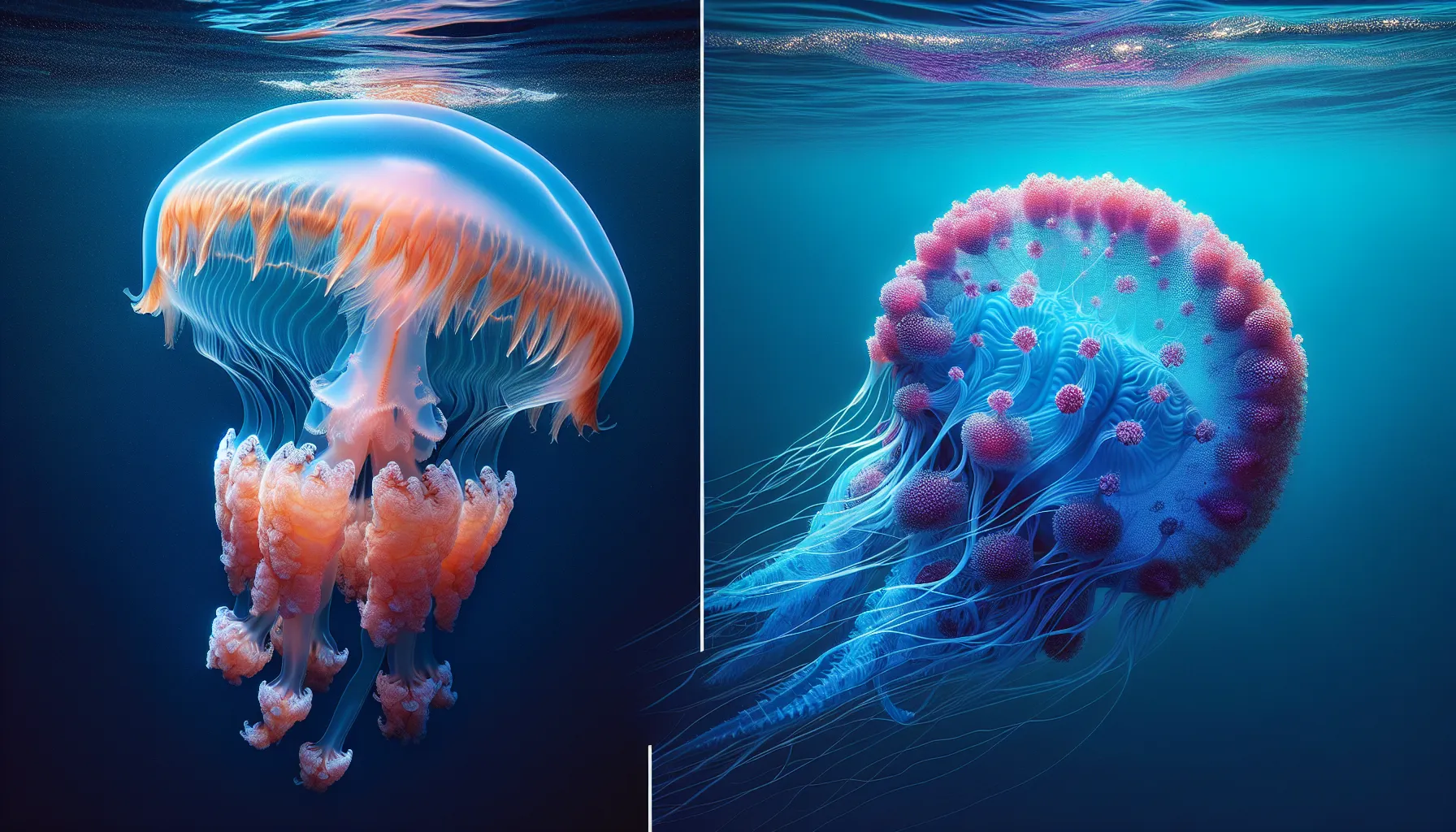
In the intricate and vibrant tapestry of marine ecosystems, two captivating creatures often captivate the imagination of observers: the jellyfish and the Portuguese Man o’ War. Even though sharing a preference for aquatic habitats and sometimes being mistaken for one another, these organisms possess profound differences that set them apart in fascinating ways. Understanding these distinctions not only fuels curiosity but also provides valuable insights into marine biology and safety.
Introduction to Jellyfish and Portuguese Man o’ War
What Is a Jellyfish?
A jellyfish is a gelatinous marine invertebrate, belonging to the phylum Cnidaria. It is characterized by its umbrella-shaped bell and trailing tentacles that contain specialized cells called cnidocytes, used for capturing prey and defense.
What Is a Portuguese Man o’ War?
The Portuguese Man o’ War, often mistaken for a jellyfish, is a siphonophore. This organism consists of a colony of genetically identical individuals called zooids, each fulfilling specialized functions that contribute to the collective’s survival.
Key Differences in Physical Characteristics
Anatomy and Structure Comparison
Jellyfish have a simple body plan with a single bell-shaped structure, while the Portuguese Man o’ War consists of multiple zooids working together in harmony. This fundamental structural difference highlights the unique biological organization of each organism.
Color and Size Variability
Jellyfish display varying hues, ranging from transparent to vibrant shades. Portuguese Man o’ Wars are noted for their blue and purple tentacles, along with a gas-filled bladder that maintains buoyancy.
Ecological Roles in Marine Ecosystems
Habitats and Distribution
Jellyfish thrive in diverse oceanic environments, from shallow coastal shores to the open sea. Portuguese Man o’ Wars, generally found in warmer waters, drift on the ocean’s surface, transported by currents and wind.
Feeding Behaviors and Prey
Both creatures use tentacles armed with nematocysts to immobilize prey, primarily feeding on small fish and plankton. But, their hunting strategies and patterns differ due to their structural and behavioral distinctions.
Interaction with Humans and Safety Considerations
Stinging Mechanisms and Effects
Jellyfish deliver venom through their tentacles upon contact, while the Portuguese Man o’ War’s stinging cells cause painful welts and poses a risk due their potent venom. Awareness of these mechanisms is essential for minimizing encounters.
Safety Tips for Encounters
To mitigate risks, avoid swimming in areas with visible jellyfish or Portuguese Man o’ Wars. If stung, consult medical assistance and refrain from touching the affected area directly.
Interesting Facts About Jellyfish and Portuguese Man o’ War
Jellyfish are known for their pulsating motion enabling navigation even without a central brain. Portuguese Man o’ Wars, distinguished by their colonial composition, exemplify the remarkable diversity of marine life.
Published: January 11, 2026 at 8:58 pm by Ellie B, Site owner & Publisher
To provide the best experiences, we use technologies like cookies to store and/or access device information. Consenting to these technologies will allow us to process data such as browsing behaviour or unique IDs on this site. Not consenting or withdrawing consent, may adversely affect certain features and functions.
Functional
Always active
The technical storage or access is strictly necessary for the legitimate purpose of enabling the use of a specific service explicitly requested by the subscriber or user, or for the sole purpose of carrying out the transmission of a communication over an electronic communications network.
Preferences
The technical storage or access is necessary for the legitimate purpose of storing preferences that are not requested by the subscriber or user.
Statistics
The technical storage or access that is used exclusively for statistical purposes.The technical storage or access that is used exclusively for anonymous statistical purposes. Without a subpoena, voluntary compliance on the part of your Internet Service Provider, or additional records from a third party, information stored or retrieved for this purpose alone cannot usually be used to identify you.
Marketing
The technical storage or access is required to create user profiles to send advertising, or to track the user on a website or across several websites for similar marketing purposes.