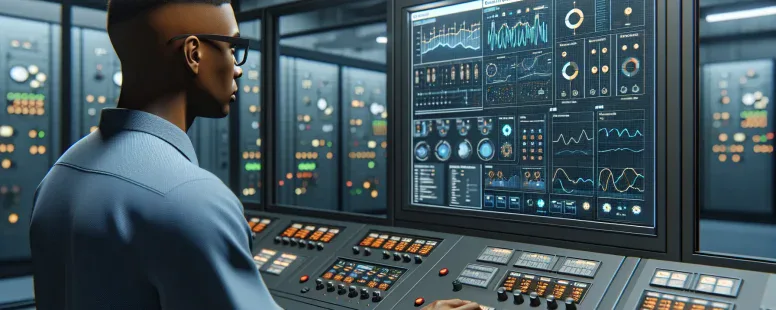
Picture standing in a bustling control room, screens glowing with vibrant visuals and data streams flowing like rivers of information. You’re at the heart of modern industrial automation, where precision and efficiency reign supreme. But how these systems communicate so seamlessly or who’s really in charge? Enter HMI (Human-Machine Interface) and SCADA (Supervisory Control and Data Acquisition), two powerhouse technologies that keep industries running smoothly.
While they often work together, HMI and SCADA serve distinct purposes within automation systems. One acts as the bridge between humans and machines, while the other oversees complex operations on a grander scale. Understanding their differences isn’t just technical jargon; it’s key to unlocking smarter processes, greater productivity, and better decision-making in any automated environment. If you’re ready to demystify these essential tools, let’s jump into what sets them apart—and why it matters to you.
Understanding HMI and SCADA
HMI and SCADA are integral to industrial automation, yet they serve distinct purposes. While both enhance operational efficiency, their functions and scopes differ significantly.
What Is HMI?
HMI stands for Human-Machine Interface. It acts as a visual interface enabling operators to interact with machinery or control systems in real-time. Through HMIs, you monitor parameters like temperature, pressure, or speed using graphical representations such as buttons, charts, or alarms.
Modern HMIs often include touchscreens for intuitive navigation. For instance, in manufacturing plants, an operator might use an HMI to adjust conveyor belt speeds or resolve equipment faults promptly. These interfaces prioritize user-friendliness for quick decision-making during operations.
What Is SCADA?
SCADA represents Supervisory Control and Data Acquisition systems designed for overseeing expansive processes across multiple locations. Unlike HMIs focusing on localized interaction, SCADA collects data from various sources to provide centralized monitoring and control capabilities.
You’d typically find SCADA applications in industries managing large-scale infrastructures like power grids or water treatment facilities. For example, a utility company could rely on SCADA to track energy distribution networks while identifying outages efficiently through its remote data collection features.
SCADA incorporates HMIs within its architecture but extends beyond by offering higher-level analysis and coordination across interconnected systems.
Key Components and Functions
HMI and SCADA serve distinct roles in industrial automation. Their components and functionalities highlight their unique scopes, enabling efficient operation and monitoring of systems.
HMI Components and Features
An HMI consists of hardware like touchscreens, keypads, or monitors combined with software interfaces. These elements allow operators to visualize machine statuses through graphical displays. For instance, dashboards on an HMI can show temperature gauges, system alerts, or motor speeds in real-time.
User-friendly navigation is a core feature of HMIs. Modern interfaces support multi-touch gestures for zooming into specific metrics or toggling between different process views easily. Customization options let you tailor the interface to suit particular operational needs.
HMIs also integrate alarm management systems. These alert operators about critical issues by displaying warnings directly on the screen or emitting audio signals. Such features ensure rapid response to unexpected events during operations.
SCADA Components and Features
SCADA systems encompass four primary components: Remote Terminal Units (RTUs), Programmable Logic Controllers (PLCs), communication networks, and central control software. Together they enable data acquisition from distributed assets across large geographical areas.
RTUs collect input from sensors at remote locations—like flow meters monitoring pipelines—and transmit it back via communication protocols such as Modbus or Ethernet/IP. In parallel, PLCs handle local control tasks while feeding data into the SCADA network for centralized processing.
The communication layer ensures seamless data transfer between field devices and control centers over wired or wireless connections. High-speed links maintain continuous updates essential for managing dynamic processes like power distribution grids.
Major Differences Between HMI and SCADA
Understanding the differences between HMI and SCADA is essential for optimizing industrial automation systems. Each serves distinct purposes, varying in scale, complexity, data handling, and overall role.
Scale and Complexity
HMI operates on a localized scale, focusing on individual machines or processes. It’s designed for direct interaction with specific equipment. For example, an operator uses an HMI to adjust parameters like motor speed or temperature within a single production line.
SCADA oversees complex systems across multiple sites or facilities. It handles macro-level operations such as managing an entire power grid or water distribution network. This scalability makes SCADA suitable for industries requiring comprehensive control over dispersed assets.
Data Handling and Processing
HMI visualizes real-time data from connected devices but lacks advanced processing capabilities. Its primary function is displaying information and enabling immediate operator action.
SCADA collects vast amounts of data from numerous sources through RTUs (Remote Terminal Units) and PLCs (Programmable Logic Controllers). Once gathered, it processes this data using centralized software to generate actionable insights. For instance, SCADA can analyze trends in energy consumption across locations to optimize performance.
Role in Automation Systems
HMI acts as the user interface within automation systems. It bridges human operators with machinery by providing intuitive controls and feedback mechanisms. Without HMIs, manual operation would be time-consuming and prone to errors.
SCADA integrates higher-level decision-making into automation workflows by offering centralized monitoring capabilities. It enables predictive maintenance by analyzing historical data patterns while ensuring operational consistency across large infrastructures like pipelines or railway networks.
Advantages and Limitations
HMI and SCADA systems both contribute significantly to industrial automation, yet they serve different purposes. Each technology has its strengths and challenges that impact their suitability for specific applications.
HMI Pros and Cons
HMI offers intuitive interaction with machines through real-time data visualization. Features like touchscreens, customizable interfaces, and alarm notifications improve operational efficiency. For example, an operator monitoring a manufacturing line can quickly identify issues such as overheating or pressure drops via graphical indicators.
But, HMIs are limited in scope. They focus on individual machines or localized processes without facilitating broader system oversight. Also, HMIs lack advanced data processing capabilities found in larger systems like SCADA.
SCADA Pros and Cons
SCADA enables centralized monitoring of large-scale operations across multiple locations by integrating diverse hardware like RTUs and PLCs with robust software platforms. In industries such as energy distribution or water management, SCADA systems collect extensive data sets for predictive analysis—essential for minimizing downtime or optimizing resource allocation.
Even though these advantages, SCADA systems require significant investment in infrastructure, including communication networks and software licensing. Their complexity also demands skilled personnel for maintenance and troubleshooting tasks.
Industry Applications
HMI and SCADA systems are vital in various industries, streamlining operations through automation and data-driven decision-making. Their applications differ based on scale, complexity, and operational objectives.
HMI Use Cases
HMIs optimize localized machine control by providing real-time visual feedback. In manufacturing plants, operators use HMIs to monitor conveyor speed or adjust robotic arm movements via intuitive touchscreen panels. The automotive industry employs HMIs for assembling vehicles with precision, enabling technicians to detect errors instantly during production.
Food processing facilities rely on HMIs for temperature monitoring in ovens or cooling units to ensure product quality. Pharmaceutical manufacturers leverage them to oversee mixing processes where accurate ingredient ratios are critical. These interfaces simplify complex tasks like calibrating machinery by translating technical data into user-friendly visuals.
SCADA Use Cases
SCADA excels in large-scale infrastructure management requiring centralized oversight across multiple sites. Power generation companies deploy SCADA to track grid performance, identify faults, and balance energy loads efficiently. Water treatment plants use it for monitoring reservoir levels and controlling pump stations across vast regions.
Oil and gas industries depend on SCADA systems for pipeline surveillance, ensuring safe transportation of resources over thousands of miles while detecting potential leaks early. Airports integrate SCADA into airfield lighting control systems to maintain safety standards during night operations or adverse weather conditions.
By combining advanced analytics with remote accessibility features, SCADA supports predictive maintenance strategies essential for avoiding costly downtimes in industries managing critical assets like refineries or public utilities networks.
Choosing Between HMI and SCADA
Selecting between HMI and SCADA depends on the scale and complexity of your industrial operations. If you’re managing localized processes, such as monitoring a single machine or adjusting parameters like conveyor speed, an HMI system is more suitable. It provides real-time data visualization through intuitive interfaces, enabling operators to respond quickly to changes.
In contrast, if your operations span multiple locations or involve large-scale infrastructures like power grids or water treatment facilities, SCADA systems offer broader functionality. They integrate real-time data acquisition, centralized control, and advanced analytics, allowing you to oversee complex systems efficiently. For instance, a utility company uses SCADA to monitor energy distribution across regions while predicting maintenance needs.
Cost is another critical factor. HMIs are relatively affordable due to their limited scope but may require additional integrations for advanced functionalities. On the other hand, SCADA involves higher initial investments in hardware (like PLCs), communication networks, and skilled personnel for setup and maintenance.
Consider scalability when deciding; an HMI might suffice for small-scale setups today but fall short as operations expand. Conversely, implementing a SCADA system from the outset ensures long-term adaptability for growing demands even though its upfront cost.
Evaluate your needs based on process size—whether it’s localized machine interaction or comprehensive infrastructure management—to make an informed choice between these technologies.
Conclusion
Choosing between HMI and SCADA depends on your operational needs, scale, and budget. Both systems play essential roles in industrial automation by enhancing efficiency and enabling data-driven decision-making. While HMI offers localized control with intuitive interfaces, SCADA provides comprehensive oversight for large-scale processes.
Understanding their distinct capabilities ensures you can carry out the right solution to optimize productivity and meet your long-term goals. By evaluating your specific requirements, you’ll be better equipped to leverage these technologies for seamless operations and future scalability.
To provide the best experiences, we use technologies like cookies to store and/or access device information. Consenting to these technologies will allow us to process data such as browsing behaviour or unique IDs on this site. Not consenting or withdrawing consent, may adversely affect certain features and functions.
Functional
Always active
The technical storage or access is strictly necessary for the legitimate purpose of enabling the use of a specific service explicitly requested by the subscriber or user, or for the sole purpose of carrying out the transmission of a communication over an electronic communications network.
Preferences
The technical storage or access is necessary for the legitimate purpose of storing preferences that are not requested by the subscriber or user.
Statistics
The technical storage or access that is used exclusively for statistical purposes.The technical storage or access that is used exclusively for anonymous statistical purposes. Without a subpoena, voluntary compliance on the part of your Internet Service Provider, or additional records from a third party, information stored or retrieved for this purpose alone cannot usually be used to identify you.
Marketing
The technical storage or access is required to create user profiles to send advertising, or to track the user on a website or across several websites for similar marketing purposes.