Picture a summer afternoon humming with life—suddenly the air vibrates with a deafening chorus, and the trees shimmer as winged creatures emerge in waves. You might wonder if you’re witnessing a swarm of locusts or the legendary rise of cicadas. Both insects can transform landscapes and captivate imaginations, but their stories couldn’t be more different.
You’ll find that unraveling the mystery between cicadas and locusts reveals more than just quirky trivia. It opens a window into the hidden rhythms of nature and the unexpected ways these insects shape ecosystems. Discovering what sets them apart might just change the way you hear that summer symphony or see a buzzing cloud on the horizon.
Overview Of Cicadas And Locusts
Cicadas and locusts belong to the insect order Hemiptera and Orthoptera, respectively, yet they get mixed up almost every summer. You might hear a chorus rising from the trees or see swarms darken the skies—could you name who’s performing these natural spectacles? Each insect creates its own environmental drama, acting as both protagonist and mystery in ecosystems across North America, Africa, and Asia.
You’ll hear cicada songs in July’s heat as males vibrate their tymbals, sometimes reaching 100 decibels—a sound louder than a lawn mower (National Geographic). Unlike locusts, cicadas emerge in cycles, with periodical broods—Brood X, for example, appears every 17 years, sometimes prompting festivals like those in Cincinnati. Kids there might trade cicada shells as lucky charms, a little nervous but mostly excited.
Locusts, by contrast, are grasshoppers with a social switch. Under certain crowding conditions, solitary grasshoppers genetically shift, forming massive, fast-moving swarms. In 2020, the Horn of Africa saw swarms devouring crops, threatening food security for millions (FAO reports). Farmers prepare for locust waves the way coastal towns track hurricanes, using satellite alerts, chemical sprays, and historical memory.
What if cicadas and locusts swapped roles? Would cities brace for buzzing blackouts and farmlands for harmless husks? Scientists argue that both are vital—cicadas aerate soil while emerging, their bodies feeding birds, mammals, and even dogs. Locust swarms devastate crops yet spark international cooperation.
Do you ever wonder why some people fear the sound of cicadas or why ancient texts called locusts a curse? Varied folklore and scientific accounts keep both insects storied and significant—inviting you to listen closer next time the chorus starts or the grass turns restless.
Physical Differences
Cicadas and locusts look similar at a glance, but their physical features reveal clear distinctions. Noticing these visible traits helps you instantly tell which insect is singing in the trees or swarming fields.
Size And Appearance
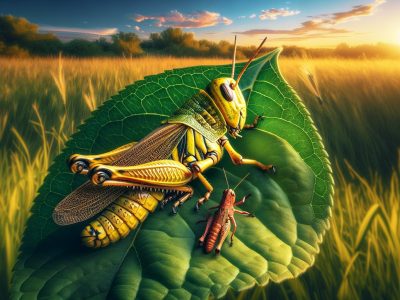
Cicadas typically range from 2 to 5 cm in length, for example Magicicada septendecim, but locusts such as Schistocerca gregaria often measure 3 to 7 cm. One good example of their difference in form: cicadas have stout, broad bodies, while locusts display slender, elongated shapes designed for high-jumping. Try picturing a slow-moving, heavy-bodied cicada perched on a branch—its body almost leaflike in repose—while a lean green locust springing upward from stalks seems all legs and speed. This variation serves their lifestyles: cicadas remain sedentary, and locusts rely on their streamlined builds for migration.
Coloration
Coloration varies more dramatically than you might expect. Cicadas often exhibit dark bodies with green, black, or brown hues, sometimes with eyes that look almost red or orange—Brood X cicadas in 2021 offered striking proof. Locusts can camouflage themselves in a range of greens, tans, and yellows, especially when swarming, sometimes shifting shades due to serotonin-driven phase polyphenism (Uvarov, 1966). Ever seen footage of a desert locust swarm? The color palette shifts from drab to bright en masse, a visual signal that the insects are ready for migration, not quite like the cicada chorus that camouflages itself with bark and leaf.
Wing Structure
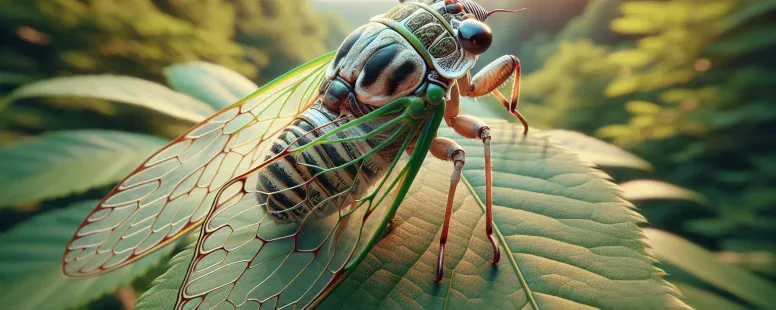
Wings distinguish these insects as well. Cicadas have clear, membranous wings marked with distinctive veins arranged like stained glass—a dog-day cicada’s wings catch sunlight and seem almost iridescent. Locusts bear two pairs of wings: the front pair (tegmina) are thick, leathery and protect the delicate hindwings, which are larger and ideal for strong flight. That’s how locusts traverse continents, while cicadas flutter clumsily from tree to tree. Try questioning yourself: when wings shimmer and sing, is it the cicada’s call you’re hearing, or the shadow of a locust on a cornfield?
Life Cycle And Behavior
Life cycle patterns distinguish cicadas and locusts more than most may expect. You might recognize their behavior across seasons, but the underlying mechanisms reveal deeper differences.
Reproduction Patterns
Cicadas thrive on periodicity, with broods like Magicicada septendecim emerging every 13 or 17 years, according to the USDA. You’ll often find their nymphs tunneling underground, feeding on tree root fluids for over a decade before synchronously surfacing in massive numbers. Locusts by contrast, such as Schistocerca gregaria, lay eggs frequently—typically multiple times per year when conditions are right, with hoppers hatching in 2-3 weeks. If rainfall increases, do locust populations sometimes multiply exponentially? Yes, swarms may appear seemingly overnight due to this rapid reproduction.
Swarming Behavior
Swarm behavior draws a sharp line between cicadas and locusts. Cicadas gather en masse but remain largely stationary; their emergence is more like a summer music festival than a mob on the move. Locusts, but, shift dramatically when crowded. Behavioral transformation from solitary to gregarious forms triggers massive, mobile swarms that can stretch for miles, devouring vegetation in their path—examples include the 2020 East African outbreak that affected croplands across eight countries (source: FAO). Ask yourself, can cicadas ever become a threat in similar ways? Unlike locusts, cicadas never display coordinated feeding frenzies.
Sound Production
Sound forms a major behavioral divide. Cicadas, equipped with tymbals—specialized abdominal organs—produce persistent, species-specific songs that can exceed 100 decibels. Males call to attract mates, resulting in a deafening summer chorus that, for many, becomes the soundtrack of July. Locusts instead rely on stridulation, rubbing hind legs against wings to generate short clicks and chirps, rarely audible above ambient noise. Would your summer nights sound the same if cicadas vanished, replaced by the quieter locust? Likely not, as their auditory signatures define seasonal soundscapes in regions like the eastern United States.
Insect Type
Key Reproduction Pattern
Swarming Behavior
Sound Production
Cicada
Synchronized, periodic broods
Stationary, mass emergences
Loud, tymbal-based songs
Locust
Frequent, rain-triggered
Migratory, voracious swarms
Soft, stridulation clicks
Habitat And Distribution
Cicadas thrive in deciduous forests and urban landscapes across North America, East Asia, and Australia. Their emergence turns old maples, oaks, and sycamores into trembling amphitheaters of sound in July, painting patches of suburban Connecticut with a shimmer of vibrating wings. If you dig beneath grassy lawns or reach for roots of those trees, seventeen years of anticipation buzzes just beneath your feet. Have you ever noticed how quiet some forests grow before that sudden eruption? That’s the cicada, biding its time silently—a patient architect of anticipation.
Locusts live by a different rule of movement and invasion. Grasslands, savannas, and agricultural fields from eastern Africa through Southwest Asia and down into Australia serve as their stages. Unlike cicadas, locusts own no home, just migratory routes etched by hunger and climate. When drought breaks with rain, you might see them transform from drab loners into glistening, synchronized armies—turning daylight murky with their numbers. It isn’t just nature documentaries that catch these swarms; farmers in Kenya will tell you swarms in 2020 darkened skies, covering 2,400 square kilometers (FAO, 2020). What stories could those fields tell if they had voices?
While cicadas root themselves in a single patch for years, locusts chase the green horizon wherever fortunes favor. The boundaries are blurry, the migrations unpredictable, sometimes driven by shifting winds or sudden rainfall. If you have ever wondered why your garden rings with song some summers but sits silent in others, it’s because cicada populations are as cyclical and mysterious as a hidden clock. If a locust swarm passed through your region last year, you’d find scars in your fields and tales in the local news.
Yet, if you compare distribution maps, you’ll notice another wrinkle—cicadas rarely threaten crops, while a cloud of locusts can shift the fate of thousands of people overnight. Are you more likely to wake to a symphony or a silence in your own backyard? Geography, weather, and phenotype all intertwine with the fate of both insects. A single river may divide the territory: cicadas thriving in the wooded North, locusts haunting the broad plains South.
These habitats aren’t just backdrops; they’re characters in an epic about survival, transformation, and song. So next time you step outside, will you picture yourself on the edge of a waiting forest or under the shadow of a moving cloud?
Impact On Environment And Agriculture
Cicadas emerge in immense waves, their synchronized songs filling forests, city parks, and unlikely neighborhoods across North America each July—transforming still air into pulsating soundscapes that, for some, evoke nostalgia or slight frustration. Yet did you ever wonders how much these broods shape your world? Cicadas bring benefits: aerate the soil as nymphs, their mass deaths enrich the ground with nutrients, and adults form a reliable feast for birds, raccoons, and even fish (for example, largemouth bass in Virginia see booms in summer feeding). Cicadas rarely damage healthy trees; instead, their shallow egg-laying grooves prune weaker branches, encouraging new growth—a natural arborist’s touch.
In sharp contrast, locust swarms, such as the Schistocerca gregaria outbreaks documented by FAO in Ethiopia and India during 2020, create havoc on unimaginable scale. Swarms can reach billions, devouring 2,500 metric tons of crops daily, which is enough grain for up to 35,000 people (source: United Nations). Picture waking up to see the sky darken as clouds of locusts descend, stripping fields bare in hours and leaving farmers with shattered hopes—can you picture that devastation echoing across continents?
This difference between cicadas and locusts lies not just in biology but in their societal impact. Cicadas delight festival crowds in Ohio every seventeen years; locusts provoke emergency government responses and international aid. Conservationists see cicada emergences as ecological resets, while locusts prompt debates on pesticide use, drone surveillance, and biocontrol strategies. Which of these insects would you rather meet on your morning walk—one that enriches ecosystems or another whose hunger carries the power to destabilize economies?
Environmental stories play out year after year. Cicadas you’ll hear as a symphony of survival, singing to mark time and bring new life. Locusts, but, march as silent armies, leaving landscapes silent in their wake. If the world was suddenly a place where cicada cycles swapped with locust plagues, would farmers in Kansas need to fear the sound of song—whereas children in Nairobi await the hush of disaster?
In agriculture’s theater, cicadas act as supporting cast, sometimes trimming a limb but never stealing the scene. Locusts, but, take center stage, threatening crops, livelihoods, and even peace. How might you prepare for an insect season knowing it could shape harvests or rewrite local folklore? Entomologists, farmers, and policy makers all share the stage, each with differing strategies, hopes, and fears—your own perspective shapes whether these insects become a nuisance, a neighbor, or a nightmare.
How To Identify Cicadas And Locusts
Spotting cicadas and locusts means turning your eyes and ears toward two different worlds. Cicadas, often called the musicians of July, fill yards and forests with a rattling chorus that rises and falls like waves at dusk. If you hear an near-deafening drone coming from tree branches, you’re likely listening to cicadas—sound produced by tymbal organs vibrating at up to 120 decibels (Sanborn, 2017). Locusts, on the other hand, tap out softer, rhythmic clicks, usually blending into the soundscape until a swarm appears and the quiet turns suddenly chaotic.
Look close, and the differences jump out. Cicadas move slow, crawling across rough bark or sitting motionless on tree trunks, their bodies thick and robust. Their wings gleam like stained glass, each vein etched with the linear clarity of subway maps. Entomologists, referencing Moulds (2005), note that cicadas measure 2–5 cm: you might think of them as miniature emerald statues in the summer sun. Have you ever peered at a cicada’s red eyes and black face up close? The gaze feels ancient, almost alien, a memory from prehistoric forests returning every 17 or 13 years, like clockwork, to remind us of nature’s deep rhythms.
Locusts tell a story of movement—sometimes solitary, more often caught up in the tornado of sudden change called “gregarization.” A lone locust standing in a field looks unremarkable, its green-brown body camouflaged against grass. Yet, under the right weather and food conditions, billions will erupt into a churning mass stretching for kilometers. The locust’s slender build, elongated femur, and two pairs of dusky wings mark it as a master jumper and persistent flier. Flashbacks to the Horn of Africa, January 2020: News reports (FAO, 2020) showed locust swarms darkening skies and stripping entire regions of crops faster than you can blink. What does a locust swarm sound like up close? Some farmers have described it as “wind made solid.”
Naming—another trick—often leads to confusion. Walk through a festival in Nashville and locals point to “cicadas,” marveling at their arrival. But across the Atlantic, a farmer points to a swarm and mutters “locust,” the word heavy with memories of devastation. The semantic lines blur, but your senses sort the difference: sound, movement, habitat, and time.
You might ask: How can one insect bring joy and another fear? Perhaps it’s about scale, sound, and survival. Cicadas invite you to listen; locusts compel you to act.
Feature
Cicada Example
Locust Example
Sound Production
Loud song (120 dB, July broods)
Soft clicking, noisy swarms
Body Shape
Stout, 2–5 cm, broad wings
Slender, 3–7 cm, elongated legs
Movement
Stationary, climbs trees
Jumps, flies, swarms
Coloration
Dark or green, red/black eyes
Brown/green, blends with grass
Habitat
Wooded/urban, tree trunks
Fields, grasslands, crops
If you find yourself pausing on a summer walk, riddled with questions about where the music comes from or how the fields emptied overnight, you are already halfway to mastering the difference between cicadas and locusts. See their worlds through sound and structure; the rest is a matter of noticing what story the landscape is trying to tell you.
Conclusion
When you come across the familiar hum of cicadas or spot a distant swarm of locusts, you’re witnessing two insects with fascinatingly different stories. By recognizing their unique traits and behaviors, you’ll gain a richer appreciation for the complex roles they play in nature.
Next time you’re outdoors, take a moment to listen and observe. You might discover that the world of cicadas and locusts is more intricate and meaningful than you ever imagined, offering new reasons to value the diversity buzzing all around you.
Published: July 25, 2025 at 8:57 am by Ellie B, Site owner & Publisher
To provide the best experiences, we use technologies like cookies to store and/or access device information. Consenting to these technologies will allow us to process data such as browsing behaviour or unique IDs on this site. Not consenting or withdrawing consent, may adversely affect certain features and functions.
Functional
Always active
The technical storage or access is strictly necessary for the legitimate purpose of enabling the use of a specific service explicitly requested by the subscriber or user, or for the sole purpose of carrying out the transmission of a communication over an electronic communications network.
Preferences
The technical storage or access is necessary for the legitimate purpose of storing preferences that are not requested by the subscriber or user.
Statistics
The technical storage or access that is used exclusively for statistical purposes.The technical storage or access that is used exclusively for anonymous statistical purposes. Without a subpoena, voluntary compliance on the part of your Internet Service Provider, or additional records from a third party, information stored or retrieved for this purpose alone cannot usually be used to identify you.
Marketing
The technical storage or access is required to create user profiles to send advertising, or to track the user on a website or across several websites for similar marketing purposes.