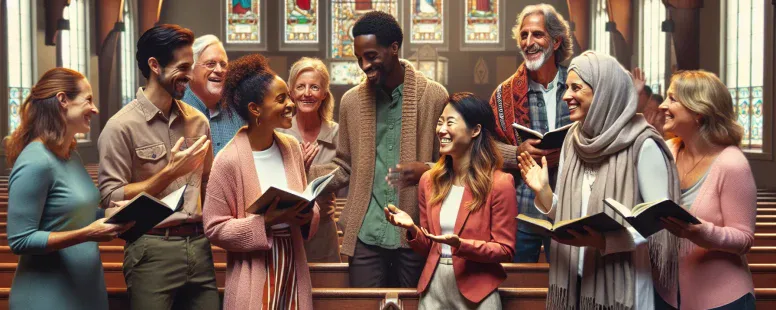
Picture stepping into a city where every street sings with a different melody yet all harmonize under the same sky. The world of Christian denominations feels much like this—vivid, layered, and full of unexpected intersections. You might hear ancient chants echoing in a candlelit cathedral or joyful hymns spilling from a small country chapel. Each tradition offers its own rhythm, colors, and customs that shape how faith is lived and understood.
But what really sets these communities apart? Beyond the familiar symbols and shared stories lies a tapestry of beliefs and practices that might surprise you. Exploring these differences isn’t just about spotting contrasts—it’s about discovering unique strengths and hidden gems that could deepen your own spiritual journey. Are you ready to find out how these diverse paths connect and where they might lead you?
Overview Of Christian Denominations
You encounter a complex tapestry when exploring Christian denominations: each thread—whether Catholic, Orthodox, Protestant, or newer Charismatic movement—weaves distinct beliefs, practices, and leadership structures. Catholic parishes, for example, revere the Pope in Rome as their spiritual head, anchoring rituals like the Eucharist to centuries-old church tradition (Vatican, 2023). In contrast, if you stepped into an Eastern Orthodox congregation, you’ll notice elaborate iconography, chanted liturgies, and a deep sense of continuity from the apostolic era; many Greek and Russian Orthodox communities preserve languages and customs from centuries ago.
You might ask, “How do Protestants fit into this picture?” Martin Luther’s 16th-century Reformation fractured European Christianity, leading to denominations like the Lutherans, Baptists, and Methodists, each emphasizing individual relationship with Scripture over centralized authority. Some, like the United Methodist Church, blend hierarchical oversight with democratic governance, while others, like most Baptist churches, insist every local church is independent—picture a mosaic that’s beautiful because no piece tries to dominate the others.
Sometimes beliefs diverge in surprising ways. Presbyterians, for example, use elders as decision-makers (not bishops or deacons). Pentecostal churches, thriving in regions like sub-Saharan Africa and Latin America, focus on ecstatic worship, spontaneous prayer, and beliefs about present-day miracles. How different would your experience feel if worship included speaking in tongues or faith healing? Are all these expressions merely cultural artifacts, or could they point to something deeper in humanity’s search for meaning?
Consider this: when the World Council of Churches gathers, hundreds of denominations send delegates, each fluent in a shared faith yet fluent in their own dialect—the dependency links of history, culture, and doctrine. Yale theologian Miroslav Volf argued, “Christianity always occurs as denominationally embodied.” Your worldview, shaped by these expressions, grows richer when you search for both agreement and difference.
If you reflect on these manifold denominations, you’ll see more then just surface-level customs. Can discovering their stories expand your spiritual vocabulary? Next time you enter a church or read a faith story online, listen for those dependency connections between tradition and present day—how does diversity create a fuller harmony?
Historical Origins And Development
Christian denominations trace distinct timelines that anchor your beliefs in context-rich traditions and striking moments of change. This path shaped faith as much as geography, language, and ambition did.
Early Church Splits
Divergence among early Christians begins with the Jewish-Christian sect in Jerusalem, quickly extending across the Roman Empire’s urban centers. The First Council of Nicaea (325 CE) tries to unify doctrine, but doctrinal disagreements persist. Geographic distance, cultural differences, and language barriers—Latin West, Greek East, Coptic Egypt—drive deep splits. The Great Schism of 1054 splits the Roman Catholic and Eastern Orthodox churches officially, citing disputes over papal authority and the wording of the Nicene Creed. For example, you notice Eastern Orthodox traditions use leavened bread in the Eucharist, while Catholics adopt unleavened. You’ll find echoes of these ancient arguments in cathedral frescoes, hymns, and even church calendars across continents.
The Reformation And Its Impact
Martin Luther’s 1517 challenge to indulgences sparks the Protestant Reformation, a movement fracturing Catholic dominance in Western Christendom. His followers form the Lutheran tradition, while John Calvin’s teachings shape Reformed churches in Geneva and eventually Scotland (Presbyterianism). Henry VIII’s separation from Rome creates the Anglican Communion, blending Catholic ritual and Reformed theology. Between 1525 and 1600, Anabaptists, Baptists, and other radicals innovate around adult baptism and congregational governance. If you look at the chaotic patchwork of religious toleration across 16th-century Europe (Germany, Switzerland, England), each polity negotiates alliances and persecutions. Denominations like Mennonites arise in resistance, surviving centuries by emphasizing pacifism.
Numbers from Pew Research Center in 2011 estimate over 41,000 distinct Christian denominations globally. This fragmentation, often driven by interpretation and local context, transforms how you experience worship, community, and doctrine today. You hear echoes of these splits in debates over church leadership, the role of scripture, and music—shaping Christianity’s identity with every encounter.
Key Doctrinal Differences
Doctrines form the backbone of Christian denominations, setting each one apart through distinct interpretations and practices. Some may draw their beliefs from stories passed down for generations, while others debate every word looking for deeper truth. See how significant entities in Christianity handle salvation, sacraments, and the source of authority—they’re like languages shaping entire worlds within the same book.
Beliefs About Salvation salvation, Christian groups structure their beliefs around God’s grace, human action, or a mysterious combination. Catholic thought, for example, teaches salvation emerges from faith in Christ combined with participation in church sacraments—picture a road where faith, confession, baptism, and communion mark the key milestones. Protestant entities—such as Lutherans or Evangelicals—describe salvation as a gift unlocked only by faith, quoting Ephesians 2:8-9, “For by grace you are saved through faith.” Orthodox believers, but, treat salvation as a lifelong journey called theosis, seeing humanity transformed step by step into God’s likeness.
Could you picture a room divided by invisible lines, each group claiming, “this is the way”? Some people raise questions about infants: Should babies be baptized, securing grace early, or should belief wait for mature understanding? Take the Quaker tradition. It tosses aside sacraments entirely, emphasizing inner spiritual light as the true path to salvation.
Views On The Sacraments
You’ll witness distinct perspectives on sacraments, sometimes sparking centuries-long debates. Catholicism holds seven sacraments, from baptism to anointing of the sick. Each one operates, in their view, as a direct pipeline for grace—almost like sacred handshakes from God. Ask a Baptist minister, though, and you’ll hear about only two: baptism and the Lord’s Supper. Even those come with strong caveats—the Lord’s Supper, for Baptists, only symbolizes Christ’s sacrifice.
Orthodox liturgies, rich with incense and centuries-old chants, declare sacraments as “mysteries.” These rites don’t just symbolize, they transform the ordinary—every drop of wine and crumb of bread believed to become holy essence. In contrast, many Pentecostal or independent charismatic churches use spontaneous worship and healing services that resemble revival meetings more than ritual ceremonies.
Ever met someone who’s been re-baptized? That’s how interpreted symbolism divides. Anabaptists, for instance, insist on believer’s baptism, rejecting infant baptism as too soon. It’s like watching people debate when the story really begins.
Authority Of Scripture And Tradition
If you picture the Bible as a map, the paths each denomination follows varies wildly. Catholic and Orthodox authorities draw on both Scripture and oral tradition—think of tradition as footnotes and commentaries passed down from the apostles, shaping the journey along the main route. The pope, councils, and ancient creeds provide landmarks for Catholics, while Orthodox believers trust in the Eastern fathers and conciliar decisions.
Reformation voices, like Martin Luther and contemporary evangelicals, insisted sola scriptura—the idea that the Bible alone governs belief. It’s a statement with ripple effect: every chapter and verse subject to prayer, debate, and conscience. But what happens when there’s no agreement on a passage? Fragments appear, new denominations are born over disagreements about everything from creation to communion.
Do you ever question whose voice shapes your story? Some communities, like Methodists, build a “Wesleyan Quadrilateral,” which balances Scripture, tradition, reason, and experience. Others, such as Jehovah’s Witnesses and Mormons, add entirely new texts, pushing the boundaries of Christian identity.
Denomination Entity
Salvation
Sacraments
Source of Authority
Catholic
Faith + Works + Sacraments
7 Sacraments
Bible + Tradition + Papacy
Orthodox
Theosis (synergy of grace and human action)
7 Mysteries
Bible + Apostolic Tradition
Lutheran
Faith Alone
2 Sacraments (Baptism, Eucharist)
Bible Alone
Baptist
Faith Alone
2 Ordinances (Symbolic)
Bible Alone
Pentecostal
Faith + Experience of Holy Spirit
Varied (emphasis on gifts)
Bible Alone + Spirit’s Guidance
Mormon (LDS)
Faith + Works + Covenants
Multiple (unique to LDS)
Bible + Book of Mormon + Prophets
Jehovah’s Witness
Faith + Obedience + Preaching
Memorial of Christ’s Death
Bible (NWT) + Watchtower Interpretation
Could the tapestry of Christian thought be richer because of these doctrinal differences? Some traditions keep their doctrine in music, others in silence, others in debate. The conversation, maybe, is as meaningful as the answer if you let it draw you in.
Differences In Worship Practices
Worship in Christian denominations shapes your entire experience, coloring every gathering with a particular rhythm, aesthetic, and sound. These patterns form a secret language, each echoing the history and theology of the tradition it’s rooted in.
Liturgy And Rituals
Liturgy and ritual in Christian worship can either feels like stepping into a carefully choreographed ballet or entering a spirited conversation with friends. In Catholic and Orthodox churches, you encounter formal rites—such as the Eucharist, incense processions, and recitation from missals—that traces their roots to the first centuries AD, as chronicled by the Vatican and the Orthodox Church in America. For instance, the Easter Vigil in a Catholic cathedral envelops you in sensory layers: candles flicker, bells ring, and the congregation moves in almost timeless synchrony, inviting you into living history.
On the other hand, Protestant traditions differs dramatically in ritual complexity. Some denominations, like Episcopalians, still follow detailed liturgical calendars with scripted prayers, while Baptists favor spontaneous prayer and unscripted sermons. This flexible structure often feels more like a dialogue than a performance. You might attend a Methodist communion service where the elements are passed down the pew by ushers, or join a Pentecostal fellowship circle, hands raised, prayers woven with personal testimony—each form drawing on unique beliefs about divine presence and human participation.
What if your own spiritual journey has spanned more than one tradition? People often describe feelings of both discomfort and discovery the first time they witness unfamiliar rituals. For example, a lifelong Presbyterian may be startled by the incense in an Orthodox service or moved by the exuberance in a Pentecostal meeting. This diversity, according to historians like Philip Jenkins, reflects not confusion but a dynamic dialogue with the transcendent (The Next Christendom, Oxford University Press, 2011).
Music And Worship Style
Music and worship style set the emotional temperature of a service, giving voice to theology through melody and rhythm. In African American Baptist churches, gospel choirs sway and clap, weaving congregational joy into call-and-response songs that echoes the experience of hope in adversity. Mainline Protestants, such as Lutherans, may feature solemn organ hymns, their lyrics echoing doctrine and tradition, while Pentecostals prefer electric guitars and impromptu praise choruses, creating an atmosphere charged with contagious enthusiasm.
Consider that in some Greek Orthodox churches, chants fill the sanctuary with harmonies sung a cappella, passed down from generations, transforming ancient Greek prayers into a felt presence for today’s worshippers. Fast-paced contemporary worship bands, common in evangelical megachurches, invite the congregation to participate as co-creators of the soundscape, dissolving the barrier between stage and pew. These shifts in musical style can sometimes even spark debate within congregations over what forms feel most “authentic.”
The interplay between music, ritual, and doctrine isn’t accidental. Each denomination crafts its worship style as a living commentary on what it believes about God, community, and the place of emotion in faith. Experiencing these contrasts firsthand, you might find yourself surprised by what moves you—a silent moment in a Quaker meeting or the thrum of a drum in a charismatic service. When was the last time you let the music or ritual of a new tradition deepen your curiosity? The tapestry of Christian worship practices, rich in tone and texture, encourages you to step in, listen, and discovers how many languages faith can speak.
Church Structure And Leadership
Church structure and leadership give each denomination a distinct rhythm, like conductors bringing different orchestras to life. Some traditions lean on rigid hierarchies, while others champion shared voices.
Roles Of Clergy
Clergy roles shape how you interact with your faith community, and they defining spiritual authority. In Roman Catholic parishes, priests stand as mediators, performing sacraments and guiding daily worship; at the summit, the Pope acts as both global shepherd and symbol of unity (Vatican.va). By contrast, Eastern Orthodox priests also perform sacraments but operate under local bishops, whose authority flows from ancient apostolic succession—a living thread to the early church.
Protestant clergy roles look drastically different. In Baptist congregations, pastors lead by preaching and pastoral care but often swim in the same pool as their congregation—equal under Scripture, as described by the Southern Baptist Convention. Mainline Lutheran pastors follow detailed liturgical patterns but answer to regional synods. Methodists appoint ministers, though laity share in decision-making and spiritual life. Pentecostal leaders may emerge from lay backgrounds, their authority springing less from ordination than from charismatic experience and linking personal calling to community validation.
Ask yourself: How do these layers of authority and spiritual oversight affect your sense of belonging, or your willingness to challenge tradition? Can a priest’s blessing mean more than a lay elder’s prayer—does ritual context, or personal charisma weigh heavier in your own spiritual story?
Church Governance Models
Church governance models map the architecture of decision-making, from single-handed direction to collective discernment. In Catholicism, a vertical structure reigns, with ultimate authority concentrated in the Vatican’s Magisterium—a body of bishops united with the Pope. Rules flow downward, preserving continuity and preventing doctrinal drift (Catechism of the Catholic Church). The Orthodox Church presents a mosaic of self-governing national churches, each led by patriarchs who balance autonomy with ancient creeds, forming a “communion of communions”.
Protestantism plots a wide spectrum of governance models. Presbyterians deploy a representative system, where elders (presbyters) meet in councils, and power circulates rather than accumulates—think checks and balances. The Anglican Communion blends hierarchy and synod, with bishops in place but decisions shaped by clergy and laypeople voting together. Congregationalists, as in United Church of Christ or many Baptists, trust each local church to govern itself, choosing leaders by vote and shaping doctrine from the ground up. In Pentecostal or nondenominational churches, informal or charismatic models often thrive, leadership unraveled from tradition and woven into the ebb and flow of spiritual experience.
What happens to church unity when every member carries a vote, or when all direction radiates from a distant center? Does democracy dilute mystery, or does hierarchy smother reform? Real-world clashes, like the Episcopal Church’s debates over social issues, reveal how governance structure impacts both policy and personal faith (Pew Research Center, 2014).
Denomination
Clergy Title
Leadership Structure
Decision-Making
Roman Catholic
Priest, Bishop, Pope
Centralized, hierarchical
Vatican-led
Eastern Orthodox
Priest, Bishop, Patriarch
Decentralized, conciliar
Synod-led
Presbyterian
Pastor, Elder
Representative, presbytery
Elder council
Baptist
Pastor, Deacon
Congregational
Local church vote
Pentecostal
Pastor, Elder
Often charismatic or informal
Charismatic, community
Anglican/Episcopal
Priest, Bishop
Hierarchical & synodical
Shared, synodical
You’re invited now to ponder: Does an open vote inspire greater trust, or does a seen hierarchy offer surer spiritual ground? Some peoples prefer the steady beat of tradition, others, the unpredictable current of grassroots voices. Sometimes, there isn’t a right answer—only the legacy of choices echoing across centuries, shaping what worship means in every corner of churches alive with difference.
Cultural And Regional Influences
Christian denominations look like vivid tapestries, woven with colors from the lands where they’ve grown. You can see the Mediterranean olive groves in Orthodox icons, Caribbean rhythms in Pentecostal praise, and Nordic solemnity in Lutheran hymns. Regional roots aren’t just backdrops; they’re shaping the very heart of your worship and beliefs. For example, Anglican churches in Kenya fill their services with Swahili music and vibrant dance. Meanwhile, Irish Catholic parishes weave centuries of folk tunes and Gaelic prayers through their liturgy.
Climate, language, and even local foods seep into rituals. Eastern Orthodox believers in Greece throw flower petals at Pascha—symbolizing resurrection in the burst of spring. Mexican Roman Catholics gather for Día de los Muertos, honoring saints alongside ancestors with marigolds crowded on altars. In Appalachian valleys, shape-note singing in Baptist churches echo the longing of rural communities—an ancient harmonization passed by oral tradition.
Political winds and colonial legacies have left their imprint on every pew and pulpit. You might find the Anglican Church in Nigeria arguing for social justice, reflecting both colonial histories and indigenous calls for reform. Latin America’s Catholic liberation theology rose alongside resistance to dictatorship, its sermons a rallying cry for the poor. Religious borders can run parallel to geopolitical ones; Croatian Catholicism and neighboring Serbian Orthodoxy trace both faith and history across war-scarred landscapes.
Ask yourself—how’d your Sunday service look if you grew up in Seoul versus São Paulo? Would incense fill the air and monks chant in silence, or would street processions and samba spill out from church doors? As sociologist Philip Jenkins (The Next Christendom, 2002) documents, Christianity’s demographic shift toward the Global South has birthed new forms blending indigenous practice, colonial inheritance, and contemporary needs.
Sometimes, denominations even fracture under the pressure of regional identities. Splits between Ethiopian and Egyptian Orthodox churches echo ancient Coptic and Amharic influences, much as Southern Baptist conventions in America reflect both theological and cultural divides. Spiritual identity is as much about where you are as what you believe.
Pause for a moment to picture stepping into worship halfway across the globe—would it feel foreign or strangely familiar? Your experience of faith, from the words you pray to the way you sing, can’t help but carry the mark of people and place. When denomination meets culture, the result is a living testament to Christianity’s ongoing evolution—every gathering, a conversation between heaven and earth, translated into the language of home.
Conclusion
Exploring the differences between Christian denominations opens your eyes to the depth and variety within the faith. Each tradition offers a unique path to understanding God and community, shaped by centuries of history and local culture.
As you encounter new practices or beliefs, let curiosity guide you. Embracing this diversity can enrich your own spiritual journey and help you appreciate the broader story of Christianity.
To provide the best experiences, we use technologies like cookies to store and/or access device information. Consenting to these technologies will allow us to process data such as browsing behaviour or unique IDs on this site. Not consenting or withdrawing consent, may adversely affect certain features and functions.
Functional
Always active
The technical storage or access is strictly necessary for the legitimate purpose of enabling the use of a specific service explicitly requested by the subscriber or user, or for the sole purpose of carrying out the transmission of a communication over an electronic communications network.
Preferences
The technical storage or access is necessary for the legitimate purpose of storing preferences that are not requested by the subscriber or user.
Statistics
The technical storage or access that is used exclusively for statistical purposes.The technical storage or access that is used exclusively for anonymous statistical purposes. Without a subpoena, voluntary compliance on the part of your Internet Service Provider, or additional records from a third party, information stored or retrieved for this purpose alone cannot usually be used to identify you.
Marketing
The technical storage or access is required to create user profiles to send advertising, or to track the user on a website or across several websites for similar marketing purposes.