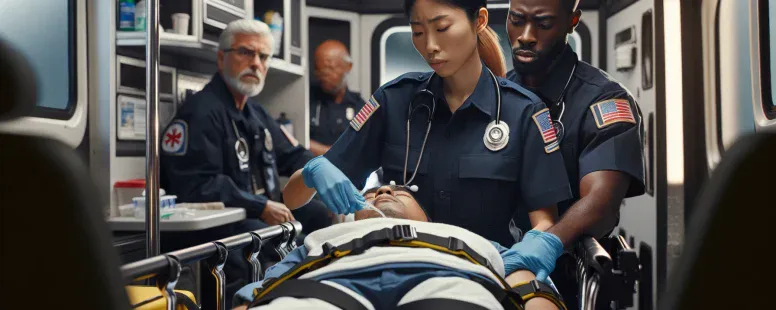
Picture the piercing wail of sirens slicing through city streets, lights flashing against rain-soaked pavement. In that high-stakes moment when every second matters, two professionals leap into action—each with a distinct role, both vital to saving lives. But do you know what truly sets an ambulance technician apart from a paramedic?
You might be surprised to learn that the difference isn’t just about uniforms or titles. It’s about the depth of training, the scope of care, and the unique strengths each brings to the scene. Understanding these roles could change the way you view emergency response—and might even help you make more informed choices in a crisis.
Overview of Emergency Medical Roles
You might find ambulance technicians and paramedics standing side by side beside their bright flashing vehicle, but how often have you wondered who gives insulin during a diabetic coma, or who’s authorized to intubate a trauma patient on a cold rainy night? These professionals share the same ambulance but live in distinct semantic worlds. Ambulance technicians frequently handle first-response tasks. They’re the first hands to check vitals, carry patients across slippery stairs, and calm chaotic scenes. For example, in a sudden car collision on a rural road, an ambulance technician, like Jordan, rapidly takes your pulse and applies a cervical collar. He’s quick but always limited by legal protocols—Jordan can’t give advanced drugs or perform invasive procedures.
Meanwhile, paramedics operate in a broader semantic field: they’re trained to use advanced airway equipment, administer life-saving medications, and interpret ECG readings. Picture Maria, a paramedic, recognizing an acute myocardial infarction in a downtown alley. She’s drawing on thousands of hours of training—more than double what technicians receive (NREMT, 2023). Which role would you trust if your child stop breathing at 3AM? Scope of care truly shapes destiny—ambulance technicians stabilize, paramedics resuscitate.
Job titles and uniforms may blur, but scopes of practice don’t overlap. Each role exist because your emergency care can be a rollercoaster, not a straight line. Ambulance technicians lean on established protocols and timely handovers; paramedics make clinical judgments, reading signs most never see. This balance changes patient outcomes. You can picture protocols as the rails of a train track: one role keeps the train steady, the other reroutes it when disaster looms.
So, when sirens howl in your neighborhood tonight, the type of emergency medical role stepping out that ambulance defines the care you or your loved one recieve. Which expertise the team brings may shift the story between life altered or life restored.
Education and Training Requirements
Education and training act as the main pathways that divide ambulance technicians and paramedics. Your responsibilities, authority in emergencies, and the impact you make all connect directly to these distinctive journeys.
Ambulance Technician Training
Ambulance technician training delivers a focused experience. You enter with a high school diploma, and training courses usually last 8 to 12 weeks at most institutions, like the National Association of Emergency Medical Technicians (NAEMT). These courses walk you through CPR, patient assessment, and safe driving with blaring sirens. Real-life scenarios, such as stabilizing a crash victim before paramedic arrival, test your readiness.
Classroom hours hover around 150, and supervised ambulance rides build practical skills. You learn to apply splints, check vital signs, and assist advanced responders. Certification exams cap the program, validating your readiness for on-scene challenges.
Training varies by state—for instance, South Carolina requires completion of a state-approved EMT-Basic course and passing the National Registry exam, while in the UK, you can become an Emergency Care Assistant with just six weeks of training. These shifts in structure reflect regional demands and clinical protocols.
Paramedic Education Pathways
The paramedic education pathway offers a broader scope. You start by qualifying as an EMT, then enter accredited programs at colleges or universities. Coursework extends far beyond what technicians face, with most programs demanding 1,200 to 1,800 classroom and clinical hours, according to the U.S. Bureau of Labor Statistics.
You’ll cover advanced airway management, pharmacology, EKG interpretation, and trauma care, mastering skills shown in real emergencies—such as using a defibrillator on a cardiac arrest patient or delivering medications to stop anaphylaxis. Clinical internships embed you in emergency departments and ambulance teams, world’s where life and protocol merge in every split-second choice.
Graduation leads to the National Registry of Emergency Medical Technicians-Paramedic certification exam. Stories abound of students balancing night shifts and study sessions, each scenario presenting a new puzzle—and a new responsibility.
Paramedic training’s intensity shapes your clinical judgement. While a technician may relay signs and symptoms, you’ll synthesize that data, decide on advanced interventions, and carry the legal accountability for those actions. You become a critical decision-maker at the frontline of acute care.
Scope of Practice and Responsibilities
You encounter ambulance technicians and paramedics on hectic street corners or calm suburban intersections, each making split-second decisions. Both professions respond to 911 calls, but their scopes of practice set clear boundaries. Their actions ripple through emergencies, changing outcomes in ways that even witnesses rarely understand.
Duties of an Ambulance Technician
You notice that ambulance technicians often check pulses, take blood pressure, and secure patients to stretchers. For instance, one technician, Kelly, recalls arriving first to a car crash, assessing a woman’s breathing, and reassuring her child—all before the paramedics showed up. In most regions, technician’s duties cover basic life support—applying oxygen masks, splinting limbs, and using automated external defibrillators (AEDs). They transport patients, monitor basic vitals, and assist paramedics during resuscitation efforts. According to the National Registry of Emergency Medical Technicians (NREMT), ambulance technicians’ interventions exclude medication administration and invasive procedures such as intubation.
You might wonder if a technician can manage a heart attack without paramedics. Legally, technicians provide stabilizing care only; their training doesn’t authorize medication for chest pain (such as nitroglycerin), nor advanced airway techniques. Real-world protocols reinforce these limits, prioritizing technician safety and clear hierarchy at chaotic scenes.
Roles and Skills of a Paramedic
You observe paramedics taking decisive control—intubating airways, giving intravenous medications, interpreting heart rhythms on electrocardiograms, or leading trauma drills. Paramedics, such as Jasmine from Chicago, remember starting IVs on collapsed marathon runners while explaining every move to frantic bystanders. State statutes, like those referenced by the National Highway Traffic Safety Administration (NHTSA), define paramedics as advanced-level providers authorized to deliver complex clinical care. Paramedics conduct rapid sequence intubation, defibrillation, medication administration (for example, epinephrine or morphine), ECG interpretations, and focused physical exams.
You hear paramedics making split judgments—whether to rush a patient directly to a trauma center or administer a field intervention first. Hospital staff often rely on paramedic reports to anticipate critical needs. In life-or-death situations, paramedics handle both technical mastery and dynamic leadership, a contrast to the technician’s protocol-driven approach. Studies in Prehospital Emergency Care (2022) found that advanced paramedic actions correlate with reduced mortality after cardiac arrest.
You see, every beat matters when someone collapses, and every role—technician or paramedic—adds to the rhythm of survival.
Certification and Career Progression
Picture your first day wearing the ambulance service badge. You shuffled through the doors, adrenaline humming under your technician uniform. For ambulance technicians, a certification starts fast: you’re in class, then on the ambulance, within three months. State boards only ask for a high school diploma and a recognized training certificate; you’ll pass a cognitive assessment, do a hands-on skills check, and, in places like Texas, submit fingerprints before you even touch the siren. These first hurdles shape your routine: you’ll stabilize fractured ankles, monitor breathing patterns, and sometimes ask yourself, “Am I truly ready to handle pain and panic?”
Picture a paramedic you once idolized. She had more stripes on her sleeve, a sense of calm like a seasoned air-traffic controller. To reach her level, you’d need to climb: EMT certification first, then 1,800 hours of instruction, some all-night ER shifts shadowing trauma surgeons, and pharmacology labs where drug dosages become second nature. National Registry Paramedic (NRP) exams, clinical internships, and continued education follow. Halfway through the journey, many wonder: “Is all this effort just a gateway to drugs, drips, and decisive calls?” For paramedics, national certification opens doors to flight medic programs, critical care teams, and instructorship at accredited institutions (NREMT, 2023).
In career ladders, advancement options diverge. A technician usually stays in entry-level positions unless pursuing further training, while certified paramedics ascend—team leader, field supervisor, emergency medical services (EMS) director. A New York City paramedic may mentor rookie techs one week, then lead a multi-agency disaster response the next. Cross-training branches appear: community paramedicine, tactical EMS, and mobile integrated healthcare all wait behind additional badges. Some choose teaching, joining faculty teams at local colleges, shaping tomorrow’s responders.
If you debate between technician and paramedic paths, here’s a question: Are you after a steady routine, or does the idea of split-second judgment ignite your ambition? For some, a technician role means practical experience and steady shifts. For others, the paramedic’s advanced scope resembles both chess master and rapid responder. Data compiled by the Bureau of Labor Statistics shows median annual salaries can go from $36,000 for technicians to $48,000 for paramedics, with regional and overtime variants.
Title
Training Length
Certification Steps
Progression Options
Median Salary*
Ambulance Technician
8–12 weeks
State test, skills check
Lateral, further education
$36,000
Paramedic
12–24 months
EMT + NRP test, clinical hours
EMS leadership, education
$48,000
*Source: US Bureau of Labor Statistics, 2023
Professional growth depends not on the patch you wear, but the paths you follow, curiosity you embrace, and the lives you want to shape. Which journey attracts more—is it mastering the rhythm of basic care or venturing deep into the pulse of advanced interventions?
Work Environments and Team Structure
You’ll spot ambulance technicians and paramedics side by side on the city’s busiest streets, or tucked inside a rural medical outpost where silence can break in an instant. Their work environments stretch from bustling trauma bays in level I trauma centers (CDC, 2021), to narrow hallways in apartment complexes where seconds slip away. Ever ride in the back of an ambulance at 2 a.m.? You’d find the scene humming, the cab packed with equipment, radios chattering, and a team moving in practiced choreography.
Ambulance technicians join teams with the primary focus on support—lifting patients, preparing stretchers, gathering vital signs, and relaying critical details to charge paramedics (Journal of Emergency Medical Services [JEMS], 2022). They rarely lead solo outside of low-acuity non-emergency transport or static-event coverage, since regulations in most states restrict clinical independence (National Registry of Emergency Medical Technicians [NREMT], 2023). In contrast, paramedics orchestrate the call—managing the crisis, giving medications, performing interventions, and directly communicating with physicians by radio. Picture the technician as a steady hand on deck, while the paramedic crafts the blueprint for patient survival.
Team structure depends on agency resources and regional protocols. In fire-based EMS systems, you’ll usually find two paramedics per ambulance for high-risk calls; in private ambulance companies, a common model pairs one paramedic with a technician. That structure’s strategic—paramedics handle complex cases, technicians keep logistics seamless. For example, in a sudden cardiac arrest, the technician supports chest compressions and equipment management while the paramedic manages the airway, medication, and command decisions.
Dynamic team exchange happens in mutual aid responses, when paramedics and technicians from different agencies converge—think multi-vehicle pileup or natural disaster. The technician’s local knowledge or calm under pressure may shine, even as the paramedic coordinates with incident command or hospital staff. Role boundaries blur in crisis, but the underlying hierarchy remains clear.
If you’ve ever wondered—is a technician’s quick blood pressure reading or a paramedic’s medication more important in that frantic moment? The answer’s both, like different keys tuning the same symphony. Picture what could change if every EMT felt empowered to offer their insight, or if paramedics took a moment to teach on the scene.
Next time you see an ambulance team at work, ask yourself: What invisible lines shape their teamwork? What would you notice if you could step right into their shoes for a shift? In these shared environments—chaotic, unpredictable, and occasionally heroic—it’s not just the protocols or paychecks that set these roles apart; it’s how they weave together in those fleeting, life-or-death moments.
Key Differences Between Ambulance Technician and Paramedic
Understanding ambulance technicians and paramedics sometimes feels like standing at a crossroads between expertise and immediacy. Picture arriving on-scene with flashing lights—every minute counts and every decision impacts survival. You might ask, who wields what authority or makes “the call” when sirens pierce the night? The roles, even though both anchoring pre-hospital emergency medicine, take diverging paths when life’s on the line.
Training and Education
Ambulance technicians complete focused programs, usually 8 to 12 weeks long (National Registry of Emergency Medical Technicians). They learn to read vital signs, perform cardiopulmonary resuscitation, and manage trauma bandaging. For example, if a patient fainted at a concert, the technician might assess consciousness and breathing—stopping short of advanced airways or drug administration.
In contrast, paramedics—think clinical commandos—bridge basic readiness with surgical precision. Paramedic training, often lasting 1,200 to 1,800 hours, involves pharmacology, ECG interpretation, and invasive procedures (U.S. Bureau of Labor Statistics). You might work with a paramedic who can intubate, interpret cardiac rhythms, and push intravenous epinephrine during cardiac arrest.
Scope of Practice and Clinical Judgment
Technicians deliver basic life support. They’re the hands that stabilize, splint, and transport, obeying rigid protocols. But, when a ten-car pileup blocks the interstate, paramedics step in: starting IVs, managing advanced airways, or even making on-scene triage calls alongside physicians via telemedicine. The gap between “observe and report” versus “diagnose and treat” defines the two professions. Could you picture letting a technician interpret a complex arrhythmia with just weeks’ schooling? Protocols keep patients safe.
Team Dynamics and Patient Outcomes
Technicians and paramedics don’t work in silos. An anecdote from a Boston emergency team illustrates this: a technician once secured a combative trauma victim while a paramedic inserted a chest tube—a harmony of basic and advanced skills. Peer-reviewed studies (JAMA, 2020) report a 22% improvement in cardiac arrest survival rates when advanced interventions—those reserved for paramedics—are promptly administered. Who leads the “rescue symphony” falls to the paramedic, though every team member’s role is crucial.
Legal Authority and Decision-Making
Ambulance technicians work under strict, delegated authority. Paramedics practice with “standing orders” that empower rapid, autonomous decision-making. When seconds matter, the distinction between asking for permission and acting instantly can change the entire outcome. Picture two professionals, both holding stethoscopes, but only one authorized to deliver morphine or cardiovert a patient in arrhythmia right then.
Career Progression and Income
Technicians enter fast and can make a direct impact, with fewer advancement options unless they “level up.” Paramedics, in contrast, inhabit roles from community paramedicine to EMS management, and even flight or critical care specialization (American Ambulance Association). The path you choose shapes not just your everyday adrenaline but your salary and leadership options, too.
Questions and Considerations
Are you drawn to quick fixes or in-depth medical puzzles? Do you thrive on clear directives or rapid-fire complexity? Each profession carves its place in the chain of survival. Your decision echoes through crowded ER bays, dimly lit highway accidents, and urgent dispatches—a heartbeat that pulses where urgency meets expertise.
Conclusion
Choosing between becoming an ambulance technician or a paramedic depends on your goals and the level of responsibility you’re ready to take on. Both paths let you make a real difference when it matters most. Whether you’re drawn to the fast entry and supportive role of a technician or the advanced skills and leadership of a paramedic you’ll play a crucial part in saving lives and supporting your community every day.
To provide the best experiences, we use technologies like cookies to store and/or access device information. Consenting to these technologies will allow us to process data such as browsing behaviour or unique IDs on this site. Not consenting or withdrawing consent, may adversely affect certain features and functions.
Functional
Always active
The technical storage or access is strictly necessary for the legitimate purpose of enabling the use of a specific service explicitly requested by the subscriber or user, or for the sole purpose of carrying out the transmission of a communication over an electronic communications network.
Preferences
The technical storage or access is necessary for the legitimate purpose of storing preferences that are not requested by the subscriber or user.
Statistics
The technical storage or access that is used exclusively for statistical purposes.The technical storage or access that is used exclusively for anonymous statistical purposes. Without a subpoena, voluntary compliance on the part of your Internet Service Provider, or additional records from a third party, information stored or retrieved for this purpose alone cannot usually be used to identify you.
Marketing
The technical storage or access is required to create user profiles to send advertising, or to track the user on a website or across several websites for similar marketing purposes.