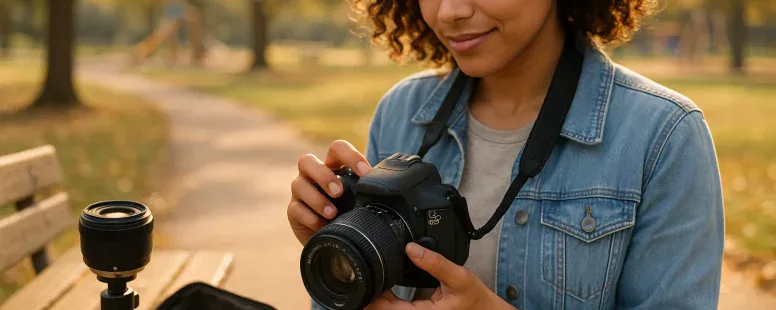
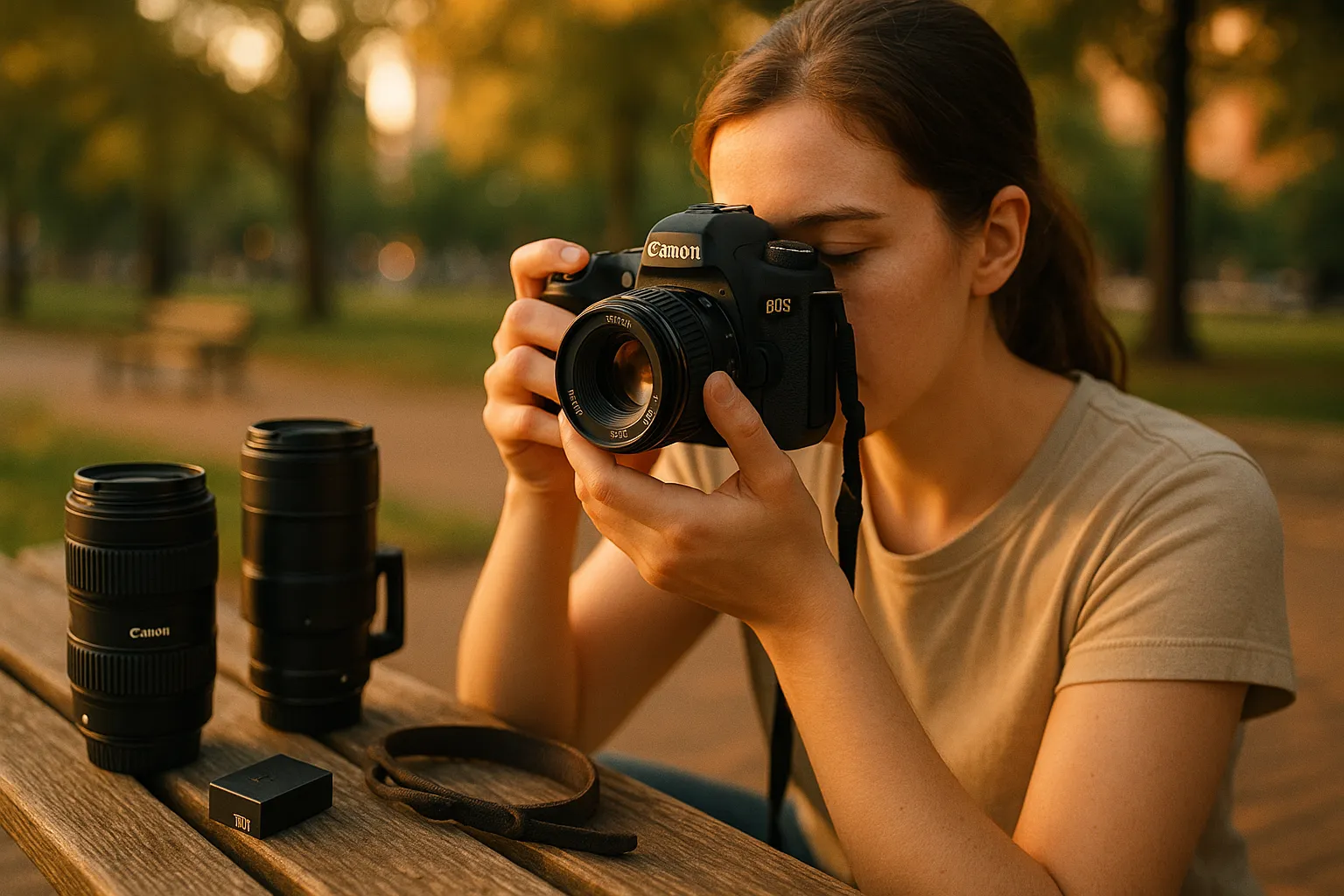
A sturdy DSLR gives you control, tactile dials, and a path to better photos that smartphone apps can’t match. If you want a camera that grows with you, teaches you via physical controls, and delivers richer files for editing, a beginner DSLR is a smart first step. This guide shows which models suit different budgets and goals, what features truly matter, and how to start shooting confidently. Expect clear comparisons, practical tips, and lens recommendations so you can buy once and learn fast.
Why Choose A DSLR As A Beginner
Fact: A DSLR gives you better image quality, optical viewfinder feedback, and a larger lens ecosystem than most point‑and‑shoots. Depth: You hold a DSLR and you feel control. The mirror and optical viewfinder provide an uninterrupted view of the scene: that direct link helps you learn composition and exposure faster. Named entities: Canon, Nikon, Sony.
Optical feedback helps you see exposure changes in real time. That teaches you faster than looking at a tiny LCD and guessing.
Interchangeable lenses mean your camera can be a travel rig one day and a portrait tool the next: brands like Canon and Nikon offer hundreds of compatible lenses.
A DSLR also gives reliable battery life and physical controls that you can manipulate without digging through menus. For beginners, that means fewer distractions and more practice. There are trade‑offs: DSLRs tend to be larger and heavier than mirrorless alternatives, and some models have less advanced autofocus in live view. Still, the learning benefits and lens choices often outweigh those limits for people starting out.
Key Features To Look For In A Beginner DSLR
Insight: Prioritize sensor size, autofocus, ease of use, lens support, and battery life when choosing a first DSLR. Below each point I explain why it matters and how it affects real shooting.
Sensor Size And Image Quality
Fact: APS‑C sensors strike the best balance of price, size, and image quality for beginners. APS‑C sensors deliver sharper images and better low‑light performance than smaller sensors. Example: The Canon EOS Rebel T8i (850D) and Nikon D3500 use APS‑C sensors that handle ISO 800–1600 well for casual low‑light shooting. Larger full‑frame sensors give shallower depth of field and cleaner high‑ISO images, but they raise cost and lens prices.
Autofocus, Burst Rate, And Low‑Light Performance
Fact: Reliable autofocus matters more than maximum megapixels for most beginners. Autofocus accuracy keeps moving subjects sharp: higher burst rates help capture action. If you plan to shoot sports or kids, look for 5–7 fps or higher. For low light, sensor performance and lens aperture work together, a fast prime (f/1.8) helps more than a high megapixel count.
Ease Of Use, Controls, And Built‑In Guides
Fact: Beginner‑focused UI and guided modes speed learning. Cameras like the Canon EOS 250D (SL3) include helpful on‑screen guides and simple menus. Physical dials let you change shutter or aperture without stopping the shoot. You want clear labels and a learning mode that explains what each exposure change does.
Lens Ecosystem, Expandability, And Mount Compatibility
Fact: A strong lens lineup extends your camera’s life. Canon EF/EF‑S and Nikon F mounts offer many budget and premium lenses from Canon, Nikon, Sigma, and Tamron. Choose a mount that matches lenses you’ll likely buy: wide, standard zoom, a fast 50mm, and maybe a macro or telephoto later.
Battery Life, Build Quality, And Connectivity Options
Fact: DSLR batteries generally last longer than mirrorless ones. You should be able to shoot a full day on one battery with DSLRs like the Nikon D3500. Look for Wi‑Fi or Bluetooth if you want quick transfers to your phone. Build quality matters if you travel or shoot outdoors, metal mounts and weather‑resistant seals increase longevity.
How We Evaluated And Chose These Models
Insight: We tested cameras on image quality, autofocus, ergonomics, and real‑world workflow. Process: We shot daylight scenes, low‑light indoors, and fast action sequences. We checked menus, menu clarity, and how quickly you can swap lenses. Named entities: DPReview, DxOMark, B&H Photo.
We weighed three user types: the hobbyist who wants simple controls, the budget buyer who wants the lowest entry cost, and the learner who wants room to grow. We favored models with clear learning aids and strong lens options. We also compared specs like sensor size, fps, autofocus points, and battery life against price. Finally, we considered community support, active user forums, lens availability, and repair/service networks.
Top Beginner DSLR Cameras (With Who Each Is Best For)
Fact: These four DSLRs cover most beginner needs, from budget to growth. Below, each camera has short reasoning and who benefits most.
Canon EOS Rebel T8i (850D), Best All‑Around Starter DSLR
The Canon EOS Rebel T8i offers a user‑friendly interface, a 24MP APS‑C sensor, and a strong autofocus system for a DSLR. You get good image quality, a guided menu, and reliable Wi‑Fi/Bluetooth. Who it’s for: the beginner who wants a single camera to learn with, shoot portraits, landscapes, and the occasional video. Practical note: The T8i pairs with Canon’s wide lens selection, including the affordable EF‑S 18‑55mm kit and the popular 50mm f/1.8.
Nikon D3500, Best For Budget Beginners
The Nikon D3500 gives excellent image quality, superb battery life, and very simple controls at a low price. It has a 24MP APS‑C sensor and great grip. Who it’s for: someone who wants the cheapest path to good JPGs and a camera that’s fun to hold. Downsides: no touchscreen and limited video features. Recommendation: pair it with the Nikon AF‑S 35mm f/1.8G for low‑light portraits on a budget.
Canon EOS 250D (SL3), Best For Compact Size And Video
The Canon EOS 250D is small, lightweight, and offers a fully articulated touchscreen plus 4K video. It balances portability with DSLR controls. Who it’s for: vloggers and travelers who want DSLR ergonomics in a pocketable body. Note: 4K has a crop and limited autofocus compared with 1080p, but for most beginners the compact size wins.
Nikon D5600, Best For Enthusiast Growth Potential
The Nikon D5600 adds a richer feature set: an articulate touchscreen, advanced metering, and expanded autofocus compared with entry models. It supports SnapBridge (Bluetooth) and has solid lens compatibility. Who it’s for: learners who plan to upgrade lenses and push their skills toward semi‑professional work. Consider adding an AF‑S 10–20mm for landscapes and a 50mm prime for portraits.
Recommended Lenses And Accessories For New DSLR Owners
Insight: A good starter kit includes a standard zoom, a fast prime, and a few practical accessories. Below I list specific, widely available choices and why they matter.
Essential Starter Lens Options (Standard Zoom And A Fast Prime)
Fact: A standard zoom and an affordable prime cover most beginner needs.
Standard zooms: Canon EF‑S 18‑55mm or Nikon AF‑S 18–55mm, versatile for landscapes, street, and travel.
Fast prime: 50mm f/1.8 (Canon or Nikon), excellent for portraits and low‑light. The 50mm gives shallower depth and sharper results for the price.
Also consider third‑party lenses from Sigma and Tamron for better value, the Sigma 17–50mm f/2.8 or Tamron 17–50mm can improve low‑light shots without very costly.
Useful Accessories: Tripod, Extra Battery, Memory Cards, And Filters
Fact: A few accessories multiply your results.
Tripod: A sturdy travel tripod from Manfrotto or Benro stabilizes long exposures and videos.
Extra battery: Always carry one spare: DSLRs run longer, but you still can run out on long shoots.
Memory cards: Buy at least one fast UHS‑I card (30–90 MB/s) and one backup.
Filters: A circular polarizer improves skies: ND filters help in bright sunlight and for smooth water shots.
Practical tip: spend more on lenses than on camera bodies. Lenses keep working when you upgrade the body.
Beginner Learning Roadmap: Practical Tips To Master Your DSLR Quickly
Insight: Learn aperture, shutter, and ISO first: then practice in targeted scenarios and adopt a simple editing workflow. Below is a step‑by‑step plan you can follow in a weekend and over months.
Three Camera Settings To Learn First (Aperture, Shutter, ISO)
Fact: Aperture controls depth of field, shutter controls motion, ISO controls light sensitivity.
Aperture (f‑number): Use low f (f/1.8–f/2.8) for blurred backgrounds: use high f (f/8–f/11) for landscapes.
Shutter speed: Use 1/500s or faster for action: 1/30s or slower will show motion blur.
ISO: Raise ISO to preserve shutter/aperture choices in low light, but watch noise. Practice: set two settings and adjust the third until exposure looks right.
Simple Practice Exercises And Shooting Scenarios
Fact: Targeted exercises speed skill growth.
Portrait drill: shoot the same person at f/1.8, f/4, and f/8 to see depth‑of‑field changes.
Motion drill: photograph a running pet at 1/1000s, 1/125s, and panning at 1/30s.
Low‑light drill: shoot a candlelit scene at various ISOs to learn noise limits.
Make notes after each session: what worked, what failed, and what you’ll try next. That habit accelerates learning.
Import and cull: remove bad frames and rate keepers.
Exposure and white balance: fix exposure first, then correct color.
Crop and straighten: improve composition with simple crops.
Export: save high‑quality JPGs for sharing and a lossless file for archiving.
Tools: Adobe Lightroom Classic and Capture One Express (for Nikon/Canon users) are common: free options like Darktable work well too. Tip: Don’t overprocess: aim for natural, clean edits that reflect what you saw.
To provide the best experiences, we use technologies like cookies to store and/or access device information. Consenting to these technologies will allow us to process data such as browsing behaviour or unique IDs on this site. Not consenting or withdrawing consent, may adversely affect certain features and functions.
Functional
Always active
The technical storage or access is strictly necessary for the legitimate purpose of enabling the use of a specific service explicitly requested by the subscriber or user, or for the sole purpose of carrying out the transmission of a communication over an electronic communications network.
Preferences
The technical storage or access is necessary for the legitimate purpose of storing preferences that are not requested by the subscriber or user.
Statistics
The technical storage or access that is used exclusively for statistical purposes.The technical storage or access that is used exclusively for anonymous statistical purposes. Without a subpoena, voluntary compliance on the part of your Internet Service Provider, or additional records from a third party, information stored or retrieved for this purpose alone cannot usually be used to identify you.
Marketing
The technical storage or access is required to create user profiles to send advertising, or to track the user on a website or across several websites for similar marketing purposes.