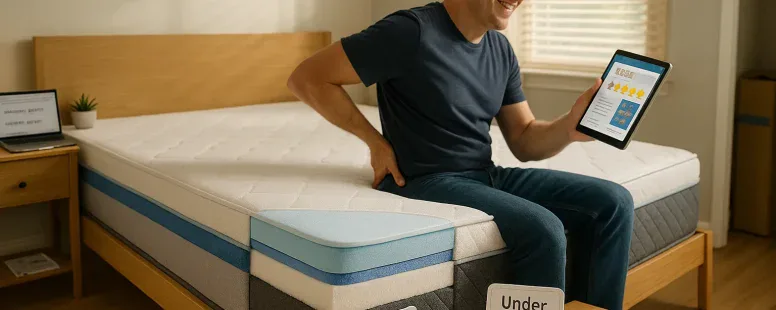
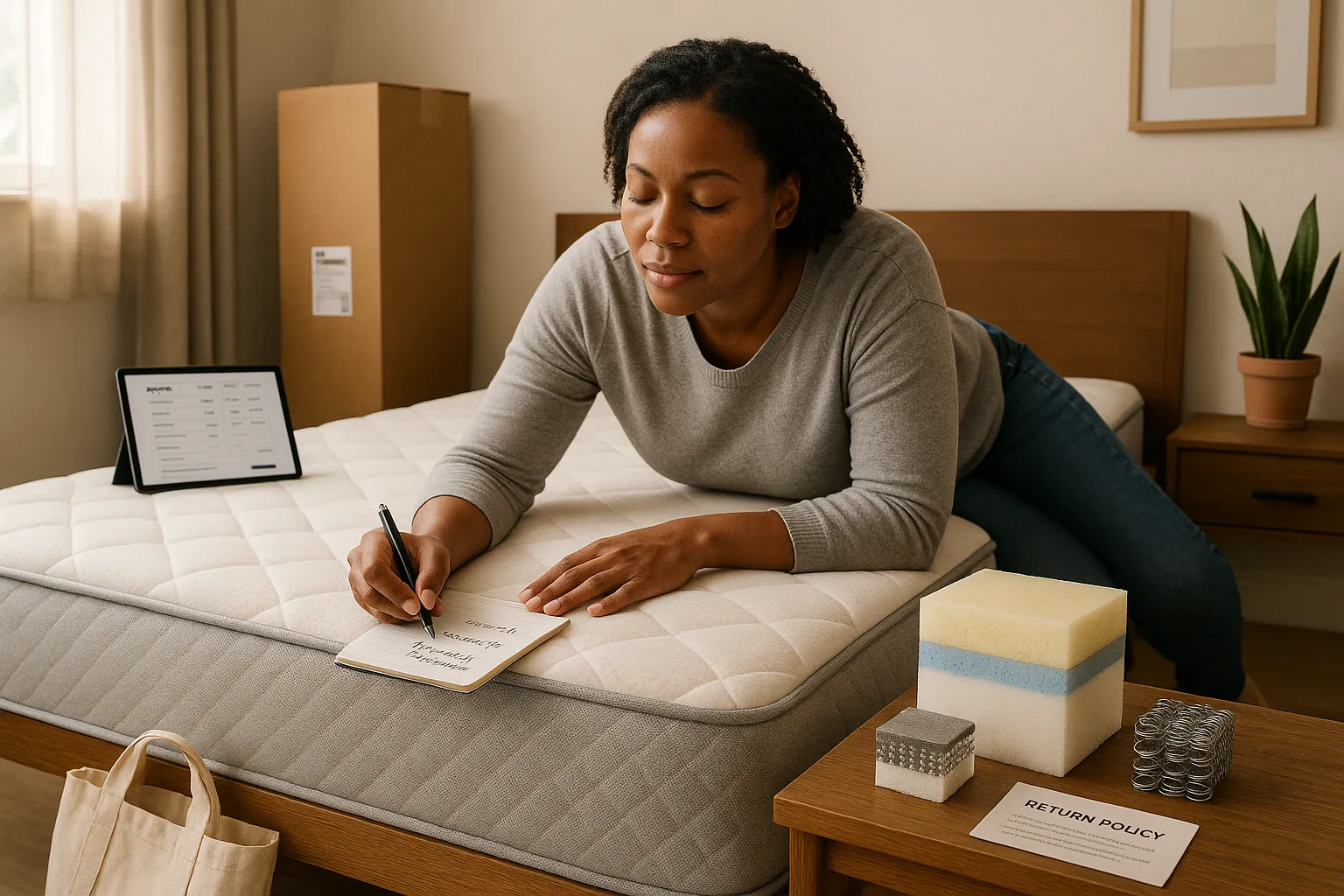
Finding the best mattress on a budget doesn’t mean surrendering comfort. You can sleep cool, wake without back pain, and still keep your bank account intact. Picture stepping into bed that hugs pressure points but pushes back where you need support, all for a fraction of the cost of luxury brands. This guide shows how to spot those bargains, which features truly matter, and which budget mattresses punch above their price. Expect clear buying rules, real brand examples, and practical checks you can use tonight.
How To Choose A Cheap Mattress Without Sacrificing Sleep Quality
Fact: A cheap mattress can still provide good sleep when you prioritize support and durable materials first.
Start by defining your non-negotiables. You want even spinal alignment, pressure relief at hips and shoulders, and minimal sag after a year. Write those down. They will guide every trade-off.
Budget Tiers And What To Expect
Fact: Price brackets predict lifespan and features.
Under $300: Basic innerspring or thin foam. Expect short warranty (3–5 years) and quicker wear. Good for guest rooms, children, or temporary housing. Brands: Zinus, Lucid (value lines).
$300–$500: Better foam density, thicker comfort layers, and longer sleep trials. You often get motion isolation and reasonable edge support. Brands: Allswell, Amazon Basics mattress options.
$500–$1000: Entry-level hybrids and higher-density memory foam. Expect 10-year warranties and stronger support cores. Brands: Tuft & Needle, Nectar (sales bring these into this range).
Start by picking the tier that matches your use case. Don’t overspend for features you won’t use. If you sleep alone and change positions often, motion isolation matters more than edge support.
Key Features To Prioritize: Support, Durability, Motion Isolation
Fact: Support, durability, and motion isolation correlate most with long-term sleep quality.
Support: Look for a firm support core (high-resilience foam or pocketed coils). The mattress should keep your spine neutral. Lie on it for at least 10 minutes in-store: online, read full-thickness specs.
Durability: Foam density is the simplest proxy. Aim for memory foam at least 4 lb/ft³ in comfort layers and high-resilience foam in the base. Innersprings should use pocketed coils rather than continuous coil for longer life.
Motion isolation: If you share bed, choose memory foam or pocketed-coil hybrids. Innerspring alone transmits more movement.
Trade-offs: Cooling vs. contouring. Memory foam contours well but traps heat: a thin gel layer or breathable cover helps. Pocketed coils add airflow but can increase price.
Vulnerable moment: I once bought the cheapest mattress for an apartment move and woke sore for months. I learned to spend a little more for support: that investment stopped my morning stiffness quickly. You may have to try two or three options before finding the right fit, and that is normal.
Top Affordable Mattress Types Compared
Fact: Three mattress families dominate the budget market: innerspring, memory foam, and hybrid (including latex options).
Innerspring: Pros, Cons, And Best Use Cases
Fact: Innerspring offers the best price-to-bounce ratio.
Pros: Responsive feel, cooler sleep, low price. Cons: Less contouring, faster sag, more motion transfer on cheap models.
Best use cases: You sleep on your stomach, prefer a bouncy surface, or need a lightweight mattress (easier to move). Budget innersprings from IKEA or Amazon Basics often do well for dorms and guest rooms.
Real example: A $250 twin innerspring from a major value brand lasted 18 months before noticeable sag. It was fine for my nephew’s room but not for daily adult use.
Memory Foam: What To Look For On A Budget
Fact: Memory foam provides pressure relief but quality varies with density.
Look for: Comfort layers of at least 2 inches of memory foam with density 3–5 lb/ft³ and a transitional foam layer above the base. A breathable cover or gel infill improves temperature control.
Pros: Excellent motion isolation, strong pressure relief, usually affordable. Cons: Can feel hot: low-density foam breaks down faster.
Brands to inspect: Zinus memory foam lines, Lucid, and some Allswell models. Read third-party durability tests or user reviews that mention sagging after a year.
Hybrid And Latex Alternatives: Middle Grounds To Consider
Fact: Hybrids mix coils and foam to balance airflow and contour.
Hybrids: Offer better edge support and airflow than pure foam. On a budget, hybrids often reduce comfort layer thickness, so check layer specs. Pocketed-coil hybrids from brands like Linenspa or budget lines from Nectar can be good midrange picks.
Latex alternatives: Pure latex is pricey. Talalay or Dunlop latex on sale may fall into the upper budget tier. Synthetic latex or latex blends give bounce and durability but watch the materials list for “poly-latex” which may not perform like real latex.
Decision tip: If you sleep hot, favor hybrids or coil-based innersprings. If you want pressure relief and share a bed, choose memory foam or a hybrid with quality foam layers.
Best Mattresses Under $500 And $500–$1000 (Buying Scenarios)
Fact: Your best mattress depends on price band and sleep habits.
Under $500: Choose memory foam or value innerspring. Expect 6–10 inch profiles and modest warranties. Good picks: Zinus Green Tea Memory Foam (often under $300), Linenspa Hybrid (quick sales under $300), and Allswell Luxe on sale.
Who should buy here: Students, renters, guest rooms, or buyers replacing a worn-out thrift purchase.
What to check: Foam density values, coil type, and a minimum 30-night trial.
$500–$1000: You can get stronger hybrids and higher-density foams. Good picks: Tuft & Needle Original (on sale near $500), Nectar (frequent discounts bring it into this band), and Casper entry models.
Who should buy here: Most couples, side sleepers with shoulder pain, and anyone wanting a longer warranty (usually 10 years).
What to check: Edge support, coil count or foam density, and the sleep trial length.
Scenario planning: If you sleep with a partner and wake to tossing, spend toward the $700–$1000 mark for better motion isolation and edge support. If you’re single and want pressure relief, a $350–$450 memory foam with a good return policy often does the trick.
Shopping tip: Watch holiday sales, Memorial Day, Prime Day, and Black Friday often drop $200–$400 off these models. Stack manufacturer coupons with retailer promos when possible.
How To Shop Smart: Tips To Find Deals And Avoid Scams
Fact: Most scams rely on confusing warranties, hidden fees, or fake reviews.
Verify seller identity. Buy from manufacturer sites, Amazon storefronts with verified badges, or established retailers (Wayfair, Mattress Firm). Avoid generic listings with no contact info.
Read warranty fine print. Warranties often exclude body impressions less than 1.5 inches. That matters. A 10-year warranty that only covers defects in the first 2 years is misleading.
Check sleep trial logistics. Free returns are great, but inspect restocking fees or pickup charges. Confirm who pays return shipping.
Understanding Trial Periods, Warranties, And Return Policies
Fact: Trial periods vary and the return cost often falls on the seller.
Trial length: 30–120 nights is common. Longer trials let you test seasonal comfort shifts. But, some brands require 30 days of use before returns to allow the mattress to break in, this is normal.
Warranties: Compare what triggers coverage. Expect coverage for manufacturing defects, not for comfort preference. Document photos and dates when you report issues.
Returns: Ask if the brand donates returned mattresses or resells them. Some companies charge a pickup fee: others coordinate with charities.
When To Buy In-Store Vs. Online And How To Compare Offers
Fact: In-store shopping lets you test feel: online delivers better prices.
Buy in-store when you need immediate replacement or want to try firmness firsthand. Use the showroom visit to note models, firmness numbers, and layer thickness. Then check online prices for identical model names, online is often cheaper.
Buy online when you want longer trials and bigger discounts. Use promo codes and verify the return flow. Always compare the exact spec sheet. A model advertised in-store may have different layers than the online version.
Practical trick: If a mattress feels great in store, ask for the model number and check online for past versions or factory seconds that cost less. But watch for shipping costs and warranty differences.
Care, Maintenance, And When To Replace A Budget Mattress
Fact: Proper care extends mattress life: most budget mattresses need replacement every 5–8 years.
Daily care: Use a breathable mattress protector to guard against stains and moisture. Rotate the mattress every 3 months for the first year, then every 6 months thereafter, unless the label says rotation voids warranty.
Cleaning: Spot clean with mild detergent and air dry. Don’t soak foams. Vacuum the surface every few months to reduce dust and allergens.
When to replace: Replace when you notice 1.5+ inches of sag, new or worsening pain, or if allergens reduce sleep quality. Also replace if the warranty defect period is over and you still have comfort issues.
Honest warning: Budget mattresses can decline faster than you expect. Plan to budget for a replacement sooner than a luxury mattress would require. That planning avoids surprise costs.
Quick Buying Checklist And Recommended Specs By Sleep Position
content: Fact: A short checklist focuses buying decisions and prevents regret.
Quick checklist
Firmness target: Side sleepers 4–6/10 (softer), back sleepers 5–7/10 (medium-firm), stomach sleepers 6–8/10 (firmer).
Foam density: Comfort layers 3–5 lb/ft³ for memory foam: base foam higher density (≥1.5 lb/ft³ for support layer).
Coil type: Pocketed coils for motion isolation and durability: continuous coils for cheapest option only.
Thickness: Aim for 10–12 inches for couples: 8–10 inches can work for singles or lighter sleepers.
Trial & warranty: Minimum 30-night trial, warranty of 5–10 years.
Return logistics: Free pickup or confirmed return partner.
Recommended specs by sleep position
Side sleepers: 3–4 inches of contouring foam or a soft hybrid top. Pressure relief at shoulders is critical.
Back sleepers: Medium-firm core with a firmer support layer and thinner comfort top to keep spine aligned.
Stomach sleepers: Firmer base with minimal sink (look for firmness 6.5+/10).
Combination sleepers: Responsive foam or thin comfort layer over pocketed coils for quick repositioning.
Call to action: Now you have a clear map. Use the checklist while you shop, test the mattress for at least 30 nights if possible, and don’t hesitate to return a model that fails to support you. A smart purchase today saves you pain tomorrow.
Last Updated: March 16, 2026 at 11:11 am by Ellie B, Site owner & Publisher
To provide the best experiences, we use technologies like cookies to store and/or access device information. Consenting to these technologies will allow us to process data such as browsing behaviour or unique IDs on this site. Not consenting or withdrawing consent, may adversely affect certain features and functions.
Functional
Always active
The technical storage or access is strictly necessary for the legitimate purpose of enabling the use of a specific service explicitly requested by the subscriber or user, or for the sole purpose of carrying out the transmission of a communication over an electronic communications network.
Preferences
The technical storage or access is necessary for the legitimate purpose of storing preferences that are not requested by the subscriber or user.
Statistics
The technical storage or access that is used exclusively for statistical purposes.The technical storage or access that is used exclusively for anonymous statistical purposes. Without a subpoena, voluntary compliance on the part of your Internet Service Provider, or additional records from a third party, information stored or retrieved for this purpose alone cannot usually be used to identify you.
Marketing
The technical storage or access is required to create user profiles to send advertising, or to track the user on a website or across several websites for similar marketing purposes.