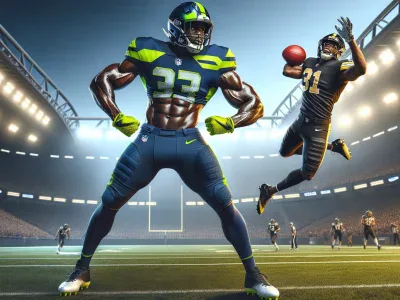
Picture you’re building the ultimate NFL dream team. Two electrifying wide receivers stand before you: Justin Jefferson, the young phenom redefining consistency and finesse, and Tyreek Hill, a blazing speedster who leaves defenders grasping at air. Both dominate in their own right, but which one truly reigns supreme?
Comparing Jefferson’s precision route-running with Hill’s game-breaking explosiveness feels like choosing between art and chaos. Each brings unique skills that can shift momentum in an instant. But deciding who’s better overall, things get complicated—stats only tell part of the story, while play style and impact add depth to the debate.
So how do you measure greatness? Is it raw athleticism or technical mastery? Let’s jump into what sets these two superstars apart and uncover who deserves the crown as football’s most dynamic wide receiver today.
Analyzing Their Playing Styles
Understanding the playing styles of Justin Jefferson and Tyreek Hill highlights their unique contributions to the NFL. Each player possesses distinct attributes that define their success on the field.
Justin Jefferson’s Style Of Play
Jefferson demonstrates a refined approach, relying heavily on precision and route-running expertise. His ability to create separation from defenders stems from his advanced footwork and timing. In 2022, he led the league with 1,809 receiving yards, showcasing his consistency as a deep threat.
Jefferson excels in contested catch situations, often outmaneuvering defenders with calculated positioning. For instance, during Week 10 of the 2022 season against Buffalo Bills, his one-handed fourth-down catch became a defining moment of his career. You notice how he combines physicality and technique effortlessly when observing him play.
Tyreek Hill’s Style Of Play
Hill’s explosive speed makes him one of the most dynamic players in football history. Nicknamed “Cheetah,” he leverages his acceleration to outrun defenders and turn short passes into lengthy gains. In 2020 alone, Hill recorded a career-high 15 touchdown receptions underscoring his red-zone efficiency.
His agility allows him to perform sharp cuts while maintaining balance at high speeds—a critical skill for eluding defensive coverage schemes like man-to-man or zone defense. Against Baltimore Ravens in 2021’s Week 2 matchup, Hill demonstrated this by turning an intermediate pass into a game-changing touchdown after evading multiple tackles.
In comparing these styles directly: does Jefferson’s technical mastery outweigh Hill’s unmatched athleticism? Or do they excel equally but serve different team strategies?
Performance Statistics Comparison
Analyzing performance statistics offers a clear perspective on the strengths of Justin Jefferson and Tyreek Hill. Their numbers reflect their distinct playing styles and impact on the field.
Receiving Yards And Receptions
Jefferson led the NFL in 2022 with 1,809 receiving yards across 128 receptions. His average of 14.1 yards per catch showcases his ability to consistently gain significant yardage, demonstrating exceptional route-running precision. In contrast, Hill recorded 1,710 receiving yards on 119 receptions during the same season, with an impressive average of 14.4 yards per catch that highlights his explosiveness after the catch.
Both players excel at creating separation from defenders but achieve it differently—Jefferson through sharp cuts and timing and Hill using acceleration bursts to outpace coverage.
Touchdowns And Big Plays
Hill’s peak touchdown performance came in 2020 when he scored 15 touchdowns, many resulting from long plays enabled by his speed and agility. Though his recent seasons haven’t hit that mark, he remains a constant deep-threat target for quarterbacks.
Jefferson scored eight touchdowns in both the 2021 and 2022 seasons. While not as high as Hill’s best year, Jefferson compensates by excelling in contested situations inside the red zone.
Hill’s big-play potential is evident through his career-long catches exceeding 70+ yards multiple times; meanwhile, Jefferson’s highlight reel includes memorable clutch performances like a one-handed grab versus Buffalo that saved critical downs.
Consistency Across Seasons
Jefferson has surpassed over 1,400 receiving yards each season since entering the league in 2020—a testament to his reliable production regardless of defensive focus or game plans against him.
Hill’s seasonal outputs fluctuate more due to team strategy shifts or quarterback changes but remain impactful nonetheless: six consecutive Pro Bowl selections validate his consistent elite presence among NFL receivers.
Impact On Team Performance
Both Justin Jefferson and Tyreek Hill significantly influence their teams’ success, but they do so in distinct ways based on their individual skill sets.
Role Within Their Teams’ Offenses
Jefferson functions as the centerpiece of the Minnesota Vikings’ passing game. His ability to run precise routes and make contested catches allows him to consistently move the chains. In 2022, his 128 receptions accounted for over 35% of the team’s total completions, showcasing his pivotal role in creating offensive momentum. The Vikings often rely on Jefferson in critical third-down situations due to his knack for finding space against tight coverage.
Hill operates as a game-changer within the Miami Dolphins’ offense. His elite speed stretches defenses vertically, opening up opportunities not just for himself but also for teammates like Jaylen Waddle. Defenders have to account for Hill’s deep-threat potential every play, which disrupts opposing defensive schemes. For example, during the 2022 season, he averaged 14.4 yards per catch and consistently drew double coverage, enabling other players to exploit mismatches.
Contributions In Key Moments
Jefferson thrives under pressure during high-stakes moments. His one-handed catch versus Buffalo in Week 10 of 2022 is an iconic example of clutch performance; it extended a crucial drive that eventually led to an overtime victory. Also, he recorded five games with over 150 receiving yards that season, elevating his team’s performance when stakes were high.
Hill’s explosiveness shines brightest in pivotal scenarios where big plays are needed most. In Week 9 against Chicago during the same season, he recorded seven receptions for 143 yards and a touchdown—demonstrating his ability to deliver game-altering performances even against tough matchups. Hill’s speed makes him lethal on quick slant routes or deep balls when facing late-game deficits or two-minute drills.
Player
Offensive Role
Key Example
Justin Jefferson
Precision route-runner
One-handed catch vs Buffalo (2022)
Tyreek Hill
Explosive deep-threat
Seven catches for 143 yards vs Chicago
Physical Attributes And Athleticism
Justin Jefferson and Tyreek Hill are both elite wide receivers, but their physical traits and athletic capabilities set them apart in distinct ways. Examining their speed, agility, strength, and catch radius highlights these differences.
Speed And Agility
Tyreek Hill’s speed dominates the NFL landscape. Known as “Cheetah,” he clocked a 4.29-second 40-yard dash at his Pro Day. His top-end acceleration allows him to blow past defenders and make explosive plays, often turning short receptions into long touchdowns. For example, in Week 12 of the 2020 season against Tampa Bay, he recorded an astonishing 269 receiving yards with three touchdowns, showcasing his ability to outrun defenses consistently.
Justin Jefferson is fast but not on Hill’s level raw speed. But, his agility compensates for this difference. He excels in making sharp cuts during route running and maintains balance through contact from defenders. In a pivotal game against Buffalo in the 2022 season, Jefferson’s precise footwork helped him secure a crucial one-handed contested catch that demonstrated elite body control and spatial awareness.
Strength And Catch Radius
Jefferson’s strength lies in his ability to win contested catches even though tight coverage situations. Standing at 6’1″ with a wingspan advantage over most defensive backs (33” arm length), he can reach balls others might miss. His performance against Green Bay in Week 1 of the 2022 season included nine receptions for 184 yards—several requiring high-point grabs under pressure.
Hill relies less on physical strength and more on finesse when catching passes due to his smaller frame (5’10”, around 185 pounds). Though not known for winning jump-ball scenarios frequently like Jefferson does, Hill uses quickness out of breaks to create separation pre-catch rather than relying on post-contact adjustments.
Both players maximize their respective skill sets effectively within team strategies tailored around those attributes—Jefferson thrives by overpowering opponents physically while Hill dismantles them with unmatched velocity bursts paired with surgical precision routes.
Versatility And Adaptability
Justin Jefferson and Tyreek Hill exhibit unique versatility and adaptability, demonstrated through their ability to perform under varying conditions and against diverse defensive strategies.
Performance In Different Situations
Jefferson adapts seamlessly to different game scenarios. He excels in high-pressure moments, such as critical third downs or red-zone opportunities. For instance, his one-handed catch against the Buffalo Bills in 2022 highlighted his capability to deliver during pivotal plays. His precision route-running ensures he remains effective whether facing man coverage or zone schemes.
Tyreek Hill thrives in dynamic situations where quick adjustments are necessary. His speed allows him to capitalize on broken plays, turning potential losses into significant gains. A notable example is a game against the Tampa Bay Buccaneers in 2020 when Hill recorded over 200 receiving yards in the first quarter by exploiting mismatches. His ability to shift gears mid-play showcases unmatched situational awareness.
Ability To Handle Defensive Schemes
Defensive schemes often prioritize neutralizing Jefferson’s impact due to his role as Minnesota’s primary offensive weapon. Even though double teams and bracket coverages, Jefferson maintains elite productivity by leveraging his agility and body control to create separation. In 2022, he led the league even though consistently facing top-tier cornerbacks like Jaire Alexander.
Hill challenges defenses differently by forcing them to account for his deep-threat potential on every snap. Safeties frequently play deeper zones when he’s on the field, opening space underneath for teammates like Jaylen Waddle. Against aggressive press coverage, Hill uses explosive acceleration off the line of scrimmage to beat defenders instantly—a tactic that contributed significantly during Miami’s playoff push last season.
Both players adapt their skill sets effectively within team strategies while forcing opposing defenses into difficult decisions about coverage priorities and resource allocation.
Conclusion
Deciding whether Justin Jefferson or Tyreek Hill is the better wide receiver eventually depends on what you value most in a player. Both bring unmatched skills to the field, excelling in their own ways and making significant impacts for their teams. Jefferson’s consistency and precision contrast with Hill’s explosive speed and game-changing ability, making each uniquely dominant.
Instead of trying to crown one as definitively better, it’s worth appreciating how both elevate the game with their talent. Whether it’s Jefferson’s reliability or Hill’s electrifying style, these two are redefining what it means to be an elite NFL wide receiver.
Last Updated: August 11, 2025 at 7:23 am by Ellie B, Site owner & Publisher
To provide the best experiences, we use technologies like cookies to store and/or access device information. Consenting to these technologies will allow us to process data such as browsing behaviour or unique IDs on this site. Not consenting or withdrawing consent, may adversely affect certain features and functions.
Functional
Always active
The technical storage or access is strictly necessary for the legitimate purpose of enabling the use of a specific service explicitly requested by the subscriber or user, or for the sole purpose of carrying out the transmission of a communication over an electronic communications network.
Preferences
The technical storage or access is necessary for the legitimate purpose of storing preferences that are not requested by the subscriber or user.
Statistics
The technical storage or access that is used exclusively for statistical purposes.The technical storage or access that is used exclusively for anonymous statistical purposes. Without a subpoena, voluntary compliance on the part of your Internet Service Provider, or additional records from a third party, information stored or retrieved for this purpose alone cannot usually be used to identify you.
Marketing
The technical storage or access is required to create user profiles to send advertising, or to track the user on a website or across several websites for similar marketing purposes.