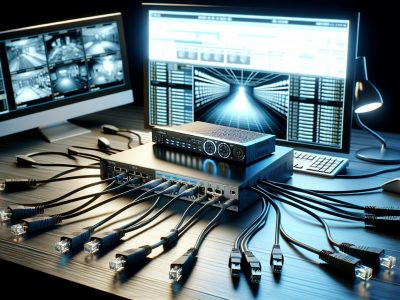
Choosing the right surveillance system for your needs is a critical decision, as it directly affects your security measures. Among the most popular options are DVR (Digital Video Recorder) and NVR (Network Video Recorder) systems. While both serve the primary function of recording video, they differ in compatibility, connectivity, and features, each catering to specific security requirements. Join us as we explore DVRs and NVRs to help you make an well-informed choice.
Understanding DVR and NVR Systems
What Is a DVR?
A Digital Video Recorder (DVR) is a system designed to process and record video from analog cameras. DVRs typically rely on coaxial cables to transmit video signals. This technology has been popular for many years due to its straightforward functionality and reliable performance. Consider DVR systems if you have existing analog cameras or prefer a simpler set-up that gets the job done efficiently.
What Is an NVR?
A Network Video Recorder (NVR), on the other hand, works seamlessly with IP (Internet Protocol) cameras. Instead of needing physical cabling for video transmission, NVR systems use network connectivity. This advanced technology allows for higher-definition recordings and remote access. NVRs are ideal for individuals or organizations aiming for maximum scalability and high-resolution surveillance.
Key Differences Between DVR and NVR
Technology and System Architecture
The fundamental distinction lies in how video data is handled. DVRs convert analog signals to digital format for storage. NVRs, but, receive already-digitized video data directly from IP cameras.
Installation and Connectivity
DVR systems require coaxial cables, limiting flexibility in camera placement. Conversely, NVR systems use an Ethernet network, offering greater versatility and often simplifying installation.
Video Quality and Storage Options
NVR systems generally provide better video quality due to compatibility with high-resolution IP cameras. Storage options in both systems are extensive but differ in compression methods and formats, influencing video clarity and efficiency.
Factors to Consider When Choosing Between DVR and NVR
System Complexity and Scalability
NVR setups are more scalable, accommodating future expansions or upgrades. DVR systems, while more straightforward, can be constrained by their dependence on analog hardware.
Cost and Budget Considerations
DVR systems usually present a cost-effective solution upfront. But, NVR systems, while requiring a higher initial investment, offer advanced features that may justify the expense for certain scenarios.
Use Cases and Application Scenarios
Choose DVR systems for existing analog setups or small-scale surveillance needs. Opt for NVR systems when high-definition recording and remote monitoring are priorities, particularly in larger or more critical environments.
To provide the best experiences, we use technologies like cookies to store and/or access device information. Consenting to these technologies will allow us to process data such as browsing behaviour or unique IDs on this site. Not consenting or withdrawing consent, may adversely affect certain features and functions.
Functional
Always active
The technical storage or access is strictly necessary for the legitimate purpose of enabling the use of a specific service explicitly requested by the subscriber or user, or for the sole purpose of carrying out the transmission of a communication over an electronic communications network.
Preferences
The technical storage or access is necessary for the legitimate purpose of storing preferences that are not requested by the subscriber or user.
Statistics
The technical storage or access that is used exclusively for statistical purposes.The technical storage or access that is used exclusively for anonymous statistical purposes. Without a subpoena, voluntary compliance on the part of your Internet Service Provider, or additional records from a third party, information stored or retrieved for this purpose alone cannot usually be used to identify you.
Marketing
The technical storage or access is required to create user profiles to send advertising, or to track the user on a website or across several websites for similar marketing purposes.