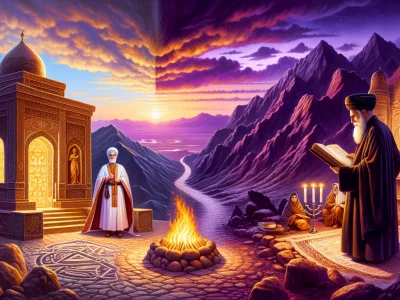
In the tapestry of human history, two texts stand out as cornerstones of faith for millions around the globe: the Bible and the Quran. Both scriptures offer profound insights into spiritual life, ethical conduct, and community bonding. Yet, a question often arises in discussions and inquiries: which of these sacred texts is older? In exploring this question, we will not only investigate into dates and historical references but also uncover the cultural and religious dynamics that shape them. This journey will lead us to a deeper understanding of the origins of spirituality, shared tradition, and the connecting threads of humanity.
Historical Overview of the Bible
Origins and Compilation of the Bible
The Bible’s origins stretch back over millennia, encapsulating a rich array of texts composed across different periods. Traditionally, we understand its two main sections: the Old Testament, which corresponds with the Hebrew Bible, and the New Testament, focusing on the life and teachings of Jesus Christ. The Old Testament dates back as far as the 12th century BCE, though most scholars propose that significant portions took shape between the 8th and 2nd centuries BCE.
The compilation of the Bible was not a singular event: it unfolded gradually over centuries. We witness a diverse collection of authors, prophets, historians, and apostles, contributing to the formation of these texts. The synods of various churches, particularly in the 4th century, solidified the canon we regard today.
Key Texts and Versions of the Bible
The Bible exists in numerous versions and translations, making it one of the most widely read texts globally. The King James Version, published in 1611, is particularly notable for its poetic language. Variants such as the New International Version and the English Standard Version cater to modern readers while maintaining fidelity to the original texts. These translations reveal a rich tapestry of theological reflection and interpretative diversity.
Historical Context of the Quran
Origins and Compilation of the Quran
The Quran, on the other hand, presents a distinct narrative of revelation that began in the 7th century CE. Muslim tradition holds that the Quran was revealed to the Prophet Muhammad over 23 years, beginning in 609 CE. These revelations were orally transmitted and later compiled into written form during the caliphate of Abu Bakr and standardized by Uthman around 650 CE.
Unlike the Bible, which evolved through a diverse array of authors, the Quran is seen as the direct word of God as transmitted to Muhammad. This singular authorship gives the Quran a unique status within Islamic tradition, emphasizing its role as a divine prescription for life and morality.
Key Texts and Variants of the Quran
While the Quran is relatively uniform in its text, variations do exist in recitation and dialect across different Muslim communities. These are referred to as the Qira’at, each reflecting the diverse linguistic and cultural contexts of the Islamic world. But, all versions adhere to the core essence of the text, assuring that its primary message remains unchanged.
Comparative Analysis of Textual Origins
Chronological Development of Sacred Texts
When we compare the Bible and the Quran, it is essential to acknowledge the distinct timelines of their creation. The Bible, particularly the Old Testament, predates the Quran by several centuries. Key texts like the Torah, a significant section of the Old Testament, were already in circulation when Islam emerged in the 7th century.
Influence of Cultural and Historical Factors
Cultural and historical contexts also play a significant role in shaping these texts. The Bible reflects the historical trajectory of ancient Israelite society, and later, early Christian communities. In contrast, the Quran emerges from the socio-political landscape of 7th-century Arabia, addressing the specific issues and challenges of its time. Understanding these contexts aids our comprehension of the texts beyond their chronological timelines.
Conclusions and Implications
Understanding the Significance of Relational Age
In concluding our exploration of the ages of these sacred texts, we recognize that while the Bible is chronologically older than the Quran, both are integral to their respective faiths, providing moral guidance, community cohesion, and a sense of belonging. Their age may define their historical significance, but their ongoing relevance speaks volumes about human spirituality.
Reflections on Faith and Tradition
Faith often intertwines with tradition, enriching our lives with values and insights from these ancient texts. As we reflect on our discussions, it’s clear that both the Bible and Quran offer vital teachings that transcend mere age, providing spiritual nourishment to those who seek it. For more on the religions behind these texts, read about what is older: Christianity or Islam and what is older: Zoroastrianism or Judaism. You can also explore ancient civilizations that predated these faiths in our article on what is older: Egypt or China.
To provide the best experiences, we use technologies like cookies to store and/or access device information. Consenting to these technologies will allow us to process data such as browsing behaviour or unique IDs on this site. Not consenting or withdrawing consent, may adversely affect certain features and functions.
Functional
Always active
The technical storage or access is strictly necessary for the legitimate purpose of enabling the use of a specific service explicitly requested by the subscriber or user, or for the sole purpose of carrying out the transmission of a communication over an electronic communications network.
Preferences
The technical storage or access is necessary for the legitimate purpose of storing preferences that are not requested by the subscriber or user.
Statistics
The technical storage or access that is used exclusively for statistical purposes.The technical storage or access that is used exclusively for anonymous statistical purposes. Without a subpoena, voluntary compliance on the part of your Internet Service Provider, or additional records from a third party, information stored or retrieved for this purpose alone cannot usually be used to identify you.
Marketing
The technical storage or access is required to create user profiles to send advertising, or to track the user on a website or across several websites for similar marketing purposes.