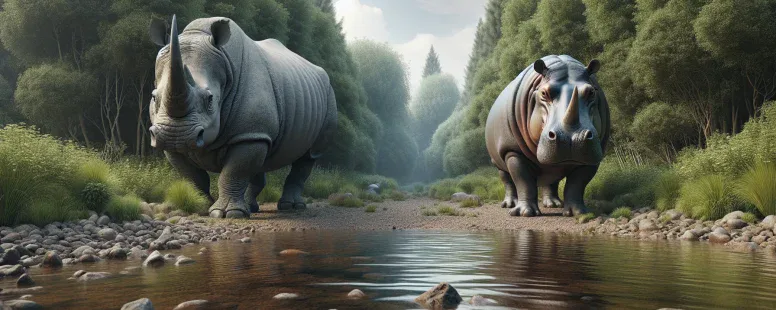
When contrasting two of the most formidable and awe-inspiring mammals on our planet, the rhinoceros, often regarded for its impressive horn and solitary demeanor, and the hippopotamus, with its commanding size and aquatic lifestyle, come readily to mind. Both creatures embody strength and dominance in their respective domains, yet they exhibit fascinating distinctions worth exploring. This article dives deep into the physical attributes, behaviors, ecological roles, and conservation challenges of these magnificent giants to provide a comprehensive comparison based on scientific insights.
Physical Characteristics
Size and Weight Comparison
The rhinoceros, a terrestrial powerhouse, can weigh between 2,200 to 7,700 pounds, depending on the species, with heights reaching nearly 6 feet at the shoulder. Conversely, the hippopotamus, native to aquatic regions, averages around 3,300 to 7,000 pounds, with a more compact build when considering its length.
Notable Features
Rhinoceroses are distinguished by their horn or horns composed of keratin, the same material as human hair and nails. This feature plays a significant role in their defense and interactions. Hippopotamuses showcase massive jaws with formidable canines and incisors utilized for territorial disputes and defense mechanisms.
Behavioral Traits
Social Structures
Hippopotamuses are gregarious, often seen in pods comprising multiple individuals, reflecting their social nature. They establish hierarchies within their groups, primarily governed by dominant males. In contrast, rhinoceroses are notably solitary, with interactions primarily restricted to territorial disputes or mating.
Territorial Nature
Both animals exhibit distinct territorial behaviors. Rhinos mark their territory using dung piles and horn scratching. Hippos, on the other hand, assert dominance within their aquatic habitats through vocalizations, jaw displays, and physical confrontations.
Habitats and Ecology
Preferred Environments
Rhinoceroses inhabit grasslands, savannas, and forests, where browsing and grazing sustain their dietary needs. Hippopotamuses reside along rivers, lakes, and wetlands, emphasizing their reliance on water for thermo-regulation and safety during the day.
Role in the Ecosystem
Both animals are ecological keystones. Rhinos shape vegetation dynamics through grazing, promoting biodiversity. Meanwhile, hippos contribute nutrients to aquatic ecosystems via defecation, enhancing fish and plant productivity.
Rhinoceros and Hippopotamus Encounters
Comparative Strengths and Abilities
Rhinos possess immense physical power enhanced by their robust frame and horn usage. Hippos, with their powerful jaws and agility in water, remain formidable even to large predators.
Interaction Scenarios
Direct interactions between these species in overlapping habitats are rare but would likely lead to intricate displays of territoriality, with either animal defending its domain strongly.
Conservation Status and Human Impact
Threats and Challenges
Both species face significant threats, including poaching and habitat loss due to human expansion. The rhinoceros’ horn remains a critical factor in its illegal hunting.
Efforts for Preservation
Conservation programs, including anti-poaching initiatives and habitat restoration, aim to secure the futures of both species. Public awareness campaigns play a critical role in fostering global support.
Published: November 7, 2025 at 10:22 pm by Ellie B, Site owner & Publisher
To provide the best experiences, we use technologies like cookies to store and/or access device information. Consenting to these technologies will allow us to process data such as browsing behaviour or unique IDs on this site. Not consenting or withdrawing consent, may adversely affect certain features and functions.
Functional
Always active
The technical storage or access is strictly necessary for the legitimate purpose of enabling the use of a specific service explicitly requested by the subscriber or user, or for the sole purpose of carrying out the transmission of a communication over an electronic communications network.
Preferences
The technical storage or access is necessary for the legitimate purpose of storing preferences that are not requested by the subscriber or user.
Statistics
The technical storage or access that is used exclusively for statistical purposes.The technical storage or access that is used exclusively for anonymous statistical purposes. Without a subpoena, voluntary compliance on the part of your Internet Service Provider, or additional records from a third party, information stored or retrieved for this purpose alone cannot usually be used to identify you.
Marketing
The technical storage or access is required to create user profiles to send advertising, or to track the user on a website or across several websites for similar marketing purposes.