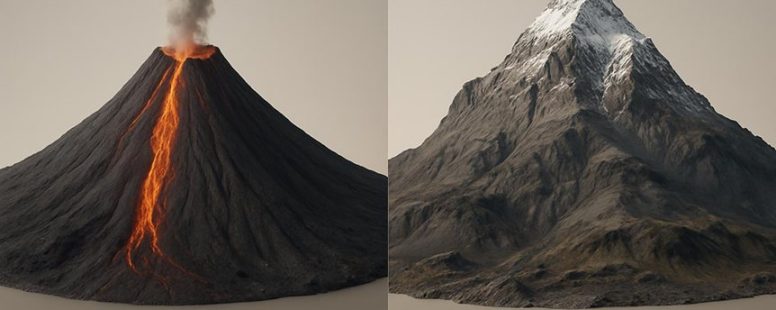
Beneath the sky’s vast canvas, towering peaks and fiery vents seem to whisper stories of Earth’s restless heartbeat. But what truly sets a volcano apart from a mountain? At first glance, they might appear similar, yet their origins are worlds apart—one builds its fiery crown from molten rage, the other rises through ancient forces.
Discovering these differences isn’t just academic; it unlocks a deeper appreciation for our planet’s vibrant dance. Surprisingly, knowing what makes a volcano special can even help predict eruptions and protect communities.
Let’s delve into the fiery and majestic forces shaping our world.
What Is a Mountain? How Are They Formed?
A mountain is a large landform that rises high above the surrounding area. Mountains are mainly made through the movement of tectonic plates. These huge pieces of Earth’s crust push against each other over millions of years. When they collide, they force the land upward, forming mountains. An example is the Himalayas, which are still growing because the Indian plate is pushing into the Eurasian plate.
Unlike volcanoes, which erupt lava and gases, most mountains do not release gases unless they are part of volcanic structures. Some mountains, like Mount St. Helens in Washington, are volcanic and can erupt suddenly. But most mountains, like the Rocky Mountains or the Alps, grow slowly over time through tectonic forces.
Mountains support many different plants and animals that are specially adapted to living at high altitudes. For example, snow leopards live in the mountains of Central Asia, and mountain pine trees grow on rocky slopes. These ecosystems are tough and can survive harsh weather conditions.
How Do Volcanoes Erupt and Shape Landforms?
When magma pushes up through the Earth’s crust, pressure gets higher and higher until it causes a volcano to erupt. This eruption can be quiet or very explosive. When it erupts, magma, gases, and ash shoot out and pile up to form different landforms. For example, volcanoes like Mount St. Helens grow taller with each eruption, and lava can spread out to create flat lava plains.
Some people wonder how this process changes the land. It can build new mountains or fill valleys with lava. But eruptions can also be dangerous because they can cause ash clouds and hot lava flows that threaten nearby towns.
There are two main types of eruptions: quiet and explosive. Quiet eruptions happen when lava flows slowly and cools into new rock. Explosive eruptions happen when gases trapped inside magma suddenly escape, causing a big burst. Both types shape the land in different ways, but they both show how powerful volcanoes are.
Understanding how magma moves and erupts helps us learn why some areas have volcanoes and how they change the land over time. It’s a natural process that has shaped Earth’s surface for millions of years.
Magma Movement and Pressure
Magma movement and pressure are the main reasons why volcanoes erupt. Magma is hot, molten rock that stays underground. When it moves up through cracks in the Earth’s crust, it causes an increase in pressure. When this pressure gets too high, the volcano erupts and releases magma and gases.
Here is how it works:
Magma builds up underground, creating high pressure inside the volcano.
Gas bubbles form inside the magma, making it expand and push harder.
When the pressure becomes too strong, magma pushes upward toward the surface.
The eruption happens when magma and gases escape, changing the land and releasing pressure.
Understanding how magma pressure works helps us see why some eruptions are so powerful. For example, when the lava flows from Mount St. Helens in 1980, it was caused by magma rising quickly due to pressure build-up. Some volcanoes might not erupt because the rocks around them are strong enough to hold the magma back.
However, there are two sides to this story. Some scientists say that pressure is the main cause of eruptions, while others believe that changes in the magma’s composition or the way gases are trapped can also trigger eruptions. Both ideas are important for understanding volcanoes and predicting eruptions.
Knowing about magma pressure helps us prepare for eruptions and stay safe but remember that predicting exactly when a volcano will erupt is still hard.
Formation of Landforms
Volcanoes form new land by erupting magma, gases, and ash. When magma reaches the surface, it cools and hardens, creating landforms like volcanic cones. This process builds up the land over time. Ash from eruptions is carried by the wind and settles on existing mountains. These layers can turn into new rock. Repeated eruptions deposit more material, changing the area a lot. For example, they can create large craters called calderas or flat-topped lava plateaus. Eruptions also break down old mountain sediment, spreading it around. As eruptions continue and materials build up, the land changes shape and often stands out sharply from the surrounding area. This is why volcanic landforms are so different from regular mountains. Some landforms are formed quickly by eruptions, while others take many years to develop.
What Are the Structural Differences Between Volcanoes and Mountains?
Volcanoes and mountains are both tall landforms, but they form in very different ways.
A mountain is made when the Earth’s crust slowly pushes up over many years. This process can create large, uneven land with peaks and valleys. Mountains often have glaciers on top, which can wear them down over time. Examples include the Rockies in the United States or the Himalayas in Asia.
A volcano is built from melted rock called magma that erupts from inside the Earth. When magma reaches the surface, it cools and hardens, building up the volcano. This process repeats many times, creating a cone-shaped mountain with a crater or vent at the top where eruptions happen. Volcanoes often have layers of ash and lava flows, which make them look striped or layered. A famous example is Mount Fuji in Japan.
One big difference is the structure. Volcanoes have a main vent or opening at the top that erupts magma, ash, and gases. Mountains usually do not have such openings. Instead, they are formed by plate movements that slowly lift the land.
Another difference is shape. Volcanoes are often cone-shaped because of repeated eruptions, while mountains can be more irregular and massive. Sometimes glaciers cover both types of landforms, but the inside of a volcano stays centered around magma chambers and vents, no matter how much ice covers it.
Some people see volcanoes as dangerous because of eruptions, but they also bring new land and minerals. Mountains are usually safer but can be tough to climb or live on because of their size and ruggedness.
How Do Tectonic Forces Create Mountains and Volcanoes?
Tectonic forces are what cause mountains and volcanoes to form on Earth. These forces happen because of the way tectonic plates move and interact. When plates crash into each other, they can push the land upward, creating mountain ranges like the Himalayas. Sometimes, one plate slides under another, which puts a lot of pressure on rocks below. This pressure heats the rocks and melts them into magma, the hot liquid inside Earth.
Volcanoes form when magma rises through cracks in the crust. Gases from the magma escape, causing eruptions. These eruptions can be quiet or explosive. When magma and gases push upward along faults or plate boundaries, they shape the volcano. Over millions of years, the constant movement of tectonic plates keeps changing the surface. New mountains and volcanoes rise while others wear down.
Some people wonder if all mountains and volcanoes are caused by the same forces. The answer is mostly yes, but different types of plates create different features. For example, the Andes mountain range in South America formed because of subduction, while the Himalayas grew because of plate collision. These processes show how powerful forces deep inside the Earth shape the world we see.
Understanding how tectonic forces work helps us see why Earth looks different over time. It also reminds us that our planet is always changing, sometimes in dramatic ways.
How Do Volcanic Landforms Evolve Over Time?
Volcanic landforms change over time mainly because lava builds up land, and erosion wears it down. Lava from eruptions creates new landforms like mountains, cones, and plateaus. Over time, wind, rain, and glaciers slowly wear these features away. Tectonic activity, such as earthquakes and shifting plates, also plays a role. It can cause volcanoes to grow taller, collapse, or change shape completely.
For example, Mount Fuji in Japan grew taller with lava flows but has also been shaped by erosion and earthquakes. Sometimes, a volcano erupts many times, adding new layers of lava and ash. Other times, erosion can carve away parts of a volcano, changing its appearance.
Some people think volcanic landforms mostly grow larger because of lava, while others see erosion as equally important. Both are true because lava builds up land, but erosion wears it down. The way volcanoes change depends on many things like climate, the type of lava, and how active the volcano is.
Lava Accumulation Builds Land
Lava buildup is how volcanoes make new land. When a volcano erupts, it sends out melted rock called lava. As the lava cools down and hardens, it sticks to the ground or water. Over time, this process makes the land grow bigger and taller.
Here is how lava buildup makes land:
Lava flows out of the volcano and spreads over the nearby area. It can flow slowly or quickly.
With each eruption, more lava stacks on top of the old lava. This makes the volcano taller and bigger.
When the lava cools and hardens, it creates new ground. This adds more land to the volcano.
If eruptions keep happening, they can build large volcanoes like shield volcanoes or stratovolcanoes.
Some volcanoes grow very large through continuous lava buildup. For example, Mauna Loa in Hawaii is a shield volcano that has grown over thousands of years because of constant lava flow. But there are also limits. Sometimes, lava flows too far or too fast for it to build up land effectively. Eruptions can also be dangerous to nearby towns and people.
Erosion Shapes Landforms
Erosion is when natural forces wear down landforms like volcanoes. Over time, wind, rain, and flowing water break apart rocks and carry away loose material. This process changes sharp volcanic peaks into softer, rounded hills or flat plateaus. For example, a tall, jagged volcano might become a gentle hill after many years of erosion. Climate affects how fast erosion happens. Areas with heavy rain or hot weather see faster changes because the water and heat weaken rocks more quickly. Rainwater can seep into cracks, making them bigger and causing parts of the volcano to fall away. Wind can also carry tiny particles that scrape and smooth rock surfaces. Sometimes, erosion happens slowly over hundreds of years, turning rough volcanic features into valleys or fertile plains.
Some people see erosion as a natural way that volcanic landforms change. Others warn that rapid erosion, caused by heavy storms or human activities, can lead to landslides or loss of soil. While erosion shapes these landforms, it also can make them less stable or more prone to damage. Understanding how erosion works helps us see how volcanoes and other landforms grow softer and more gentle over time. It’s a slow process, but it can greatly change the way volcanic areas look and feel.
Tectonic Activity Influence
Tectonic activity is what causes many changes in volcanic landforms over time. It is the movement of Earth’s plates beneath the surface. These movements help create and change volcanoes in different ways.
First, when plates move apart or slide past each other, magma can rise up through cracks. This process forms new volcanoes, like the ones seen along the mid-ocean ridges or at specific fault lines. For example, the Great Rift Valley in Africa has many volcanoes because of these plate movements.
Second, eruptions happen when magma reaches the surface and releases gases and lava. These eruptions can build up new landforms, such as mountains or islands. Sometimes, the gases released can cause ash clouds that spread over large areas, affecting air travel and climate.
Third, lava flows from erupting volcanoes cool and harden. Over time, these cooled lava layers add to the size of the volcano or create new landforms nearby. This process can also change the nearby environment, like destroying forests or creating new habitats.
Lastly, the Earth’s surface can sink or rise because of tectonic shifts. This is called subsidence or uplift. When land sinks, it can cause lakes or basins to form. When the land rises, it can make mountains taller or change volcanic activity patterns.
Some scientists believe tectonic movements are the main cause of volcano formation and change. Others warn that not all landform changes are directly caused by tectonics. Sometimes, erosion or other natural forces also shape volcanic areas.
Knowing how tectonic activity influences volcanoes helps us understand why Earth’s surface looks the way it does. It shows how dynamic and changing our planet really is.
What Are Common Misconceptions About Mountains and Volcanoes?
Many people believe all mountains are volcanoes or that volcanoes are always erupting. But these ideas are not true. A mountain is a large landform that rises high above the ground. Some mountains are formed by the Earth’s plates pushing together, and they are not volcanic at all. For example, the Himalayas are made by tectonic forces, not volcanoes.
Volcanoes are mountains that form when melted rock, called magma, reaches the surface. Some volcanoes erupt often, but many are quiet most of the time. These quiet volcanoes are called dormant. Others are extinct and will never erupt again. For example, Mount Fuji in Japan is active, but Mount Kilimanjaro in Africa is extinct.
People often think all volcanoes are dangerous and erupt violently. While some are very destructive, others just quietly release ash or gases. Knowing the difference helps us understand the natural forces that shape our planet. It also reminds us that not every mountain is a volcano, and not all volcanoes are active. Recognizing these facts can help us better appreciate how the Earth is changing every day.
Why Understanding Mountain and Volcano Landforms Matters
Understanding the different landforms of mountains and volcanoes is important because it helps us stay safe, protect nature, and prepare for disasters. Knowing their features also shows us their cultural meaning and tells us about Earth’s history. Here are some reasons why this knowledge matters:
Recognizing volcanic landforms can help predict eruptions, which can save lives. For example, scientists study volcano shapes like craters and lava flows to see if an eruption might happen soon. Knowing this can give people warnings to evacuate safely.
Understanding how mountains form helps us protect the environment. Mountains are home to many plants and animals, and knowing how they develop helps us keep these ecosystems healthy. For example, conserving mountain forests prevents landslides and preserves water supplies.
Appreciating the cultural importance of mountains and volcanoes helps us respect local communities. Many places have sacred mountains, like Mount Fuji in Japan or Mount Kailash in Tibet. Learning about these sites shows respect for the traditions and beliefs of the people who live there.
Studying how mountains and volcanoes were formed tells us about Earth’s history. It helps scientists understand how our planet has changed over millions of years. For example, volcanic rocks found in different parts of the world tell stories of past eruptions and movements of Earth’s crust.
Some people might wonder if understanding these landforms can really help us. The answer is yes, but there are limits. Not all volcanoes will erupt, and predicting eruptions is tricky. Also, protecting mountain environments can be difficult because of human activity and climate change. Still, learning about these landforms gives us better tools to stay safe and respect our planet.
How Can You Recognize a Mountain or Volcano in the Field?
Mountains and volcanoes can be told apart in the field by looking at their shape and features. A mountain usually has jagged, uneven peaks and is covered with different plants and animals. This shows they have been around for a long time. Volcanoes often have a cone shape with a hole or crater at the top. Sometimes, you can see fresh ash or lava around them, which means they might have erupted recently.
Weather clues can also help. Volcanoes may release smoke or gases from vents, and this can be seen rising from the top. Mountains can change the weather around them, causing clouds to form or rain shadows where little rain falls.
The environment around these landforms can give clues too. For example, lush green plants near volcanic soil show fertile ground, while animal tracks or specific plants can also hint at the terrain type.
To tell the difference in the field, start by observing the shape. If it looks like a cone with a crater, it’s likely a volcano. If it has sharp peaks and is covered with a variety of plants, it’s probably a mountain. Keep an eye on signs like smoke or lava for active volcanoes. Remember, some mountains are also volcanoes that haven’t erupted recently, so always look for recent activity signs.
Knowing these details can help you correctly identify mountains and volcanoes when you are outside. But be cautious — some volcanoes may look quiet but still have the potential to erupt. Always stay safe and respect the land when exploring.
Published: March 8, 2026 at 12:50 pm by Ellie B, Site owner & Publisher
To provide the best experiences, we use technologies like cookies to store and/or access device information. Consenting to these technologies will allow us to process data such as browsing behaviour or unique IDs on this site. Not consenting or withdrawing consent, may adversely affect certain features and functions.
Functional
Always active
The technical storage or access is strictly necessary for the legitimate purpose of enabling the use of a specific service explicitly requested by the subscriber or user, or for the sole purpose of carrying out the transmission of a communication over an electronic communications network.
Preferences
The technical storage or access is necessary for the legitimate purpose of storing preferences that are not requested by the subscriber or user.
Statistics
The technical storage or access that is used exclusively for statistical purposes.The technical storage or access that is used exclusively for anonymous statistical purposes. Without a subpoena, voluntary compliance on the part of your Internet Service Provider, or additional records from a third party, information stored or retrieved for this purpose alone cannot usually be used to identify you.
Marketing
The technical storage or access is required to create user profiles to send advertising, or to track the user on a website or across several websites for similar marketing purposes.