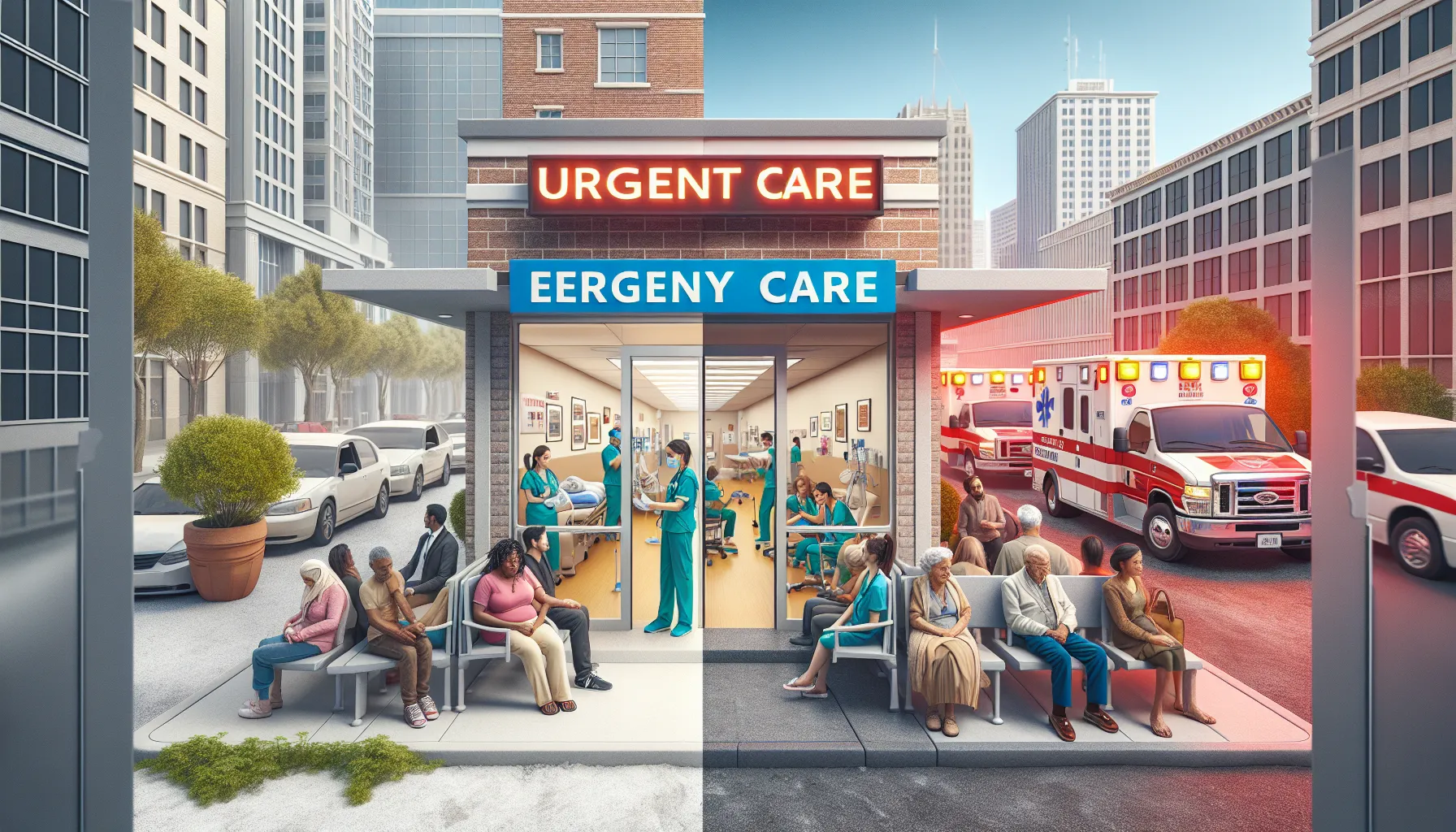
Healthcare decisions can often feel perplexing, particularly when determining where to seek appropriate care in a time of need. The distinction between urgent care facilities and emergency rooms plays a pivotal role in these moments. Understanding the key differences can empower you to make swift, informed decisions based on the severity of a condition, ensuring timely and suitable medical assistance while potentially avoiding unnecessary costs.
Understanding Urgent Care
Services Commonly Provided at Urgent Care Centers
Urgent care facilities are designed to treat a broad range of medical issues that, while non-life-threatening, still require timely attention. These centers commonly handle conditions such as minor infections, sprains, fractures, minor burns, and ear or sinus troubles. They’re also a sensible first stop when respiratory illnesses escalate — for example, knowing whether you have Flu Type A or Flu Type B can help staff determine how aggressively to treat you and whether antiviral medication is appropriate. Their goal is to bridge the gap between primary care visits and emergency situations, offering accessible and efficient healthcare solutions.
Typical Hours of Operation and Accessibility
Generally, urgent care centers operate beyond typical primary care office hours, including evenings and weekends. This extended availability ensures that individuals can address medical issues promptly without having to wait for the next business day. Conveniently located neighborhoods, they often allow walk-in patients, making the process more streamlined.
Understanding Emergency Rooms
Critical Services Available in Emergency Rooms
Emergency rooms (ERs) are equipped to handle severe, potentially life-threatening medical cases. Services include advanced diagnostics, surgical interventions, and life-saving measures such as cardiopulmonary resuscitation. Built to care for patients with complex or urgent medical needs, the ER is staffed by specialists trained to manage high-acuity conditions. Acute episodes like gallstone complications — such as pancreatitis or cholecystitis — or a large kidney stone versus gallstone obstruction are exactly the kind of sudden, severe presentations that often warrant ER-level care rather than a wait at urgent care.
Staff and Equipment Differences
Unlike urgent care centers, emergency rooms house an integrated team of specialized physicians, surgeons, and critical care nurses supported by advanced medical equipment. They are prepared for comprehensive emergency procedures, such as surgeries and intensive care assessments, providing the highest level of immediate medical intervention.
Key Factors Determining Whether to Choose Urgent Care or an Emergency Room
Severity of Medical Issues
Understanding the severity of a medical issue is the primary factor in deciding between urgent care and an ER. For non-life-threatening injuries or illnesses, urgent care provides a suitable solution. But, for conditions posing serious risks, such as chest pain, severe trauma, or difficulty breathing, the ER is vital.
Costs and Insurance Considerations
Financial implications also influence the decision-making process. Urgent care visits typically incur lower costs compared to ER visits, often preferred for non-critical care. Yet, insurance may dictate coverage specifics — the difference between an HMO and a PPO plan can be especially significant here, as HMO patients may face restrictions on which facilities are in-network, while PPO holders generally have more flexibility in choosing where they seek emergency treatment. Making it crucial to verify your plan’s particulars before deciding where to seek treatment.
Case Studies to Illustrate Appropriate Choices
Scenario One: Minor Muscle Strain
If you suffer a minor muscle strain during weekend exercises, visiting urgent care would likely suffice. These centers can offer rapid treatment, such as pain-relieving medications or referrals for physical therapy, without the extensive resources of an ER.
Scenario Two: Chest Pain and Difficulty Breathing
Conversely, chest pain paired with labored breathing constitutes a medical emergency. Such symptoms call for immediate ER care due to the possibility of heart attacks or other life-threatening conditions. The ER provides both the capacity and context for comprehensive intervention.
To provide the best experiences, we use technologies like cookies to store and/or access device information. Consenting to these technologies will allow us to process data such as browsing behaviour or unique IDs on this site. Not consenting or withdrawing consent, may adversely affect certain features and functions.
Functional
Always active
The technical storage or access is strictly necessary for the legitimate purpose of enabling the use of a specific service explicitly requested by the subscriber or user, or for the sole purpose of carrying out the transmission of a communication over an electronic communications network.
Preferences
The technical storage or access is necessary for the legitimate purpose of storing preferences that are not requested by the subscriber or user.
Statistics
The technical storage or access that is used exclusively for statistical purposes.The technical storage or access that is used exclusively for anonymous statistical purposes. Without a subpoena, voluntary compliance on the part of your Internet Service Provider, or additional records from a third party, information stored or retrieved for this purpose alone cannot usually be used to identify you.
Marketing
The technical storage or access is required to create user profiles to send advertising, or to track the user on a website or across several websites for similar marketing purposes.