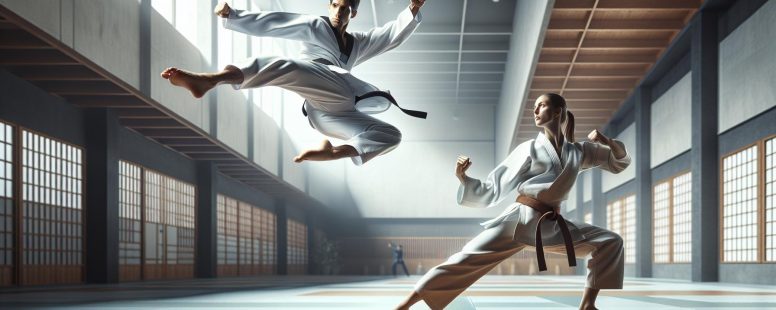
Imagine stepping into a dojo, the air buzzing with energy as students practice their forms. You hear sharp, precise movements from one side and fluid, dynamic kicks from the other. This scene perfectly encapsulates the intriguing world of martial arts, specifically Taekwondo and Karate. While both disciplines offer powerful techniques and profound philosophies, they each have unique characteristics that set them apart.
Taekwondo, with its high-flying kicks and rapid footwork, often feels like a dance of agility and speed. In contrast, Karate focuses on grounded, powerful strikes and disciplined stances, embodying strength and precision. Understanding these differences not only helps you choose the right path but also deepens your appreciation for the rich heritage and distinct styles of each martial art.
History And Origins
Ever wonder where Taekwondo and Karate came from? You’re about to find out. These martial arts have rich, unique histories that shaped their techniques and philosophies.
Origins Of Taekwondo
You know, Taekwondo likely started in Korea, around 2,000 years ago, give or take a century. The art emerged from the need to defend oneself without weapons, ’cause let’s face it, ancient Korea wasn’t always peaceful. Taekwondo’s name came about in 1955, blending elements of ancient Korean martial arts like Taekkyeon. The modern version of Taekwondo we see today emphasizes high kicks and fast footwork. It’s no wonder Taekwondo practitioners can kick so high they might touch the moon.
Origins Of Karate
Karate, on the other hand, probably traces its roots back to Okinawa—a small island in Japan. It’s generally believed that Karate may have developed from a mix of indigenous fighting styles and Chinese martial arts. So if you think about it, Karate has likely been a martial art melting pot. By the early 20th century, Karate found its way to mainland Japan, evolving into various styles like Shotokan and Goju-Ryu. Unlike Taekwondo, Karate focuses more on powerful, grounded strikes. You could say it’s the Rocky Balboa of martial arts—solid, strong, and ready for a slugfest!
So, there you have it. Two distinct martial arts, each with its own story, culture, and techniques. As you investigate deeper, you might find yourself drawn to the aerial acrobatics of Taekwondo or the steadfast power of Karate. But hey, why not like both?
Fundamental Principles
Understanding the fundamental principles of Taekwondo and Karate can enhance your appreciation of these martial arts. Jump into the core philosophies driving these disciplines.
Taekwondo Principles
Taekwondo focuses on high kicks and fluid movements. It emphasizes agility, flexibility, and speed. The principles of Taekwondo include:
Courtesy: Practitioners must show respect to instructors and peers. For example, bowing before entering the Dojang (training hall).
Integrity: Being honest and having strong moral principles. Practicing techniques correctly even when not being watched.
Perseverance: A continuous effort in improving techniques even though difficulties or learning curves.
Self-Control: Managing impulses and maintaining composure, even in challenging situations.
Indomitable Spirit: Displaying resilience and courage, especially when faced with adversity, like during intense sparring sessions.
Taekwondo’s philosophy aims to foster a spirit that values discipline and continuous self-improvement. Can you imagine the dedication required to achieve a black belt?
Karate Principles
Karate centers on powerful, grounded strikes and stances. Its principles emphasize discipline and mental focus. Key principles include:
Respect: Like Taekwondo, Karate practitioners value showing respect toward instructors and fellow students.
Effort: Diligent practice and continuous effort are crucial. Consistency in training is likely to lead to mastery.
Sincerity: Being genuine and honest in practice and in interactions with others inside and outside the dojo.
Character: Developing a strong moral character through rigorous training. This principle may lead to personal growth beyond physical ability.
Self-Control: Essential in both practice and sparring to prevent unnecessary harm to oneself and others.
Karate suggests that through disciplined practice, one might achieve not just physical prowess, but also mental and moral fortitude. Are you ready for the challenge?
Fundamentally distinct in techniques and traditions, both Taekwondo and Karate promote principled living through their specific training regimens.
Techniques And Styles
Understanding the techniques and styles of Taekwondo and Karate gives you a clearer picture of what each martial art offers.
Taekwondo Techniques
Taekwondo emphasizes kicks, with high kicks and jumping kicks being its signature moves. You’ve probably seen those fancy spinning and flying kicks in movies; those are classic Taekwondo. The art focuses on using the legs for their reach and power, with about 80% of the techniques being various types of kicks. Kicks like the roundhouse, axe kick, and side kick are foundational. Punches, though present, are less emphasized compared to Karate. Blocks in Taekwondo are often performed with an open hand, aiming to deflect attacks swiftly. Due to its dynamic nature, practitioners often incorporate rapid footwork to maintain distance and control during combat.
Karate Techniques
Karate, in contrast, prioritizes powerful hand strikes and strong stances. You’ll find an extensive variety of punches, such as the straight punch (choku zuki) and uppercut (age zuki), often executed in well-rooted stances to deliver maximum force. Karate styles frequently incorporate elbow strikes, knee strikes, and low kicks. Unlike Taekwondo, Karate’s blocks are mostly performed with closed fists, emphasizing strength and stability. The martial art also includes kata – these pre-arranged forms sequence movements to shed light on potential combat scenarios. Karate’s techniques aim to finish the opponent quickly through direct, forceful strikes.
In sum, while Taekwondo may have you soaring through the air, Karate’s likely to keep your feet grounded. Recognizing these differences enhances your practice and appreciation for each art.
Training And Practice
Exploring Taekwondo and Karate reveals distinct training methods and focuses. Understanding these can enhance your appreciation for both martial arts.
Taekwondo Training
Taekwondo training emphasizes agility, speed, and precision. You’ll likely spend significant time on flexibility exercises and stretching. These activities improve your ability to perform high-flying kicks and quick footwork.
In class, mirors may be used to refine your techniques. This helps you perfect movements and develop a sense of spatial awareness. You can expect to practice a lot of kicks. About 80% of your techniques will be kicks, with high and jumping kicks featuring prominently.
Sparring might play a big role too. Popular in many Taekwondo schools, it allows you to apply what you learn in a controlled environment. You’d use protective gear to minimize injuries and focus on real-time decision-making.
Forms, also called poomsae, are another key component. These predefined patterns of movement teach you the fundamental principles and flow of Taekwondo. They blend kicks, blocks, and strikes into a fluid routine.
Karate Training
Karate training focuses on powerful strikes and disciplined stances. You’ll probably start with basic movements, known as Kihon, and practice these repetitively. This builds muscle memory and strengthens foundational techniques.
Kata, or forms, play a significant role in Karate practice. Each kata involves a set sequence of movements representing a fight against multiple opponents. Performing Katas develops your mental focus and physical coordination.
Karate training often includes Kumite, which is sparring. It varies by style and school, but you generally learn to apply your techniques in a scenario that mimics real combat. Light contact and strict rules may be used to ensure safety.
Strength and conditioning exercises are essential too. You’ll engage in drills which promote power and endurance, fundamental for executing strong strikes. Focus mitts and heavy bags may be used to practice punches and kicks with force, developing both timing and impact precision.
As you progress, emphasis on mindfulness and mental discipline likely increases. Karate suggests a reflective approach, cultivating characteristics like perseverance and respect.
Would you prefer the high energy of Taekwondo or the grounded power of Karate? Each offers a unique path to mastering martial arts, so your choice might reflect your personal style and goals.
Competition And Rules
Understanding the competition and rules in Taekwondo and Karate can help in appreciating the distinct approaches of each martial art. Both sports have structured competitions, but they differ in scoring, permitted techniques, and uniform requirements.
Taekwondo Competitions
In Taekwondo competitions, contestants primarily focus on executing high-flying kicks to score points. The World Taekwondo Federation (WTF) and the International Taekwondo Federation (ITF) have different rule sets. WTF emphasizes full-contact sparring with electronic scoring systems, awarding points for accurate kicks to the torso and head. ITF competitions might allow more controlled sparring, awarding points for both kicks and punches. Knockouts are allowed in WTF events but discouraged in ITF matches.
Athletes wear protective gear, including headgear, chest protectors, and shin guards. Combatants compete on a mat, with matches typically lasting three rounds of two minutes each. Penalties exist for infractions like stepping out of bounds or delivering illegal strikes. The point deduction system ensures fair play.
Karate Competitions
Karate competitions, governed by organizations like the World Karate Federation (WKF), differ in focus and rules. Competitors aim to demonstrate powerful, precise strikes using punching, kicking, and blocking techniques. Matches in Karate often include kata (forms) and kumite (sparring). In kata, participants perform choreographed routines judged on technique and presentation.
Kumite sparring involves athletes facing off, scoring points for well-executed punches, kicks, and strikes. Full-contact is rare and competitors generally wear less protective gear than in Taekwondo. WKF rules discourage excessive contact, prioritizing controlled and accurate techniques over sheer power. Matches last three minutes for men and two minutes for women, with clean strikes to designated areas scoring points.
Competitors wear traditional gis (uniforms) with different belt colors indicating their ranking. Penalties are imposed for excessive force or illegal techniques to ensure safety and fairness. The scoring system rewards strategy, technique, and control, reflecting Karate’s emphasis on mental discipline.
Understanding these competition structures highlights the unique elements of Taekwondo and Karate, offering insights into their different philosophies and approaches to martial arts.
Conclusion
Choosing between Taekwondo and Karate eventually depends on your personal preferences and goals. If you’re drawn to high-flying kicks and rapid footwork, Taekwondo might be your ideal match. On the other hand, if you appreciate powerful, grounded strikes and disciplined stances, Karate could be the better fit.
Both martial arts offer rich histories, distinct techniques, and philosophies that promote personal growth and physical prowess. Whether you lean towards the agility and speed of Taekwondo or the mental discipline and precision of Karate, each path offers unique benefits.
Reflect on what resonates with you—would you prefer the dynamic energy of Taekwondo or the steadfast power of Karate? Embrace the journey, and you’ll find a rewarding martial arts experience tailored to your style and aspirations.
To provide the best experiences, we use technologies like cookies to store and/or access device information. Consenting to these technologies will allow us to process data such as browsing behaviour or unique IDs on this site. Not consenting or withdrawing consent, may adversely affect certain features and functions.
Functional
Always active
The technical storage or access is strictly necessary for the legitimate purpose of enabling the use of a specific service explicitly requested by the subscriber or user, or for the sole purpose of carrying out the transmission of a communication over an electronic communications network.
Preferences
The technical storage or access is necessary for the legitimate purpose of storing preferences that are not requested by the subscriber or user.
Statistics
The technical storage or access that is used exclusively for statistical purposes.The technical storage or access that is used exclusively for anonymous statistical purposes. Without a subpoena, voluntary compliance on the part of your Internet Service Provider, or additional records from a third party, information stored or retrieved for this purpose alone cannot usually be used to identify you.
Marketing
The technical storage or access is required to create user profiles to send advertising, or to track the user on a website or across several websites for similar marketing purposes.