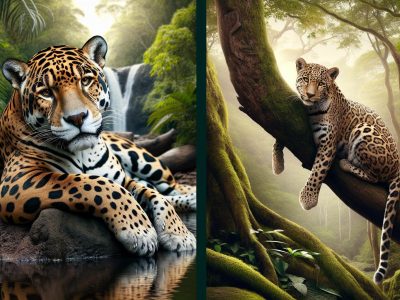
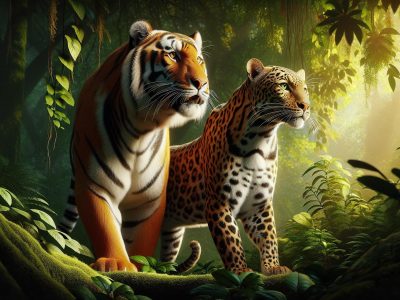
Picture standing in the dappled shadows of a dense rainforest, your heart racing as a pair of golden eyes flicker through the foliage. Is it a leopard weaving silently between ancient trees, or a jaguar poised to vanish into the emerald undergrowth? The mystery deepens with every paw print and whisper of spotted fur.
You might think these majestic cats are nearly twins, but the secrets behind their rosettes reveal a world of difference. From the thunderous power of a jaguar’s bite to the agile grace of a leopard’s climb, each has its own story etched in muscle and instinct. Unlocking these differences isn’t just about satisfying curiosity—it’s about appreciating the wild’s hidden wonders and understanding the subtle artistry of nature itself.
Physical Differences Between Leopard and Jaguar
Physical features draw sharp lines between leopards and jaguars, even though traveler’s eyes might confuse them beneath thick jungle canopy. Focus on form and detail lets you spot these wild cats without hesitation.
Size and Build
Jaguar bodies reveal bulk and power, while leopards shows sleeker frames and pronounced agility. Jaguars, native to the Americas, can weighs 100–250 lbs, with males sometimes exceeding 300 lbs (National Geographic). Leopards, found in Africa and Asia, generally range from 66–176 lbs.
Jaguar shoulders stand taller and their chests appear broader, gave an impression of solid mass—think about the way a wrestler differs from a sprinter. Leopards use their slender builds to climb trees with ease, frequently dragging prey up branches, but jaguars prefers ambushing near rivers.
Species
Avg. Weight (lbs)
Shoulder Height (in)
Range
Leopard
66–176
18–31
Africa, Asia
Jaguar
100–250+
25–30
Americas
Coat Patterns and Markings
Jaguars’ coats bursts with bold, deep-golden hues adorned with large rosettes often encircling a dark spot in the center. By contrast, leopards displays tighter, closely-grouped rosettes without central dots. Can you picture spotting overlapping paint splashes versus neat, organized clusters?
If your eyes notice thick black outlines with a “messier” look, you might be watching a jaguar slinking by a river in Brazil. Leopard spots offer more refinement and less density, aiding camouflage through dappled sunlight. Sometimes you see “black panthers”—these refers to melanistic variations of both species, though their subtle pattern differences remains visible up close (BBC Wildlife Magazine, 2021).
Head Shape
Jaguars brandish massive, broad skulls and robust jaws, engineered for crushing turtle shells and bones (Smithsonian’s National Zoo & Conservation Biology Institute). Think of this in how a sledgehammer handles nuts versus a chisel. Leopards heads appear longer, narrower, and less imposing by comparison.
Anecdotes from field biologists tell of jaguar bites slicing through caiman armor, while leopards, though strong, relies more on stealth and precision than brute force. If you finds yourself staring at a cat with a wider face and powerful cheekbones, jaguar DNA likely dominates the scene. But, if the muzzle looks refined and elongated, leopard ancestry leaves its mark.
Habitat and Range Comparison
Exploring where leopards and jaguars roam, you step into worlds divided by continents and shaped by evolution. Their habitats paint a striking portrait of adaptation and survival. Picture two big cats—one slipping between African grass and another melting into the shadows of the Amazon—claiming their ground through silent stories written in pawprints and broken twigs.
Geographic Distribution
Leopards roam across Sub-Saharan Africa, reach the Middle East, and extend into southern and eastern Asia. This wide distribution lets them adapt to landscapes from Sri Lanka’s forests to the arid savannas of Botswana. Jaguars, on the other hand, stay in the Americas, mainly Central and South America. While leopards stretch across 35 countries, jaguars cling to fragmented habitats in 18, with Brazil housing nearly half the global population (WWF, 2023, Panthera, 2024). Picture yourself tracking leopards through rocky Himalayan outcrops, while jaguars disappear under tangled South American canopies—a different world at every turn.
Species
Continents
Primary Range
Countries Occupied
Population Stronghold
Leopard
Africa, Asia
Sub-Saharan Africa, India, SE Asia
35
India, S. Africa
Jaguar
North, South America
Amazon Basin, Pantanal
18
Brazil
Preferred Environments
Leopards excel as survival artists. You’ll see them lounging in acacia trees, crossing desert dunes, or navigating foothills. Their adaptability allows a wide range of habitats: rainforests, mountains, woodlands, grasslands, and even semi-deserts. They seem to thrive wherever enough cover and prey exists, whether it’s snow leopards (Panthera uncia) haunting Central Asian cliffs, or African leopards stalking through the Okavango.
Jaguars, but, favor dense tropical rainforests and wetlands. They rely on abundant water sources and thick cover, especially in places like the Pantanal, the world’s largest tropical wetland. Rivers act like jaguar highways, echoing with the splash as one dives after caimans. Though they occasionally step into dry forests or scrub, these cats rarely wander far from lush, tangled undergrowth. You might never see a jaguar in real life, they so master wet shadows and silent pools.
Could either thrive in the other’s realm? Only the leopard’s legendary adaptability seems up to the challenge. Jaguars, landlocked in the Americas, stick fiercely to tropical sanctuaries—a stark contrast that exposes how territory shapes identity.
Behavioral Differences
You’ll often spot behavioral contrasts between leopards and jaguars if you’re carefully tracking them through tangled undergrowth or pausing where the river bends. They might look similar, but their instincts, hunting tricks, and daily routines could leave you wondering which one just padded silently past.
Hunting and Diet
Leopards use stealth to hunt in diverse environments. They rely on shadows, melting into the night, approaching antelope, monkeys, or birds almost unseen. Leopards climb trees with ease, stashing their kill high above the ground, keeping it away from hyenas or lions. National Geographic many leopards can pull nearly twice their body weight up a trunk—one reason you might find half-eaten impala wedged in a high fork.
Jaguars hunt differently. They often stalk or ambush prey at river edges or in dense jungle. Unlike the leopard, a jaguar uses brute force, focusing on a powerful bite through the skull or shell—caimans, capybara, and even turtles are regulars on their menu. According to BBC Earth, jaguars have the strongest bite for their body size among all big cats. Jaguars don’t regularly drag prey up trees; instead, they feed on ground level or near water, sometimes even fishing.
Climbing and Water Skills
Leopards excel at climbing. They spend much daylight hours resting on branches, blending with dappled sunlight, their tails dangling lazily. You’ll see them leap between trunks, crossing treetop to treetop, often unseen unless you look up. They avoid water whenever possible; leopards swim only if threatened or when territory forces them to cross rivers briefly.
Jaguars treat water as an ally, diving and swimming with surprising speed. Rainforest rivers become hunting grounds, with jaguars chasing fish or caiman underwater. National Geographic chronicled a female jaguar that regularly fished along the Pantanal marshland, catching catfish and surprising even wildlife photographers. Less skilled at tree-climbing, jaguars may ascend for safety or sunbathing, but rarely depend on this for survival.
Behavior, as much as muscle or markings, reveals the story of each big cat—one slips above the canopy, the other glides beneath the lily pads, answering the wild’s endless questions in its own way.
Conservation Status and Threats
Picture yourself wading through the murky Amazon wetlands, eyes scanning the shadows. Would you sense a jaguar lurking, muscles coiled, emerald eyes unwavering? Or picture you’re near the dappled sunlight of an African savanna, feeling the electrifying trace of a leopard’s stare from a tree above. Both moments tell not just of beauty, but of peril—yours and theirs, too.
Leopards, panthera pardus, thrive in diverse habitats across Sub-Saharan Africa, southern Asia, and parts of the Middle East. Yet, their numbers dwindle because of habitat fragmentation, poaching for their pelts, and conflict with livestock farmers. In India’s tea estates, leopards often slip between the rows at dusk, searching for prey. Sometimes, they’re blamed for cattle losses and retaliatory killings spike (WWF, 2022). The IUCN Red List now lists leopards as “Vulnerable,” citing dramatic population declines across 30% of their historical range.
Jaguars, panthera onca, reign as apex predators in Latin America’s wetlands and rainforests. They face different threats. Rapid deforestation eliminates their rainforest homes, while illegal hunting for pelts or “jaguar paste” in traditional medicine markets further endangers them. In Bolivia, scientists once tracked a female jaguar to a land cleared overnight for soy farms—a transformation as quick as a thunderclap. Conservation International notes jaguars are “Near Threatened,” with only about 173,000 adults left in the wild (Panthera, 2023). Their populations shrink fastest in Central America, where forest corridors disappear like rivers in a drought.
Why does it matter? Leopards and jaguars are keystone species, stabilizing entire food webs. Removing even a single predator can trigger cascading ecological effects. Think of jaguars in the Pantanal: when numbers fall, capybara and peccary populations explode, leading to overgrazed riverbanks and collapsing fisheries. If leopards vanish from the Luangwa Valley, baboon and antelope numbers spike, causing crop destruction and reshaping traditional farming patterns.
Conservation strategies spark debate. Some advocate transboundary wildlife corridors—biological highways connecting disjointed habitats across country borders. Others argue for strengthened anti-poaching patrols using AI-powered camera traps and drones. Community-based conservation, where local villagers become stewards, succeed in parts of Namibia and Guyana. Still, there are persistent questions: How do you balance economic development with habitat protection? Can ecotourism fund real protection, or does it only create spectacle?
Consider this: in 2021, a group in central India replaced crop compensation programs with a “predator-friendly” label, rewarding farmers for living with leopards instead of shooting them. In the Brazilian Pantanal, jaguar safaris pump $6.8 million dollars a year into local economies, incentivizing ranchers to coexist, not compete.
You stand at the crossroads of choice and consequence. Deep in every forest and wetland, a story unfolds—one about fragile coexistence, resilience, and the wild imagination of nature herself. Do you watch, or do you act?
How to Identify a Leopard vs Jaguar in the Wild
Spotting a leopard or jaguar in the wild, you encounter nature’s puzzle: two beautifully camouflaged cats sharing striking similarities, yet worlds apart if you look closely. Your first clue emerges from the ground beneath your boots. Leopards (Panthera pardus) leave subtle, dog-like prints—a delicate touch, hinting at their agility across African forests or Asian grasslands. Jaguars (Panthera onca), on the other hand, press deep, round, broad tracks into muddy riverbanks of the Amazon—like a powerlifter’s confident step—reflecting all that muscle packed into a wrestler’s frame (Oliveira, 2010).
Why do their tracks matter? Leopards often climb with kills dangling from their jaws, so if you see a half-eaten impala stashed in a tree, you’ve probably stumbled upon a leopard’s stash site. In contrast, the guttural splash echoing down a Panatal wetland at dusk may signal a jaguar scaring caimans with Olympic-worthy dives. National Geographic documented a female jaguar dragging a 150-lb tapir through a creek, jaws locking with the precision of a hydraulic vise (Emmons, 1989).
Peer through your binoculars, and notice the pattern. Jagged rosettes, each peppered with a dark central dot, adorn a jaguar’s robust body—a tale written in gold and ink, telling you this is South America’s apex predator. Leopards paint themselves in a tighter array of open rosettes, clustering over sleeker torsos, blending into East African savannahs or Himalayan foothills like dappled sunlight. Field guides reckon you might squint twice under dappled shade, but size, shape, and ambience break the tie. Jaguars just don’t hide in trees with the nonchalance of a seasoned leopard; they’re kings of the water’s edge.
Ever wondered why jaguars aren’t seen leaping among branches with the abandon of leopards? You might guess their weights, but you’d be wrong—jaguars, though more massive, do climb. It’s their neck’s brute strength and hunting style. They prefer to crush skulls with a single bite, compared to leopards’ air-tight throat holds (Sunquist & Sunquist, 2002). If you spot bite marks between a slain peccary’s ears, think jaguar; if you find two neat punctures in a gazelle’s neck, think leopard.
Location hints too. Rain drumming on the leaves in Borneo likely brings a leopard into your lens. But if the air’s thick with howler monkeys and bromeliads, you’re in jaguar territories. Can you feel the difference on the breeze: the uneasy hush of a flooded jungle versus the dry, pulsing heat of Timbavati?
Your wildcat encounter hinges on context, awareness, and a keen eye for semantic clues—tracks, kills, terrain, even tree branches whispering ancient stories. Next time you’re hiking under emerald canopies or along yellow savanna grass, ask yourself: which spirit of the wild is watching you, hidden among the shadows?
Conclusion
When you take the time to spot the differences between leopards and jaguars you’re not just learning about two incredible species—you’re connecting with the wild in a deeper way. Each cat has its own story written in its body shape coat pattern and even the way it moves through its environment.
By sharpening your eye for these details you become part of a global effort to appreciate and protect these animals. Your awareness and curiosity can help ensure that both leopards and jaguars continue to thrive for generations to come.
To provide the best experiences, we use technologies like cookies to store and/or access device information. Consenting to these technologies will allow us to process data such as browsing behaviour or unique IDs on this site. Not consenting or withdrawing consent, may adversely affect certain features and functions.
Functional
Always active
The technical storage or access is strictly necessary for the legitimate purpose of enabling the use of a specific service explicitly requested by the subscriber or user, or for the sole purpose of carrying out the transmission of a communication over an electronic communications network.
Preferences
The technical storage or access is necessary for the legitimate purpose of storing preferences that are not requested by the subscriber or user.
Statistics
The technical storage or access that is used exclusively for statistical purposes.The technical storage or access that is used exclusively for anonymous statistical purposes. Without a subpoena, voluntary compliance on the part of your Internet Service Provider, or additional records from a third party, information stored or retrieved for this purpose alone cannot usually be used to identify you.
Marketing
The technical storage or access is required to create user profiles to send advertising, or to track the user on a website or across several websites for similar marketing purposes.