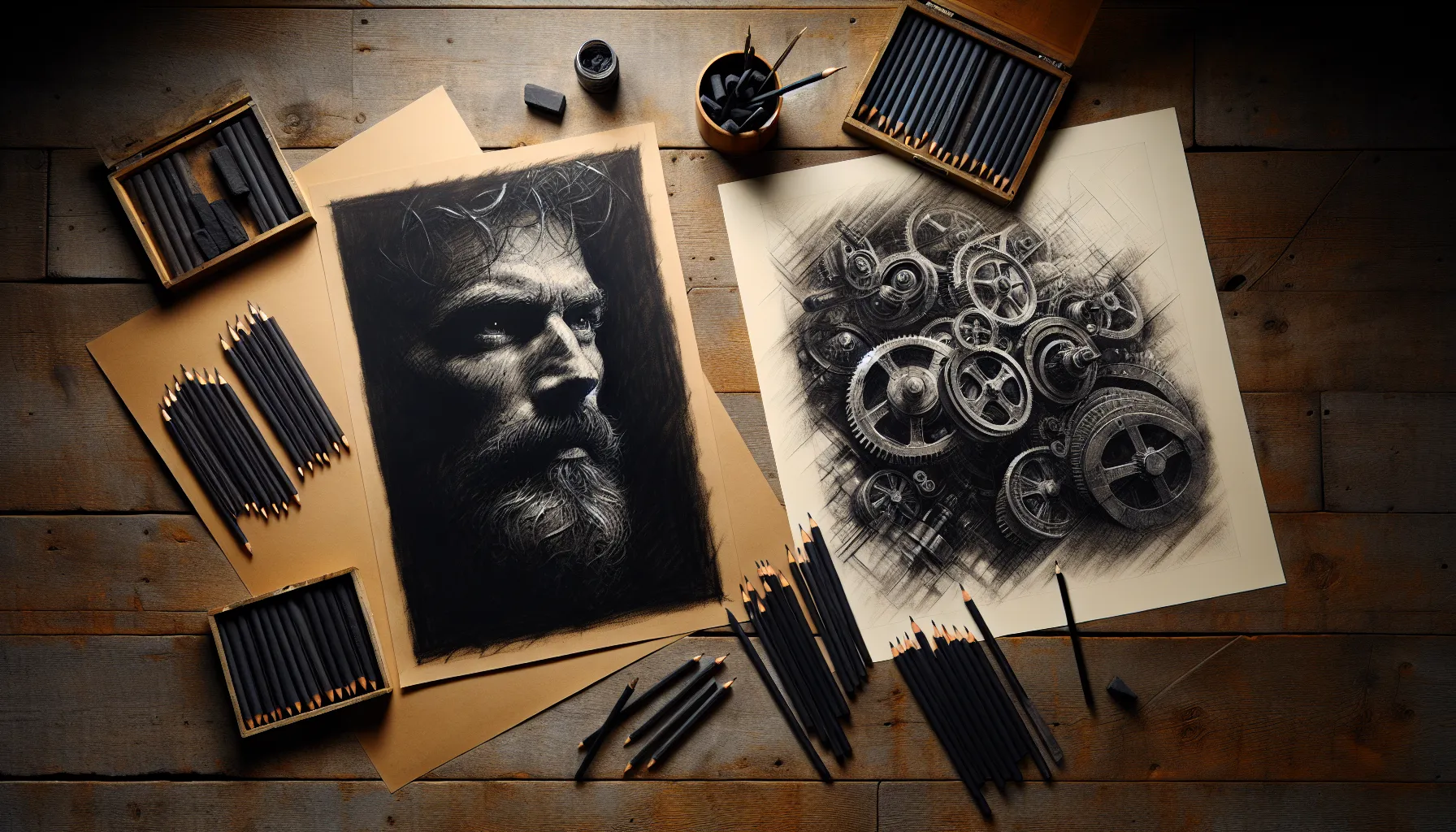
When exploring the versatile realm of drawing media, two materials that frequently captivate both novice and professional artists are charcoal and graphite. While both serve as fundamental tools for creating outstanding artworks, their unique characteristics open doors to diverse artistic possibilities. By understanding these differences, you can harness the potential of these mediums to enhance your artistic projects.
Introduction to Charcoal and Graphite in Art
Charcoal and graphite are indispensable mediums in the world of art, each bringing a distinct character to the artwork it contributes to. Charcoal, a material derived from burnt organic matter, offers rich, deep blacks and a dramatic presence on paper. Graphite, known for its precision and subtlety, provides a range of soft grays to bold blacks suited for intricate detailing and smooth shading. The choice between these mediums often depends on the desired style and outcome of the artwork, making it vital to understand their unique traits and applications.
Properties of Charcoal Art Materials
Characteristics of Charcoal Mediums
Charcoal is a dynamic drawing medium that comes in various forms, such as sticks, pencils, and powder. Its texture varies from soft to hard, allowing artists to create bold, expressive lines as well as fine details. This medium is known for its ability to achieve intense dark tones and rich contrasts, making it ideal for creating impactful compositions.
Applications of Charcoal in Artwork
Artists use charcoal for quick sketches, figure drawings, and large-scale compositions where dramatic lighting is key. Its smudging ability enables the creation of soft transitions, making it suitable for lifelike shading and texture depiction. Also, charcoal’s ease of erasure facilitates adjustments during the creative process.
Advantages and Disadvantages of Charcoal
Advantages of charcoal include its versatility, strong visual impact, and ease of blending. But, it is also prone to smudging and requires fixatives for permanence. Also, its boldness can sometimes be challenging for precision-based tasks, making it more suitable for expressive works.
Properties of Graphite Art Materials
Characteristics of Graphite Mediums
Graphite is a refined medium, often available as pencils, sticks, or powders. Its grades range from soft (B) to hard (H), providing variations in tone and texture. Graphite is prized for its smooth application, allowing clean and intricate detailing in artworks.
Applications of Graphite in Artwork
Graphite is versatile, enabling the creation of everything from detailed technical illustrations to delicate portraits. Artists value its precision and reliable control, which suit styles demanding accuracy and subtle gradation.
Advantages and Disadvantages of Graphite
Graphite offers advantages, such as ease of use, wide availability, and clean handling. Yet, its tonal range is narrower compared to charcoal, limiting its potential for stark contrasts. Also, excessive layering can create a reflective sheen, altering the visual appeal of the artwork.
Comparative Analysis: Charcoal and Graphite
Differences in Texture and Tonality
Charcoal’s intense darks contrast with graphite’s relatively moderate tonal range. While charcoal offers textures from rough to velvety, graphite provides a silkier finish due to its inherently smooth application.
Suitability for Various Artistic Styles
Charcoal’s dramatic effect makes it excel in expressive and emotional drawings. Graphite, with its precision, is better suited for realistic and technical artwork. Identifying your artistic objectives can inform the choice between these mediums.
Techniques and Approaches with Each Medium
Blending, hatching, and stippling are techniques applicable to both charcoal and graphite, but their execution varies due to differences in texture and tone. While charcoal is well-suited for bold strokes, graphite allows for fine details, offering varied approaches for achieving the desired effect.
To provide the best experiences, we use technologies like cookies to store and/or access device information. Consenting to these technologies will allow us to process data such as browsing behaviour or unique IDs on this site. Not consenting or withdrawing consent, may adversely affect certain features and functions.
Functional
Always active
The technical storage or access is strictly necessary for the legitimate purpose of enabling the use of a specific service explicitly requested by the subscriber or user, or for the sole purpose of carrying out the transmission of a communication over an electronic communications network.
Preferences
The technical storage or access is necessary for the legitimate purpose of storing preferences that are not requested by the subscriber or user.
Statistics
The technical storage or access that is used exclusively for statistical purposes.The technical storage or access that is used exclusively for anonymous statistical purposes. Without a subpoena, voluntary compliance on the part of your Internet Service Provider, or additional records from a third party, information stored or retrieved for this purpose alone cannot usually be used to identify you.
Marketing
The technical storage or access is required to create user profiles to send advertising, or to track the user on a website or across several websites for similar marketing purposes.