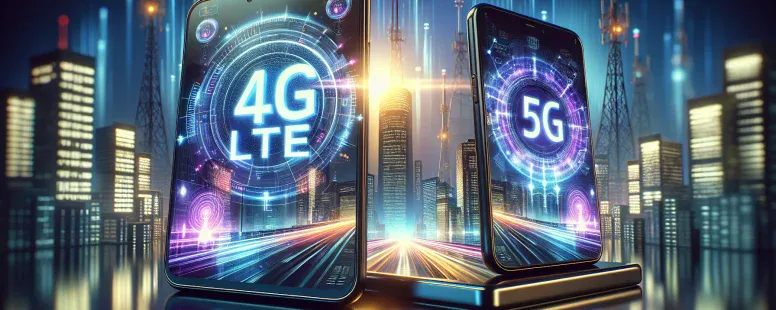
Picture a world where downloading an entire high-definition movie takes mere seconds or controlling a fleet of autonomous vehicles happens with minimal lag. This is the promise of 5G technology. In contrast, while 4G LTE has significantly boosted our connectivity over the past decade, modern demands push us to explore its successor. Understanding the evolution from 4G LTE to 5G not only offers insight into our current technological era but also helps anticipate a future of unprecedented possibilities.
Understanding Mobile Network Generations
The transition through mobile network generations, from 1G to the emerging 5G, reflects our progress in telecommunications. Each generation brought seismic shifts in how we communicate. Understanding this timeline helps contextualize the significance of these technological advancements, illustrating the path leading up to the development of 5G.
What is 4G LTE?
Characteristics of 4G LTE
4G LTE, representing “Long-Term Evolution,” is a fourth-generation mobile network standard. It introduced enhancements that made mobile internet data transfers significantly faster than previous technologies.
Advantages and Limitations of 4G LTE
LTE provides a reliable high-speed internet connection for applications like video streaming, online gaming, and VoIP. But, its performance can still lag compared to newer technologies like 5G, with slower download/upload speeds and higher latency.
What is 5G?
Key Features of 5G Technology
5G is the fifth generation of mobile network technology, distinguished by unparalleled speed, ultra-low latency, and the ability to connect numerous devices simultaneously. It makes breakthroughs possible, especially in realms like the Internet of Things and telemedicine.
Potential Impact of 5G on Connectivity
When implemented thoroughly, 5G could redefine connectivity standards, enabling advancements like remote surgeries, autonomous transportation, and smart grid management.
Comparing 4G LTE and 5G
Differences in Speed and Latency
5G significantly outperforms 4G LTE in terms of sheer speed and reduced latency, making real-time data transfer feasible for various cutting-edge technologies.
Comparisons in Coverage and Reliability
While 4G LTE covers a larger geographical area due to widespread implementation, 5G’s infrastructure is still expanding. It currently offers higher performance in urban zones.
Real-World Applications of Each Network
4G LTE supports high-definition streaming and reliable mobile communication, while 5G powers innovations like virtual reality experiences and smart city technology.
Adopting 5G: Challenges and Opportunities
Navigating Compatibility and Deployment Strategies
Transitioning to 5G requires updating infrastructure and device compatibility, which presents cost and logistical challenges to operators and consumers.
5G’s Role in Future Technological Advancements
The adoption of 5G could spur breakthroughs in robotics, AI, and other forward-looking industries, potentially reshaping daily life and commercial operations.
Published: January 5, 2026 at 6:19 pm by Ellie B, Site owner & Publisher
To provide the best experiences, we use technologies like cookies to store and/or access device information. Consenting to these technologies will allow us to process data such as browsing behaviour or unique IDs on this site. Not consenting or withdrawing consent, may adversely affect certain features and functions.
Functional
Always active
The technical storage or access is strictly necessary for the legitimate purpose of enabling the use of a specific service explicitly requested by the subscriber or user, or for the sole purpose of carrying out the transmission of a communication over an electronic communications network.
Preferences
The technical storage or access is necessary for the legitimate purpose of storing preferences that are not requested by the subscriber or user.
Statistics
The technical storage or access that is used exclusively for statistical purposes.The technical storage or access that is used exclusively for anonymous statistical purposes. Without a subpoena, voluntary compliance on the part of your Internet Service Provider, or additional records from a third party, information stored or retrieved for this purpose alone cannot usually be used to identify you.
Marketing
The technical storage or access is required to create user profiles to send advertising, or to track the user on a website or across several websites for similar marketing purposes.