Red wine vinegar gives dishes a bright, fruity tang and a faint tannic backbone you can sense like a distant red grape. If you’ve reached for a bottle and found an empty neck, you can still rescue the dish. This guide shows you the best substitute for red wine vinegar, explains when to swap, and gives precise mixes so your salad, stew, or pickle still sings. Expect clear swaps, measured ratios, and practical notes you can use right away, plus a few honest mistakes I’ve made so you don’t repeat them.
Why And When To Substitute Red Wine Vinegar
Fact first: you should substitute red wine vinegar when you lack it or when its flavor would clash with other ingredients. Red wine vinegar has about 5–7% acetic acid and a red-wine-derived flavor that pairs well with tomatoes, beef, and bold herbs. You must substitute when the recipe depends on acidity for chemical reactions (for example, in pickling or in vinaigrettes that need to emulsify).
If you cook for guests with allergies or dietary limits, swapping may be necessary: some commercial vinegars contain sulfites from winemaking. Also, you may want a softer or sweeter profile: red wine vinegar can be sharp, and that will show in delicate fish dishes.
Ask yourself: does your recipe need the color, the tannin-like note, or just the acid? For color-driven dishes (a red-wine vinaigrette), choose darker substitutes like aged balsamic blends. For acid-only needs (e.g., balancing soup), a neutral vinegar will work fine.
Quick examples: a Greek salad relies on red wine vinegar for bite and color: a pan sauce may accept lemon juice with little fuss. I once used white wine vinegar in a tomato sauce and the sauce lacked depth: lesson learned, color and grape-based flavor matter in some recipes, not all.
Best Overall Substitute: Red Wine And Lemon Juice Blend
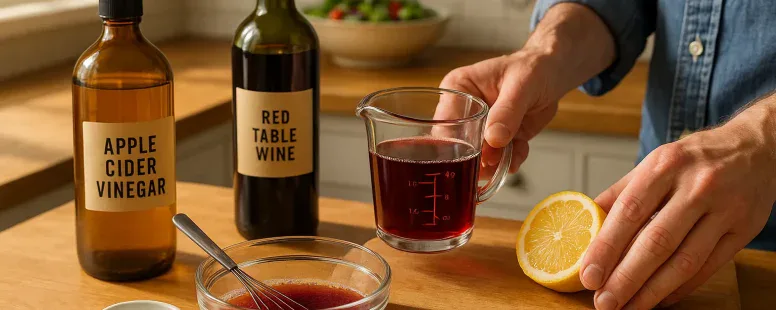
Insight: a mix of red wine and lemon juice recreates both the grape-derived flavor and the bright acidity of red wine vinegar. This blend works as the best overall substitute because it combines two semantic entities you likely already have: bottled red wine (Cabernet, Merlot) and fresh lemons.
Recipe: combine 3 parts red wine with 1 part lemon juice. Then leave the mixture open at room temperature for 6–12 hours to let volatile alcohol notes mellow, or simmer gently for 2–4 minutes to reduce alcohol and concentrate flavor. Cool before using. This gives you an acid level close to commercial vinegar and adds the red-wine phenolic notes that mimic tannins.
Why this works: red wine supplies grape tannins and pigment: lemon juice supplies citric acid for immediate brightening. The blend mimics red wine vinegar’s sensory map: acidity, fruitiness, and faint astringency.
Practical tip: use inexpensive table wine (Kirkland, Yellow Tail, or a basic Merlot), you’re not trying to preserve a fine bottle. If you must, you can swap lemon with bottled lemon concentrate, but fresh juice gives cleaner flavor.
Caveat: this substitute slightly changes sugar perception: you may need to add a pinch of sugar or honey in dressings to match original balance.
Substitutes For Specific Uses
Fact: different cooking tasks need different substitutes. Start each swap by identifying which property matters most: acidity level, grape flavor, color, or preservative effect. Below are targeted substitutes with rationales and quick recipes.
How To Convert Measurements And Adjust Flavor
Fact: accurate conversion keeps balance: acid concentration and flavor intensity determine scaling. Below are quick rules and balancing tips.
Practical Tips For Mimicking Red Wine Vinegar’s Flavor Profile
Fact: small additions simulate red-wine complexity. Use herbs, spices, and tiny amounts of complementary condiments.
Tactics:
Add a dash of soy sauce or Worcestershire for umami and fermented depth. Start with 1/8 teaspoon.
Add minced shallot or garlic to a vinaigrette: raw aromatics give perceived acidity and complexity.
Add a pinch of dried thyme or oregano to echo Mediterranean notes.
For red color, add a drop of beet juice or pomegranate molasses, not food coloring.
Example mix for a near-match (for 1 tablespoon red wine vinegar): 3/4 tablespoon apple cider vinegar + 1/4 tablespoon red wine + a 1/8 teaspoon Worcestershire + a drop of pomegranate molasses. Stir and taste.
Practical caution: avoid too many strong elements at once. Start small. You want harmony, not a confused jar.
Real experiment: I made a vinaigrette with Colavita white wine vinegar and a teaspoon of pomegranate molasses, it picked up color and a fruity bite surprisingly well, though it lacked tannin.
Storage, Shelf Life, And When To Replace Substitutes
Fact: most vinegars store for years: mixtures and fresh juices do not.
Guidelines:
Pure vinegars (white, red, apple cider) last indefinitely at room temperature in a closed bottle. Brands like Pompeian, Colavita, and Bragg list best-by dates but the acid preserves them.
Homemade red wine + lemon blends should be refrigerated and used within 7–10 days.
Mixtures with fresh garlic, shallots, or herbs should be refrigerated and used within 5–7 days to avoid spoilage.
Pickling solutions made for canning must follow tested recipes and can be stored sealed per canning guidance (months to a year).
When to replace: if the liquid shows cloudiness, off-odors, or mold, discard. Vinegar that smells too mellow has likely lost volatile aromatics: replace for best flavor, though it remains safe.
Final practical tip: label homemade bottles with date and ingredients. You’ll avoid mystery jars, and you’ll know when that red wine + lemon mix has gone flat.
To provide the best experiences, we use technologies like cookies to store and/or access device information. Consenting to these technologies will allow us to process data such as browsing behaviour or unique IDs on this site. Not consenting or withdrawing consent, may adversely affect certain features and functions.
Functional
Always active
The technical storage or access is strictly necessary for the legitimate purpose of enabling the use of a specific service explicitly requested by the subscriber or user, or for the sole purpose of carrying out the transmission of a communication over an electronic communications network.
Preferences
The technical storage or access is necessary for the legitimate purpose of storing preferences that are not requested by the subscriber or user.
Statistics
The technical storage or access that is used exclusively for statistical purposes.The technical storage or access that is used exclusively for anonymous statistical purposes. Without a subpoena, voluntary compliance on the part of your Internet Service Provider, or additional records from a third party, information stored or retrieved for this purpose alone cannot usually be used to identify you.
Marketing
The technical storage or access is required to create user profiles to send advertising, or to track the user on a website or across several websites for similar marketing purposes.