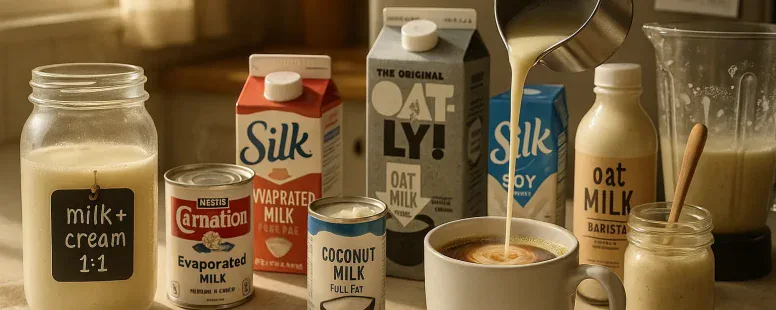
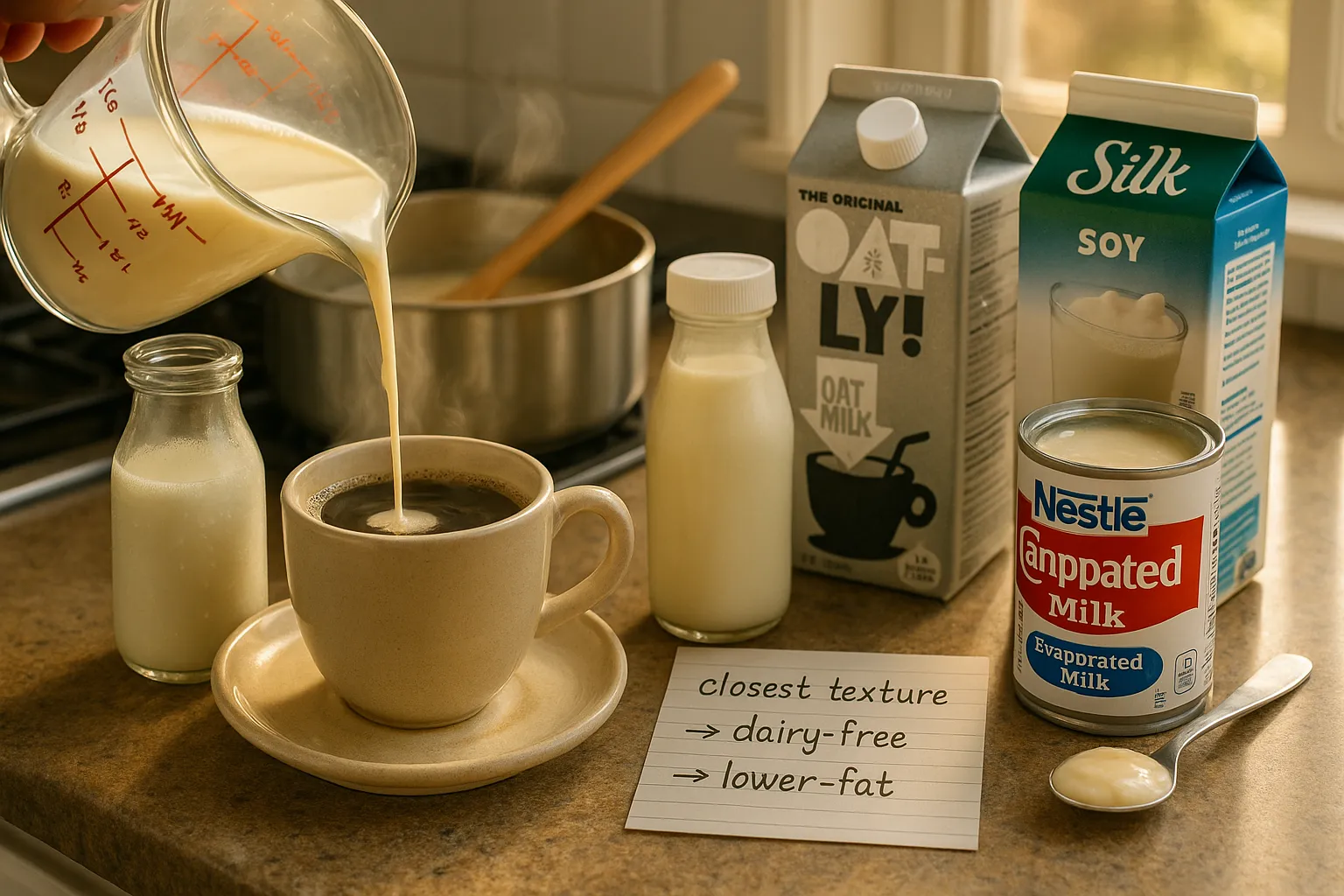
Half and half is a simple ingredient with big effects: it adds silkiness to coffee, brightens sauces, and stabilizes custards. But you may run out, be dairy-free, or want a lighter option. This guide gives clear, practical substitutes that match texture, flavor, and cooking behavior so your recipe still sings. You’ll learn exact mixes, when each swap works best, and quick fixes for coffee, baking, and savory dishes. Expect plain instructions, a few brand examples (Oatly, Silk, Nestlé), and honest trade-offs so you can choose fast and cook with confidence.
What Half and Half Is And When You Need A Substitute
Fact: Half and half is half whole milk and half light cream, usually about 10–18% milk fat, used where you want creaminess without full cream richness.
You use half and half in coffee, quick sauces, some desserts, and recipes where a light, creamy texture matters. If your coffee tastes thin, the fat and proteins in half and half add body and mouthfeel. If your sauce breaks with full cream, half and half can give you stability. You need a substitute when you don’t have it on hand, when you prefer plant-based ingredients, or when you need lower fat. Below I name substitutes by likely result, closest texture first, then dairy-free or lower-fat options.
Named entities: Starbucks (coffee shops often use half and half), Oatly (oat milk brand), Silk (soy and nut milks), Nestlé (evaporated milk product).
Top Substitutes Ranked With Quick Guidance
Fact: The best substitute depends on what you need: drinkability, cooking stability, or dairy-free compatibility.
Start here when you need a fast swap: each item lists what it is, how to make it, and where it fits best. I order these by general usefulness for most home cooks.
What It Is, How To Make It, And Best Uses
This overview tells you what each substitute does and why it replaces half and half. Use the mixes for coffee or sauces: use shelf-stable options for baking when you need longer storage.
Milk Plus Heavy Cream (Diluted Cream)
Fact: Mix 1 part heavy cream with 1 part whole milk to recreate half and half.
How to make it: Stir together equal volumes of heavy cream (36–40% fat) and whole milk (3.25% fat). Result: a rich, stable liquid that behaves like commercial half and half.
Best uses: Coffee, sauces, custards. This is the closest match for texture and mouthfeel. Use when you want the most authentic swap.
Whole Milk Plus Butter
Fact: Adding melted butter to whole milk increases fat and mimics the mouthfeel of half and half.
How to make it: For 1 cup substitute, melt 1 tablespoon of unsalted butter and whisk into 1 cup whole milk. Cool slightly before using.
Best uses: Coffee, quick sauces, baking. Warning: this adds butter flavor and can separate in high-heat sauces if not tempered.
Evaporated Milk
Fact: Evaporated milk is canned milk with about 60% of the water removed: it gives richness and shelf stability.
How to use: Replace half and half cup-for-cup. For thinner results, add an equal volume of water.
Best uses: Baking, soups, and recipes where slight caramelized flavor is fine. Brands: Carnation (Nestlé). Note: evaporated milk is cooked during processing so it changes flavor slightly.
Equal Parts Milk And Light Cream (If Available)
Fact: Light cream (18–30% fat) mixed 1:1 with whole milk approximates half and half closely.
How to make it: Combine equal parts.
Best uses: Coffee, desserts, and pan sauces where you need similar fat content without heavy cream’s weight.
Coconut Milk Or Coconut Cream (Dairy-Free)
Fact: Full-fat canned coconut milk or cream gives rich texture and holds up in heat.
How to use: Thin coconut cream with water to reach half-and-half thickness: 1 part coconut cream to 1 part water. For a lighter option use refrigerated carton coconut milk.
Best uses: Curries, coffee if you like coconut flavor, and desserts. Warning: coconut flavor will come through: use canned brands like Thai Kitchen for consistent fat.
Cashew Cream (Dairy-Free, Neutral Flavor)
Fact: Cashew cream is blended soaked cashews with water: it’s neutral and thick.
How to make it: Soak 1 cup raw cashews for 4 hours, blend with 1/2–3/4 cup water until smooth. Strain if you want an ultra-silky finish.
Best uses: Creamy soups, sauces, and desserts where you need neutral taste and cream-like body. It performs well when heated but can thicken more than dairy.
Oat Milk Or Barista Oat Milk (Plant-Based, Coffee-Friendly)
Fact: Barista-style oat milks (brands: Oatly Barista, Califia Barista) are formulated to foam and provide mouthfeel similar to dairy.
How to use: Replace half and half cup-for-cup in coffee and many recipes. Stir before using: some separation can occur in sauces.
Best uses: Coffee, lattes, and baking. Choose barista blends for froth and texture.
Soy Milk Plus A Little Oil (Plant-Based Emulsion)
Fact: Soy milk has higher protein: adding a small neutral oil mimics dairy fat.
How to make it: Blend 1 cup soy milk with 1 teaspoon neutral oil (canola or light olive) until emulsified.
Best uses: Coffee and cooking where you need protein for body. Use silk brand style products if you prefer a known brand. Be cautious: soy taste is present.
Thickening Options: Cornstarch, Flour, And Xanthan Gum
Fact: Thickening agents let you use lower-fat substitutes and still get a creamy texture.
Cornstarch: Mix 1 tablespoon cornstarch with 1 tablespoon cold water to make a slurry, then whisk into hot liquid. It thickens quickly and gives a glossy finish. Use in soups, chowders, and pan sauces.
Flour: Make a roux with equal parts butter and flour, cook briefly, then whisk in milk or substitute. Roux adds flavor and body but needs longer cooking to remove raw taste. Use in béchamel, mac and cheese, and creamy casseroles.
Xanthan gum: A pinch (1/8 teaspoon per cup) emulsifies and thickens without heating. It gives very stable results and works in cold applications like dressings or chilled custards. Blend gently to avoid sliminess.
Practical tip: Start with small amounts and test, these thickeners can overshoot quickly.
How To Substitute In Specific Recipes
Fact: Match substitute to recipe type: hot drinks require mouthfeel: baking needs chemistry: sauces need stability.
Coffee And Tea
Use milk plus heavy cream 1:1, or a barista oat milk for a near-match. If you want froth, choose a barista blend or dairy: cashew and coconut will not foam the same.
Tip: Warm your substitute before adding to hot coffee to reduce curdling and preserve crema.
Baking (Cakes, Muffins, Quick Breads)
Replace half and half 1:1 with evaporated milk or milk-plus-heavy-cream mix. For reduced fat, use whole milk plus 1 tablespoon melted butter per cup: this keeps tenderness and helps browning.
Caveat: Plant milks can change crumb and browning, use soy or oat for best results.
Savory Sauces, Soups, And Chowders
Use diluted cream (milk + heavy cream) to avoid breaking. If you must use a lower-fat milk, add a slurry of cornstarch (1 tbsp per cup) to stabilize. Roux works well when you need a richer mouthfeel and a thicker body.
Real example: For New England clam chowder, use evaporated milk plus a 1 tbsp cornstarch slurry to preserve creaminess without heavy cream.
Desserts (Puddings, Custards, Ice Cream Bases)
Use milk plus heavy cream 1:1 for custards and ice creams. Evaporated milk works in puddings but alters flavor slightly. Cashew cream can replace dairy in chilled mousses and no-churn ice creams, but cook time and stabilizers may differ.
Warning: Plant substitutes sometimes change freezing point and texture in ice cream, expect softer results with oat or cashew bases.
Practical Conversion Ratios And A Quick Chart
Fact: Simple ratios give predictable results.
Milk + Heavy Cream: 1:1 (closest match), Use cup-for-cup.
Whole Milk + Butter: 1 cup milk + 1 tbsp melted butter, Use cup-for-cup.
Evaporated Milk: Replace 1:1, Use cup-for-cup: dilute 1:1 with water for lighter texture.
Equal Milk + Light Cream: 1:1, Use cup-for-cup.
Coconut Cream: 1 part cream + 1 part water, Replace 1:1.
Cashew Cream: Blend 1 cup soaked cashews with 1/2–3/4 cup water, Use as needed.
Quick chart summary (use cup-for-cup unless noted). Keep a sticky note by the fridge: the milk+cream mix saves last-minute coffee emergencies.
Storage, Shelf Life, And Food Safety Tips
Fact: Shelf life varies, fresh dairy spoils fastest: canned and plant options last longer.
Fresh mixes: If you mix milk and cream at home, store in the fridge at 40°F (4°C) or below and use within 3–4 days. Mark the jar with the date.
Evaporated milk: Unopened, it stores months in the pantry. Opened, refrigerate and use within 4–5 days.
Canned coconut milk: Unopened, it stores months. After opening, transfer to a sealed container, refrigerate, and use within 3–4 days: the solids may separate, stir or blend.
Cashew cream and homemade plant creams: Keep refrigerated and use within 3–4 days. Freeze in portions for up to one month, but texture may change.
Food safety warnings: Never leave dairy or dairy-like mixes at room temperature for more than 2 hours. Reheat gently to avoid splitting. When in doubt, sniff and check texture, sour smell or lumps mean discard.
Practical note: For coffee, warm only the portion you need. Repeated reheating shortens shelf life and risks bacterial growth.
To provide the best experiences, we use technologies like cookies to store and/or access device information. Consenting to these technologies will allow us to process data such as browsing behaviour or unique IDs on this site. Not consenting or withdrawing consent, may adversely affect certain features and functions.
Functional
Always active
The technical storage or access is strictly necessary for the legitimate purpose of enabling the use of a specific service explicitly requested by the subscriber or user, or for the sole purpose of carrying out the transmission of a communication over an electronic communications network.
Preferences
The technical storage or access is necessary for the legitimate purpose of storing preferences that are not requested by the subscriber or user.
Statistics
The technical storage or access that is used exclusively for statistical purposes.The technical storage or access that is used exclusively for anonymous statistical purposes. Without a subpoena, voluntary compliance on the part of your Internet Service Provider, or additional records from a third party, information stored or retrieved for this purpose alone cannot usually be used to identify you.
Marketing
The technical storage or access is required to create user profiles to send advertising, or to track the user on a website or across several websites for similar marketing purposes.